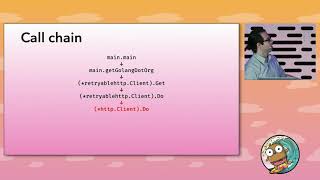
Tracking Inter-process Dependencies
Explore static analysis in Go to detect inter-process dependencies in service-oriented architectures, covering libraries, obstacles, and solutions for effective system tracking.
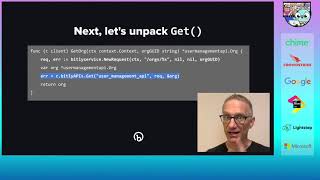
Write Once, Use Many - A Handy Package to Call Internal HTTP APIs
Explore a powerful package for consistent, simple, and maintainable internal HTTP API calls in Go, developed at Bitly for efficient service-to-service communication.

Reliability Nirvana
Explore event-driven architectures in Go, covering message systems, protobuf, and reliability patterns. Learn to build robust distributed systems with practical demos and code examples.

A Journey Through Integration Testing with Go - What Could Go Wrong?
Explore integration testing in Go using TestContainers-go and go-test-report, addressing challenges and solutions encountered during implementation for a smart city project.

React Native Architecture Overview
Explore React Native's architecture and performance optimization techniques with Facebook engineer Tadeu Zagallo. Learn best practices to maximize platform benefits in mobile app development.

State Management is Easy
Discover how MobX simplifies state management in React applications, addressing inconsistencies and offering a scalable solution without restrictive data handling.

How Pinterest Switched Their Template Rendering Engine to React
Deep dive into Pinterest's migration from Django/Nunjucks to React, covering infrastructure changes, code migration strategies, and challenges faced during the transition to a Node-based React rendering system.

A Real-World GraphQL Application in Production
Insights on building a real-world GraphQL app with Relay, Redux, and Node.js. Covers architecture, reactivity, testing, and lessons learned from Balsamiq's production deployment.

Performance Limitations of React Native and How to Overcome Them
Explore React Native's performance limitations and solutions, focusing on developer experience, code reuse, and comparison with native implementations. Learn strategies to optimize React Native apps.

Reactive Programming Demystified - Drink the Kool-Aid
Explore reactive programming with RxJS to create composable, future-proof code that can be easily adapted across JavaScript frameworks, enhancing application architecture and reducing development fatigue.
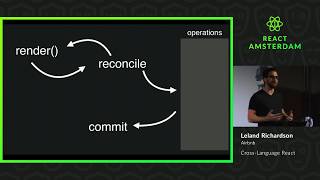
Cross-Language React
Exploring React's potential beyond JavaScript, examining its implementation in other languages and platforms, and considering architectural changes for React Native.

Native Web Apps - Use React and WebAssembly to Rewrite Native Apps
Explore how React, JavaScript, and WebAssembly can create powerful desktop applications, competing with and potentially surpassing native toolkits. Learn architecture, patterns, and tools for building hybrid 'Native Web Apps'.

Magic in the Web of It - Coroutines, Continuations, Fibers, Threads
Explore advanced React concepts like coroutines, continuations, fibers, and threads. Dive into the Fiber reconciler's implementation and its practical applications in solving specific use cases.

Paging Dr. Static! Wielding Types Like a Surgeon
Explore applying static types strategically in codebases, optimizing benefits while minimizing effort. Learn to identify critical areas and apply knowledge for maximum returns.

Native Web Apps - Use React and WebAssembly to Rewrite Native Apps
Explore using React and WebAssembly to create high-performance desktop applications that rival or surpass native apps. Learn architecture, patterns, and tools for building hybrid 'Native Web Apps' with web technologies.

Scaling Applications with Microfrontends - Leverage Features & Reduce Dependencies
Explore microfrontends architecture for scaling applications, enabling blue-green deployments, framework-agnostic teams, and reduced cross-team dependencies in frontend development.

Don't Build That App
Explore building React apps without a build step, leveraging scalable architecture using platform features. Learn to develop without node_modules, webpack, or babel for streamlined development.

Designing GraphQL Schemas - Avoid the Downsides of GraphQL's Flexibility
Explore GraphQL schema design patterns to avoid common pitfalls and create flexible, maintainable APIs. Learn best practices for naming, connections, and pagination.

Reacting to Tech Debt
Strategies for migrating legacy codebases to React, focusing on TweetDeck's journey. Explores techniques, challenges, and benefits of modernizing complex applications with React.

Complex React Migration - New Solutions to Old Codebase Problems
Discover innovative solutions for migrating complex legacy codebases to React, focusing on process and architecture changes that reduce complexity and improve workflow efficiency.

Next.js - The Hybrid Architecture for Web Developer
Explore Next.js hybrid approach combining static generation and server-side rendering for efficient React development, enabling automatic server-rendering, code-splitting, and hot-reloading without complex setups.