
Pragmatic Data Organization Leadership
Learn to lead data teams through reorganization, fostering collaboration with engineering and product teams to deliver strategic impact and customer value. Explore common pitfalls and success strategies for data organizations.

AI and the Future of Software Engineering
Explore AI's impact on software engineering, examining productivity gains, ethical concerns, and necessary shifts in team structures and skills for the future of development.

Taking the Risk Out of Software Experimentation: Balancing Innovation and Code Quality
Explore balancing experimentation and code quality in software development, leveraging SDLC practices to manage risk and reduce technical debt.
Working on Software That Is Older Than You
Explore strategies for navigating and evolving legacy codebases, drawing insights from experiences with both established and younger companies.
CryptOpt: Verified Compilation with Randomized Program Search for Cryptographic Primitives
Explore CryptOpt, a verified compilation pipeline for cryptographic primitives that generates high-performance assembly code with formal proofs, outperforming GCC and Clang for specific applications.
Reliable Actors with Retry Orchestration
Explore fault-tolerant cloud programming using actors, retry orchestration, and tail calls. Learn key application patterns and failure scenarios for building resilient cloud applications.
VMSL: A Separation Logic for Mechanised Robust Safety of Virtual Machines Communicating Above FF-A
Explore VMSL, a novel separation logic for reasoning about virtual machine communication and security in hypervisor systems, with focus on Arm's FF-A hypercall ABIs.
Putting Weak Memory in Order via a Promising Intermediate Representation
Explore an in-order shared-memory concurrency model for C/C++, supporting non-atomic accesses and compiler optimizations while maintaining soundness between source and intermediate representation.
Parameterized Verification of Disjunctive Timed Networks
Explore new techniques for parameterized verification of disjunctive timed networks, including efficient algorithms and summary construction for arbitrary-sized systems.
Verification of a Subgraph Construction Algorithm for Geometric Graphs - VMCAI 2024
Explore automated verification of a subgraph construction algorithm, focusing on geometric graph properties, edge removal, and connectivity preservation in Euclidean plane representations.
Proving Capability Safety in the Presence of Indirect Sentries
Explore capability safety proofs with indirect sentries, advancing understanding of secure programming models and language design.
Offloading-Efficient Sparse AI Systems
Explore offloading-efficient sparse AI systems to optimize performance and resource utilization in artificial intelligence applications.
A Probabilistic Choreography Language for PRISM
Explore a choreographic framework for modeling and analyzing concurrent probabilistic systems using PRISM. Learn about a new choreography language and its encoding into PRISM for enhanced system reliability.
Analyzing and Improving the Scalability of In-Memory Indices for Managed Search Engines
Explore scalability improvements for in-memory indices in managed search engines, comparing compressed and uncompressed indices on DRAM and NVM, and analyzing performance trade-offs.
Software and Hardware for Sparse Machine Learning
Explore cutting-edge software and hardware solutions for sparse machine learning, enhancing efficiency and performance in ML applications.
Formalizing DRAGSTERS - Compiling Computations for Semiring Value Multiplication and Aggregation
Explore the impact of formal methods on compiling computations involving semiring value multiplication and aggregation in positive algebra over K-relations.
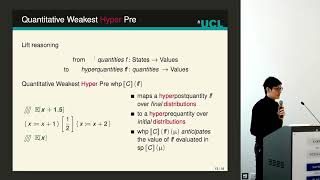
Quantitative Weakest Hyper Pre Calculus for Non-Deterministic Programs
Explore a novel weakest pre calculus for quantitative hyperproperties, enabling reasoning about hyperquantities in non-deterministic programs and extending hyper Hoare logic.
Specifying Smart Contracts with Hax and ConCert
Explore high-assurance smart contracts using Hax toolchain and ConCert for embedding, specifying security properties, and verification in Rust.
Inductive Program Synthesis via Iterative Forward-Backward Abstract Interpretation
Explore a novel approach to inductive program synthesis using iterative forward-backward abstract interpretation, enhancing search space pruning and improving synthesis efficiency.
An Automata-Based Framework for Verification and Bug Hunting in Quantum Circuits
Explore a novel automata-based approach for analyzing quantum circuits, enabling efficient verification and bug detection in large-scale quantum systems using tree automata and algebraic representations.
Automated Expected Value Analysis of Recursive Programs
Explore automated inference of expected result values in probabilistic programs with recursion, procedures, and local variables. Learn about term representation and first-order constraints for analysis automation.