You Keep Using That Word: Asynchronous in Distributed Systems
Exploring the nuanced meanings of "asynchronous" in distributed systems, this talk clarifies misconceptions and examines various communication approaches for effective cloud-native architecture.
Fault Tolerance with the ZX-Calculus and Fusion Complexes: Tools for QEC Development
Unifying frameworks for quantum error correction: ZX calculus and fusion complexes connect hardware-specific models to abstract fault tolerance, aiding QEC design for various qubit technologies.
High-Assurance Go Cryptography - Ensuring Safety in Cryptographic Libraries
Explore techniques for ensuring safety and reliability in Go's cryptography standard library, including testing, fuzzing, and formal proofs.
Signal, if You Can't - Error Correction in Fully Corrupted Networks
Explore signaling methods for performing computations in asynchronous networks with corrupted messages, focusing on error-correction techniques for damaged transmissions.

Architects Live in the First Derivative - Accelerating IT Delivery
Explore how architects can increase velocity through a fundamentally different mindset, focusing on economies of speed in systems and organizational architectures.
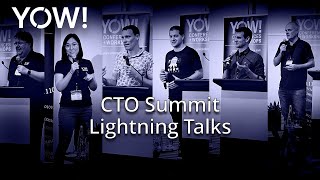
Lightning Talks - YOW! 2019
Diverse lightning talks covering software engineering topics, from IoT and AI to team dynamics and career growth. Experts share insights and experiences in rapid-fire presentations.
Cloud Native Live - Kubernetes 1.30 Release
Explore the latest features and improvements in Kubernetes 1.30 with this informative session from CNCF, highlighting key updates and their impact on cloud native computing.

Creating Software with Modern Diagramming Techniques
Explore modern diagramming techniques for software development, from domain documentation to system architecture visualization, using text-based markup for quick, shareable, and easily revisable diagrams.
Decoding Modern Tech: Cloud, APIs, Wasm, Security, and More
Explore cloud-native tech with experts discussing APIs, platform engineering, and Wasm. Gain insights on best practices for modern infrastructure and software development in this informative interview.

Creating Software with Modern Diagramming Techniques
Explore modern diagramming techniques for software creation, including text-based tools like Mermaid. Learn to effectively communicate ideas, document architecture, and improve workflows through visual representations.
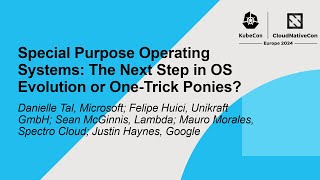
Special Purpose Operating Systems - Evolution or Limitation in Cloud Native Computing
Explore specialized operating systems for cloud-native workloads, their benefits, and operational challenges. Panel discusses immutability, atomic upgrades, and security improvements in specialized Linux distributions.

Three's a Crowd - Achieving 2-Node High Availability at the Edge
Discover a cost-effective 2-node high availability architecture for Kubernetes at the edge, offering resilience and 33% savings compared to traditional 3-node setups. Learn from real-world examples and explore open-source solutions.
Kubernetes SIG-Scheduling Introduction and Deep Dive
Explore Kubernetes kube-scheduler: functionality, customization, best practices for large clusters. Learn about ongoing SIG projects and latest developments in scheduling.
IoT and WebSockets in Kubernetes - Operating and Scaling an EV Charging Station Network
Explore challenges and solutions for scaling WebSocket-based IoT systems in Kubernetes, focusing on an EV charging platform and addressing reconnection storms through event-driven architecture and Redis-based circuit breakers.
Deploying with Confidence - Lessons Learned from a 100-Strong Development Team
Insights on scaling deployment processes for large teams, focusing on increasing release frequency while maintaining stability. Covers strategies for safe rollouts, cloud-first mindset, and robust monitoring.
SIG Instrumentation Introduction and Deep Dive
Explore Kubernetes SIG Instrumentation's efforts to ensure high-quality, consistent instrumentation across the project. Learn about ongoing initiatives and discover opportunities for collaboration.
Scaling up Without Slowing Down: Accelerating Pod Start Time in Kubernetes
Explore techniques to optimize Kubernetes pod start times, addressing cold starts and scaling challenges. Learn about various approaches tailored to different workload types and system scales.
SIG-Multicluster Introduction and Deep Dive
Explore multi-cluster Kubernetes management, best practices, and current projects. Learn about ClusterSets and how to contribute to SIG-Multicluster's efforts in solving challenges across multiple clusters and cloud providers.
XRegistry - Looking Beyond CloudEvents
Explore xRegistry's role in enhancing CloudEvents by enabling resource discovery, metadata querying, and automation in distributed systems development.
Fixing Async/Await in JavaScript and TypeScript - Learn With Jason
Explore structured concurrency to solve async/await issues in JavaScript and TypeScript, improving software architecture and enhancing code efficiency.
How KubeVirt Improves Performance with CI-Driven Benchmarking - and How You Can Too
Discover KubeVirt's CI-driven benchmarking approach for performance evaluation. Learn techniques to assess scalability, leverage CI for data collection, and apply these strategies to your Kubernetes-native components.