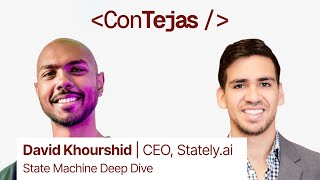
How State Machines Create Robust Software - Deep Dive
Explore XState for robust software development using state machines and actor models. Learn about state charts, AI integration, and practical applications while gaining insights into founding a tech startup.
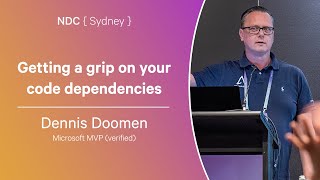
Getting a Grip on Your Code Dependencies
Explore strategies to reduce code coupling, enhance maintainability, and confidently make changes. Learn to identify and break unnecessary dependencies for more flexible software architecture.
TDD for Absolute Beginners - RailsConf 2024
Discover a simpler approach to test-driven development, challenging traditional methods and exploring why we follow certain practices in TDD for more effective coding.
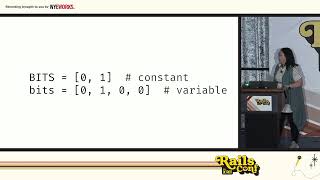
What's in a Name: From Variables to Domain-Driven Design
Explore semantic theory and its impact on naming in software engineering, from variables to domain-driven design. Improve code quality through effective naming practices.

Anthropic's AI Advancements vs OpenAI's Progress - Claude 3.5 Features Demo
Explore Anthropic AI's latest advancements, including Claude 3.5 Sonnet, Artifacts, and developer tools, while comparing its progress to OpenAI's recent developments and demonstrating practical applications.
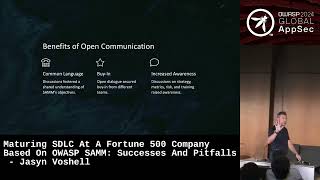
Maturing SDLC at a Fortune 500 Company Based on OWASP SAMM - Successes and Pitfalls
Explore successes and challenges in implementing OWASP SAMM to enhance software development lifecycle at a Fortune 500 company, offering valuable insights for security professionals.
Debug Your Thinking - Improving Decision-Making in Software Engineering
Explore critical thinking techniques to enhance decision-making in software engineering, leading to better-balanced choices and improved solutions for users.
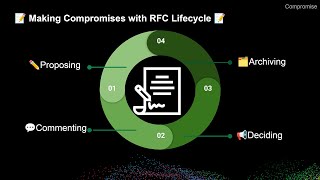
When Less Is More: Designing and Decoding Complex Distributed Systems
Explore strategies for designing and decoding complex distributed systems, focusing on architectural tradeoffs, maintaining mature software, and evolving existing systems effectively.

Harnessing EDA and Workflows to Build Real-World Generative AI Applications
Explore techniques for integrating generative AI into applications using event-driven architecture, prompt chaining, and human-in-the-loop approaches to enhance accuracy and safety.
Failure and Change: Principles of Reliable Systems - YOW! 2018
Explore principles for building reliable systems that withstand failure and change. Learn strategies to implement, understand, and verify robust software in complex environments.
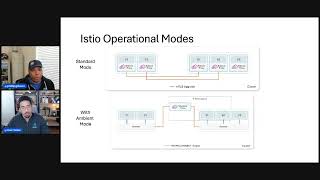
Istio Ambient - Inside a Contributor's Journey
Explore the journey of an Istio Ambient contributor, gaining insights into the development process and challenges faced in advancing cloud native computing technologies.
Toolchain-Agnostic Build Time Improvements for Linux Kernel
Explore strategies for improving Linux kernel compile and build times, including header optimization, automated refactoring, and link-time de-duplication techniques.
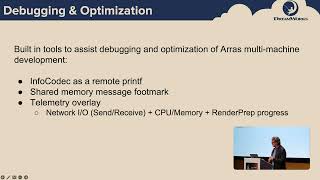
Arras - MoonRay's Distributed Computational Framework for Ray-Trace Rendering
Explore Arras, a scalable framework enabling distributed computations for ray-trace rendering. Learn how it enhances MoonRay's capabilities, allowing for unlimited computational power and accelerating processor-intensive operations in film production.
Things You Always Wanted to Know About Building Platforms
Explore common pitfalls, patterns, and lessons learned in platform engineering. Discover effective strategies and Docker's role in building robust platforms, with insights on YAML, testing, infrastructure, and GitOps.
Scale Your Application to Infinity
Learn how Intuit's IPS provides scalable persistence for hundreds of services using XML schemas, Cassandra, Elastic Search, and Data Lake, with best practices for running Cassandra.
Migrating Workloads from Mainframes to Cassandra - Problems, Experience and Learnings
Explore strategies for migrating mainframe workloads to Cassandra, focusing on cost reduction, data synchronization, and improved service quality. Learn from U.S. Bank's successful implementation.
Load Management for AI Models - Managing OpenAI Rate Limits with Request Prioritization
Learn advanced techniques for managing OpenAI API rate limits, including request prioritization and quota management, to ensure reliable AI-driven applications and optimize resource utilization.
Retrieval Augmentation and Semantic Search at Scale
Explore vector search, retrieval-augmented generation, and scaling challenges. Learn from benchmarks, AI pre-training experiments, and serving billions of vectors. Discover optimal GPU choices and efficient search result serving methods.
Scaling Kubernetes Clusters for Generative Models - Managing GPU Resources for AI Applications
Learn techniques for efficiently scaling GPU resources in Kubernetes clusters to optimize generative AI workloads, including GPU sharding and resource management strategies.
Unified Compaction Strategy in Cassandra 5.0 - Key Features and Benefits
Discover Cassandra 5.0's Unified Compaction Strategy, solving existing deficiencies, improving performance, and offering easy reconfiguration. Learn about its flexible SSTable sharding and prioritization for enhanced read and write throughput.

Noise-Adapted Quantum Error Correction and Fault Tolerance
Explores noise-adapted quantum error correction and fault tolerance techniques, focusing on strategies to mitigate errors in quantum systems for improved computational reliability.