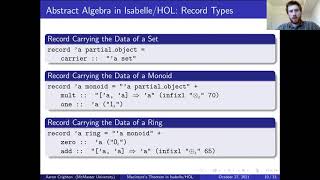
Formalizing Macintyre's Theorem in Isabelle-HOL
Exploration of formalizing Macintyre's Theorem in Isabelle/HOL, covering proof strategies, challenges, and foundational elements needed for a verified proof in the context of p-adic numbers.
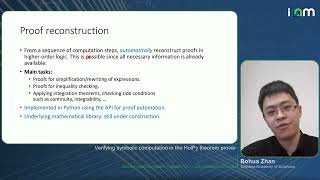
Verifying Symbolic Computation in the HolPy Theorem Prover - IPAM at UCLA
Explore HolPy, a new proof assistant for verifying symbolic computation using a user-friendly interface similar to computer algebra systems, with examples and future directions.
Autoformalization with Large Language Models - IPAM at UCLA
Explore autoformalization using large language models for translating natural language math to formal proofs, advancing formal verification and AI in mathematics.
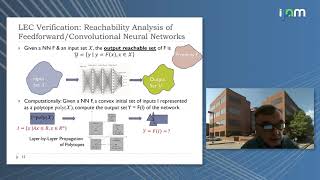
Towards Assurance-Based Learning-Enabled Cyber-Physical Systems
Exploring formal verification, monitoring, and safety case formalization for assurance-based learning-enabled cyber-physical systems, focusing on autonomous vehicles and their complex components.
Self-Hosting Kubernetes With Plural
Explore self-hosting on Kubernetes with Plural, discussing challenges, use cases, and practical insights for efficient deployment and management of open-source applications.
A SNAPshot of Profiler Guided Optimization - IPAM at UCLA
Explore profiler-guided optimization techniques for enhancing software performance, with insights from NVIDIA expert Evan Weinberg at IPAM's Exascale Co-design workshop.
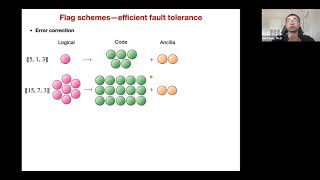
Quantum Fault Tolerance with Flag Qubits - Quantum Colloquium
Explore fault-tolerant quantum computing using flag qubits, a qubit-efficient method for error detection and correction in quantum circuits, with applications and theoretical implications.

Forgejo - A Simple Solution for Agile Development - Self-Hosted Alternative to GitHub
Learn to install and configure Forgejo, a self-hosted software forge, on Ubuntu using Docker. Step-by-step guide covers setup, Docker Compose, NGINX, and initial configuration for managing software projects.
Powering Smart Homes at Scale - Challenges and Architecture for IoT Cloud Systems
Explore the challenges and architectural considerations for building a secure, responsive, and scalable IoT cloud connecting millions of smart homes, focusing on performance, security, and system stability.
Choosing Your Giants: Principles for Navigating Emerging Tech Landscape
Principles for evaluating and adopting emerging technologies, balancing business needs with engineer engagement. Explores case studies and research to create a mindful framework for tech choices in software development.
Containers at Facebook - Advanced Linux, Btrfs, and Systemd Implementation
Explore Facebook's container infrastructure using Linux, Btrfs, and systemd. Learn about advanced file systems, process management, and new kernel features for high-traffic networks.
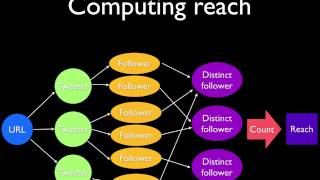
Storm: Realtime Distributed Computing with Nathan Marz - ETE 2012
Explore Storm for real-time data processing, covering concepts, development, deployment, fault-tolerance, and practical applications in distributed computing environments.
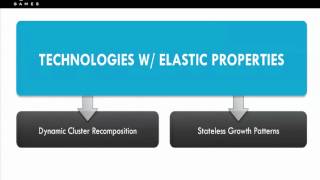
Massively Scaling to Millions of Players: A League of Legends Story - ETE 2012
Explore scaling challenges and solutions for League of Legends' PvP.net Platform, covering architecture, design, monitoring, deployment, analytics, testing, and automation.

ETE 2012 - From 0 to 5,000,000 Downloads: Creating an Advanced Applications Engineering Team
Learn how Comcast built an Advanced Applications Engineering team to develop the XFINITY TV app, driving innovation and meeting mobile app development demands for Xfinity and beyond.
Command Performance: The Why and Whether of Small-Scale Optimizations
Explore small-scale code optimizations, challenging the "premature optimization" adage. Examine unconscious optimization practices and rethink the concept of code maturity in modern software development.
Data Lakehouse and Data Mesh - Two Sides of the Same Coin
Explore how Data Lakehouse and Data Mesh complement each other in modern data management, combining technological advancements with organizational strategies for effective analytics.
Photon Vectorized Execution Engine - Technical Deep Dive
Explore Photon's vectorized execution engine, learning about expression evaluation, compute kernels, runtime adaptivity, and vectorized operations for enhanced data processing efficiency.

Data Mesh in Practice - From Data Lake to Distributed Architecture at Zalando
Explore Zalando's journey from centralized Data Lake to distributed Data Mesh architecture, focusing on data ownership, quality, and accessibility in large-scale e-commerce environments.
Apache Pulsar - Next Generation Messaging and Queuing System
Overview of Apache Pulsar's architecture, features, and benefits as a scalable messaging system with unified storage, processing, and serverless capabilities for building end-to-end streaming applications.
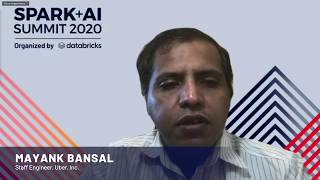
Zeus - Uber's Highly Scalable Distributed Shuffle as a Service
Explore Uber's Zeus: a highly scalable, distributed shuffle service powering data processing. Learn its architecture, integration with Spark, and performance advantages over traditional external shuffle methods.
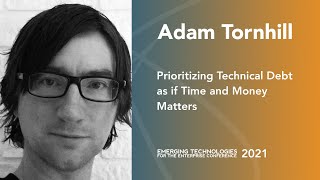
Prioritizing Technical Debt Using Version Control Data
Discover data-driven techniques to prioritize technical debt, balance short and long-term goals, and make informed decisions about code improvements using version-control insights from real-world codebases.