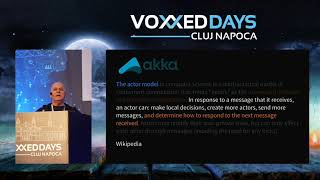
Building Stateful Clustered Microservices with Java, Actors, and Kubernetes
Explore building stateful clustered microservices using Java, actors, and Kubernetes. Learn about the actor model, resilient systems, and practical implementation in a Kubernetes environment.
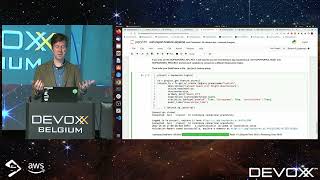
Serverless Machine Learning Systems with Hopsworks and Github Actions
Learn to build an operational prediction service using Python and free serverless tools. Explore feature pipelines, batch predictions, and MLOps best practices with a real-world surfing wave height prediction example.

Testing an Onion Architecture - Done Right
Pragmatic approach to testing hexagonal architectures, balancing unit and integration tests for optimal coverage and speed in Spring Boot applications.
From 'It Works on My Machine' to 'It Was Written by a Machine' - GitHub Codespaces & Copilot
Explore GitHub Codespaces and Copilot to enhance developer productivity, streamline workflows, and leverage AI-assisted coding for improved efficiency and collaboration in software development.
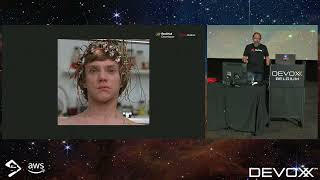
Access Your Brain with an API
Explore brain-computer interfaces: capture brain frequencies, process them, and use them as an API. Discover potential applications, including accessibility, through demos of a brain helmet SDK.
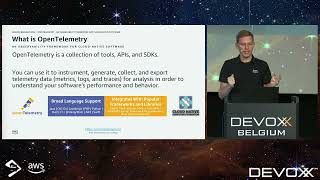
OpenTelemetry - An Observability Framework for Cloud Native Software
Explore OpenTelemetry, a vendor-agnostic observability framework for cloud-native software. Learn about its specification, integration with frameworks, and focus on solving operational challenges in distributed architectures.
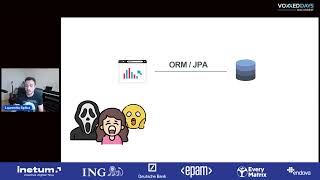
Five Most Useful Profiling Techniques to Use with Modern Java Apps
Discover five essential profiling techniques for modern Java apps, including SQL query analysis, hotspot detection, and memory usage optimization. Enhance your development process and deliver more efficient applications.
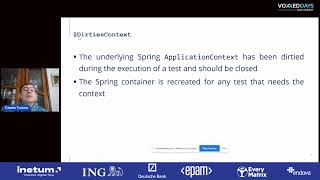
Integration Testing with Spring
Comprehensive guide to Spring integration testing, covering TestContext Framework, dirty contexts, transactions, profiles, listeners, mock MVCs, and reactive testing with WebTestClient.
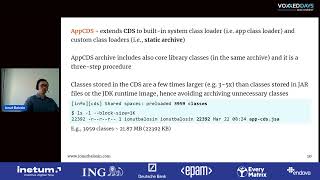
Techniques for a Faster JVM Start-Up
Explore techniques to accelerate JVM start-up times, including AppCDS, AOT compilation, and JVM flags, with practical demonstrations and benchmarks for both development and production environments.
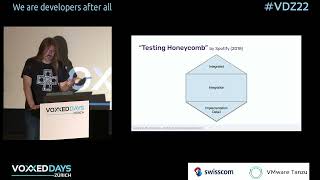
Removing Complexity from Integration Tests Using Testcontainers
Simplify integration testing for microservices using Testcontainers. Learn to create isolated, Docker-based environments for databases and services, enhancing test reliability and ease of implementation.
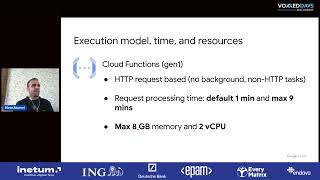
Serverless Landscape Beyond Functions
Explore the diverse serverless landscape, including containerized apps, API gateways, orchestrators, event-driven architectures, scheduled services, and hybrid serverless-serverful solutions.
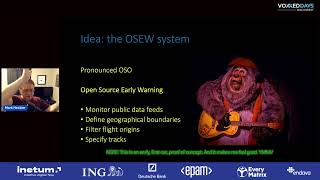
Using Coding Powers for Good in a World That Doesn't Always Feel That Way
Explore how developers can use their skills to create positive change through the example of OSEW, an open-source flight monitoring system, and learn to build impactful microservices.
Forget Mono vs. Multi-Repo - Building Centralized Git Workflows for All Apps
Discover a unified Git workflow solution for any repo architecture, implemented in Python, to streamline CI/CD processes and significantly boost development velocity.
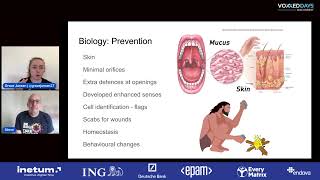
Mother Nature vs Java - The Security Face Off
Explore biological analogies for application security, drawing inspiration from nature's defense mechanisms to enhance Java software protection and development processes.

Fallacies of Software Development
Explore common misconceptions and thinking patterns in software development, including distributed computing fallacies and cognitive biases, along with techniques to avoid and mitigate them.
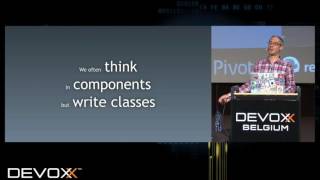
Modular Monoliths
Explore the concept of modular monoliths as an alternative to microservices, emphasizing the importance of good design principles in software architecture regardless of approach.

Zen & The Art of Angular 2
Explore Angular 2's comprehensive platform for web, mobile, and desktop development. Learn how it addresses diverse developer needs and get insights into its future direction.
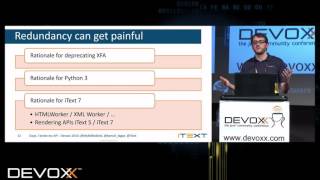
Oops, I Broke My API
Explore strategies for managing API changes, weighing arguments for and against modifications, and implementing effective transition methods to minimize user impact and maintain product loyalty.
Rust as a Support Language
Explore Rust as a safe, high-performance alternative to C/C++ for low-level development. Learn techniques for integrating Rust into existing projects and leveraging its benefits.
What's NOT New in Modular Java
Explore Java modularity concepts, comparing Jigsaw with existing approaches. Gain insights into fundamental modularity principles and their implementation in Java development.
Anticipating Java 9 - Functionality and Tooling
Explore Java 9's new features, including modularity, REPL, and Collections enhancements, with live coding demonstrations in IntelliJ IDEA. Learn about potential impacts and migration strategies.