State of the OCaml Platform 2023
Explore a decade of OCaml Platform progress, recent advancements, and future roadmap. Gain insights into key milestones, community feedback, and plans shaping the OCaml developer experience.

Getting into the Flow: Towards Better Type Error Messages for Constraint-Based Type Inference
Explore innovative approaches to improve type error messages in constraint-based type inference systems, focusing on data flow and subtyping constraints to enhance programmer understanding.

Seamless Code Generator Synchronization in the Composition of Heterogeneous Modeling Languages
Explore a lightweight generator composition concept using symbol tables for heterogeneous modeling languages, enabling seamless code generator synchronization and enhancing language composition capabilities.
Lifting On-Demand Analysis to Higher-Order Languages
Explore an innovative approach to on-demand analysis for higher-order languages, focusing on precise call graph construction and scalable bug detection in complex code bases.
Automatically Generated Supernodes for AST Interpreters Improve Virtual-Machine Performance
Explore a novel technique for improving AST interpreter performance through automatically generated supernodes, enhancing execution speed and reducing JIT compiler pressure in programming language implementations.

Language Model Agents Enable Semi-Formal Programming - LIVE23
Explore semi-formal programming using language model agents to capture semantic information and execute informal program elements, enhancing malleable programming environments.
Relational Solver for Java Generics Type System
Explore a relational solver for Java Generics Type System, enhancing understanding of advanced programming concepts and type theory.

CodeProber: Live Compiler Exploration - LIVE23
Explore interactive compiler debugging with CodeProber. Learn to identify and fix bugs in language tooling using source code-based exploration of AST properties.

Degrees of Separation: A Flexible Type System for Data Race Prevention
Explore a flexible type system for data race prevention in parallel programming, allowing aliasing while controlling it to prevent data races. Implemented as a Scala 3 compiler extension.
Realizing Persistent Signals in JavaScript
Explore persistent signals implementation in JavaScript, enabling time-travel functionality and broader application in web development through relay-server architecture and DSL library approach.
Applying Large Scale Diffing to Declarative Configuration Code for Production Safety
Explore large-scale diffing for declarative configuration code to enhance production safety, addressing unintended consequences and testing challenges in config changes.
CLOVER: Closed-Loop Verifiable Code Generation - Dafny'24
Explore CLOVER, a paradigm for ensuring correctness in AI-generated code through consistency checking among code, docstrings, and formal annotations using verification tools and language models.

Is Peter Correct or Incorrect? - O'HearnFest Lecture
Explore Patrick Cousot's analysis of Peter O'Hearn's work in program verification and reasoning, examining correctness and potential inaccuracies in his theories.

Symbolic Execution with Separating Decision Diagrams
Explore symbolic execution techniques using Separating Decision Diagrams in this advanced computer science talk by Josh Berdine.

Bi-abductive Adversarial Program Synthesis
Explore bi-abductive adversarial program synthesis techniques in this advanced computer science talk by Julien Vanegue.

Working with Peter O'Hearn in Academia and Industry
Explore Mark Harman's experiences collaborating with Peter O'Hearn across academic and industrial settings, gaining insights into their influential work.
Monotonicity and the Precision of Program Analysis
Explore the connection between program monotonicity and analysis precision. Learn how monotone behavior enables complete abstract interpretation for numeric invariant inference.
Automatic Parallelism Management - POPL 2024
Explore techniques for automatic parallelism management in high-level languages, combining static and runtime approaches to optimize performance without manual tuning.
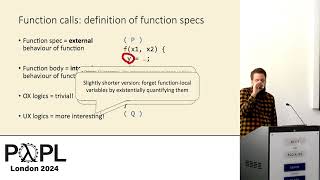
Unified Compositional Formal Methods: Exact Separation Logic and the Gillian Platform - Incorrectness'24
Explore unified compositional formal methods for program correctness and incorrectness reasoning, focusing on exact separation logic and the Gillian platform.
Crosys: Cross Architectural Dynamic Analysis for IoT Malware
Explore Crosys, a novel method for dynamic analysis of multi-architectural binaries through intermediate language interpretation and binary rewriting, addressing IoT malware analysis challenges.
Control-Flow Tracking and Misuse Detection for Non-local Jumps in C
Explore an approach for analyzing setjmp/longjmp in C, enhancing static analyzers to detect misuse and support non-local control flow through side-effecting transfer functions.