Transformers Meet Directed Graphs - Exploring Direction-Aware Positional Encodings
Explore direction-aware positional encodings for transformers on directed graphs, enhancing performance in code understanding and sorting network correctness testing.
Sound Dynamic Deadlock Prediction in Linear Time
Explore a novel approach to dynamic deadlock prediction in concurrent systems, introducing sync-preserving deadlocks and efficient algorithms for sound, linear-time detection.
Predicting Dynamic Properties of Heap Allocations using Neural Networks Trained on Static Code
Explore neural network models predicting heap allocation properties from static code, examining trade-offs, promising directions, and challenges in this innovative approach to memory management.
Automatic Differentiation for Sparse Tensors
Explore efficient automatic differentiation for sparse tensors, leveraging novel DSLs and optimizations to outperform existing frameworks in data-intensive applications.
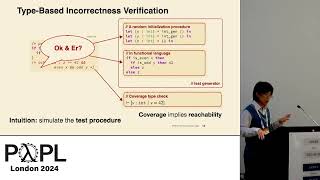
Type-Based Incorrectness Reasoning - Integrating Underapproximate Analysis in Refinement Types
Explore coverage types and their connection to Incorrectness Logic, integrating underapproximate reasoning within refinement type systems for enhanced program analysis and verification.
Inductive Program Synthesis via Iterative Forward-Backward Abstract Interpretation
Explore a novel approach to inductive program synthesis using iterative forward-backward abstract interpretation, enhancing search space pruning and improving synthesis efficiency.

An Automata-Based Framework for Verification and Bug Hunting in Quantum Circuits
Explore a novel automata-based approach for analyzing quantum circuits, enabling efficient verification and bug detection in large-scale quantum systems using tree automata and algebraic representations.
Mosaic: An Interoperable Compiler for Tensor Algebra
Explore Mosaic, an innovative compiler for sparse tensor algebra that combines external function calls and code fusion, offering flexibility and performance gains in tensor computations.
Merging Inductive Relations for Improved Program Specification
Explore an algorithm for merging inductive relations, improving automatic generation performance and simplifying mechanized proofs in proof engineering tools like QuickChick for Coq.
Consolidating Smart Contracts with Behavioral Contracts
Explore ConSol, a Solidity extension enhancing smart contract reliability through behavioral contracts. Learn to express critical conditions, prevent attacks, and improve code robustness and readability.
Falcon: A Scalable Analytical Cache Model
Explore a scalable analytical cache model for affine programs, improving performance prediction efficiency and enabling faster optimization decisions in large-scale software development.
Testing Specifications in Dafny - Dafny'24
Explore techniques for testing specifications in Dafny, including automatic mutation testing and Spec-Testing Proofs, to enhance trust in formal verification processes.
Generation of Verified Assembly Code Using Dafny and Reinforcement Learning
Explore verified assembly code generation using Dafny and reinforcement learning, combining efficiency with automatic correctness verification for complex programming tasks.
Measuring Configuration in Code - Risk Assessment and Metrics
Explore techniques for assessing configuration impact on code, including propagating complexity metrics and test coverage to configuration level, to mitigate outage risks and improve system reliability.
Towards a Language-parametric DSL for Refactoring - Short Paper
Explore a language-parametric DSL approach for refactoring, examining its potential to streamline code improvement across multiple programming languages.
Automated Verification - Session Preview
Explore automated verification techniques and advancements in program analysis with expert Viktor Kunčak at POPL'24's session preview.
Abstract Interpretation for Automatic Differentiation
Explore abstract interpretation for automatic differentiation, analyzing its application in machine learning, scientific computing, and graphics.
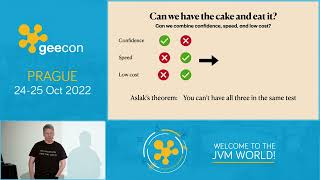
A Testable Architecture - Creating Reliable and Maintainable Test Automation
Discover how to create a testable architecture for successful test automation and executable specifications, with practical examples and proven strategies.

Malevolent Architect: Only Bad Decisions in Software Development - GeeCON 2022
Explore architectural pitfalls and solutions in software development, covering debugging, logging, burnout, and more. Learn to make informed decisions and navigate challenges effectively.

Clean and Hexagonal Architecture in Practice - It Really Works
Explore Clean and Hexagonal Architecture in practice, addressing code debt and framework challenges using Event Storming, Spring Boot, and Kotlin. Gain insights into real-world problem-solving and architectural benefits.
Apache Mynewt - Connected RTOS Project Overview
Explore Apache Mynewt's RTOS for embedded devices, covering architecture, components, and community aspects. Learn about its features and future plans for constrained IoT applications.