C++20 Concepts
Explore C++20 Concepts: their impact on code readability, design approaches, and compile-time performance. Learn to formulate requirements and compare with traditional polymorphism techniques.
Learning from C++ Juniors’ Mistakes - ACCU 2022
Explore common C++ mistakes made by junior developers, learn effective code review techniques, and discover mentoring strategies to enhance beginners' skills quickly.

Law of Demeter - A Practical Guide to Loose Coupling
Practical guide to implementing the Law of Demeter for loosely coupled, flexible, and testable code design. Explores examples, design issues, and solutions, emphasizing testing aspects and related principles.
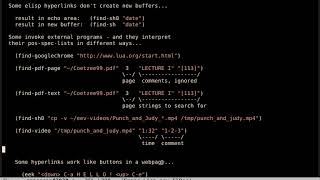
On Why Most of the Best Features in Eev Look Like 5-Minute Hacks
Exploração das características únicas do eev, destacando como suas melhores funcionalidades parecem hacks simples, mas são poderosas e eficientes para usuários do Emacs.

20 Years of NSA Security Enhanced Linux, a Retrospective
Retrospective on 20 years of NSA Security Enhanced Linux, exploring its development, challenges, and lessons learned for aspiring Linux programmers and open-source contributors.

Building a Modular Monolith with Fastify
Explore building robust, organized Node.js applications using Fastify plugins to create a modular monolith, avoiding Singleton traps and ensuring long-term codeability and testability.
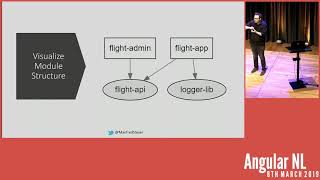
Architectures for Huge Angular Based Enterprise Applications
Strategies for scaling Angular applications: NPM packages, monorepos, and microservices for enterprise-level development and maintainability.

Proven Pinia Patterns
Explore best practices and architectural design patterns for using Pinia, Vue's improved state management library, in production applications.

Black-box Performance Analysis
Explore end-user experience and performance analysis techniques for software design, focusing on blackbox methods, memory leaks, and practical strategies for system engineers.
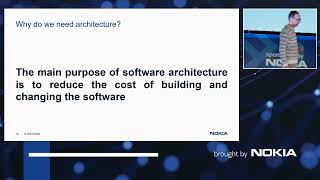
From Developer to SW Architect
Explore the journey from developer to software architect, covering essential skills, responsibilities, and challenges in this insightful talk by an experienced professional in the telecom industry.
Axiomatic Programming - From Euclidean Deductions to C++ Templates and Beyond
Explore the evolution of axiomatic programming, tracing its roots from Euclidean deductions to modern C++ templates and their future implications in software development.
CppComponents - A Modern Portable C++11 Component System
Explore a modern, portable C++11 component system for building modular and reusable software architectures, enhancing code organization and maintainability.
0xBADC0DE
Explore common coding pitfalls, anti-patterns, and strategies for dealing with problematic C++ code. Learn to prevent and address issues in software development.
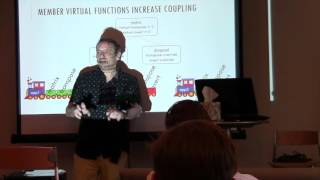
Yomm11 - Open Multi-Methods for C++11
Explore open multi-methods in C++11, solving extensibility and coupling issues. Learn about multi-methods for dynamic dispatch and their advantages over traditional approaches in object-oriented programming.
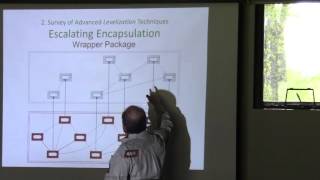
Large-Scale C++ - Advanced Levelization Techniques, Part II
Advanced techniques for managing dependencies in large-scale C++ projects, focusing on levelization and insulation methods to improve software architecture and maintainability. Practical examples demonstrate effective use of C++ language features.
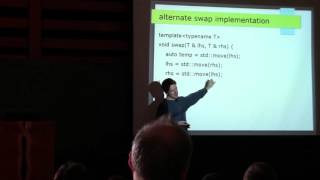
Functions Want To Be Free
Explore techniques for designing efficient interfaces, combining generic and object-oriented programming to simplify code, reduce duplication, and minimize bugs in C++ software development.
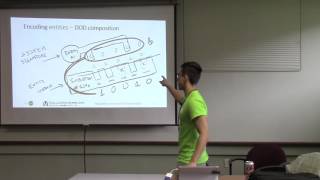
Implementation of a Multithreaded Compile-Time ECS in C++14
Explore efficient game architecture using C++14 metaprogramming to create a compile-time, multithreaded entity-component system, focusing on reusability, parallelism, and intuitive syntax.
The CPU Cache - Instruction Re-Ordering Made Obvious
Explore CPU cache anatomy, its role in hardware/software design, and how instruction reordering impacts performance. Gain insights into modern system implementation and parallelism considerations.

Rethinking Strings
Rethinking string design in C++: exploring modern approaches, optimizations, and considerations for encoding, storage, and performance in light of recent language and library developments.
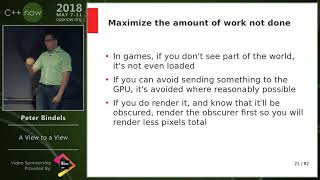
A View to a View
Exploring C++17 views: benefits, pitfalls, and implementation strategies for improved performance and cleaner abstractions in software design.
The Rough Road Towards Upgrading to C++ Modules
Explores challenges in adopting C++ Modules, discussing issues with existing systems, attempts at automated modularization, and implications for code organization and compilation performance.