
Understanding the Boundaries between Policymaking and HCI
Explores the intersection of HCI research and policymaking, discussing evidence translation, privileged forms of data, and strategies for researchers to effectively communicate findings to policymakers.

Triptech - A Method for Evaluating Early Design Concepts
Explore Triptech, a method for evaluating early design concepts in UX, focusing on user needs, desirability, and usefulness. Learn its application in tech-driven innovation practices.
What Makes a Good Conversation? Challenges in Designing Truly Conversational Agents
Explores challenges in designing truly conversational AI agents, examining human conversation qualities and how they should be applied to create more natural and effective human-agent interactions.
Social Media as a Passive Sensor in Longitudinal Studies of Human Behavior and Wellbeing
Explore social media as a passive sensor for studying human behavior and wellbeing in longitudinal research, examining data collection methods, challenges, and implications for HCI studies.
Examining the Global Language of Emojis - Designing for Cultural Representation
Explores cultural representation in emojis, examining global perceptions and proposing inclusive designs. Combines surveys, interviews, and participatory design to address cultural gaps in emoji standards.

Robust Technological Alternatives to Corporations
Exploring robust technological alternatives to traditional corporate structures, focusing on new organizational forms, employee empowerment, and the impact of digital platforms on labor and business models.
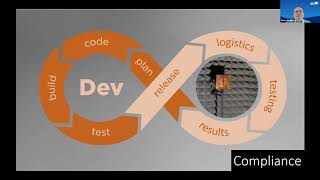
Democratizing the Production of Interactive Hardware
Explores democratizing interactive hardware production, addressing challenges in scaling from prototypes to low-volume products. Proposes innovative solutions like "DevOps for hardware" to make small-scale manufacturing viable and impactful.

Are We Trusting AI Too Much? Examining Human-Robot Interactions in the Real World
Explores human tendency to overtrust AI and robots, examining real-world interactions and potential consequences, especially in healthcare scenarios involving vulnerable populations like children with disabilities.

Community, Art and the Vernacular in Technological Ecosystems
Exploring AI's impact on race, gender, and aging through art, emphasizing inclusive tech ecosystems and community-driven approaches to shape ethical AI and robotics for a more equitable future.

Supporting Elder Connectedness through Cognitively Sustainable Design Interactions with the Memory Music Box
Innovative design of Memory Music Box to combat isolation in older adults, enhancing connectedness through familiar interfaces and cognitively sustainable technology.

Computation in the Brain Tutorial - Part 2
Explore neural computation models, focusing on assembly calculus and its applications in language processing, with insights from leading researchers in computational neuroscience.

An O(log log m) Prophet Inequality for Subadditive Combinatorial Auctions
Explore advanced techniques in combinatorial auctions, focusing on subadditive prophet inequalities and their applications in algorithmic game theory and mechanism design.
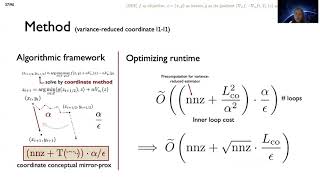
Coordinate Methods for Matrix Games
Explore efficient algorithms for solving matrix games, focusing on coordinate methods and their implementation challenges and benefits.
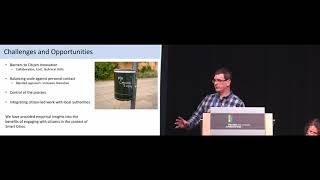
Amplifying Quiet Voices - Challenges and Opportunities for Participatory Design at an Urban Scale
Explores innovative approaches to empower disadvantaged citizens in smart city projects, highlighting challenges and opportunities for participatory design at an urban scale.
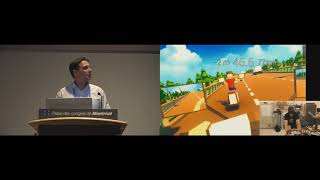
Interactive Feedforward for Improving Performance and Maintaining Intrinsic Motivation in VR Exergaming
Explores interactive feedforward technique in VR exergaming to improve performance and maintain motivation during high-intensity workouts, comparing self-models and virtual competitors.

Analysing the Effect of Tangible User Interfaces on Spatial Memory
Explore how tangible user interfaces enhance spatial memory accuracy by 24.5% compared to touch-based GUIs, despite users' perceptions, in a study on interactive tabletops for building placement tasks.

Personas and Behavioral Theories - A Case Study Using Self-Determination Theory to Construct Overweight Personas
Explore how Self-Determination Theory enhances persona creation for designing a digital weight loss coach, offering insights into user motivation and behavior change.

Social Printers - A Physical Social Network for Political Debates
Explore how physical devices create pseudonymous social networks during televised political debates, encouraging viewer engagement and personal social experiences.
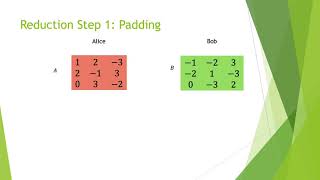
Smoothed Complexity of 2-player Nash Equilibria
Explore smoothed complexity in 2-player Nash equilibria, covering algorithmic hardness, approximation challenges, and novel approaches to finding equilibria in perturbed games.
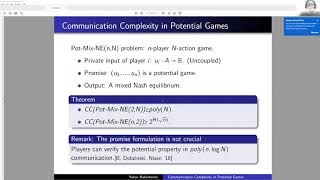
Communication Complexity of Nash Equilibrium in Potential Games
Explore communication complexity in potential games, focusing on Nash equilibrium, congestion games, and proof structures for hardness results.
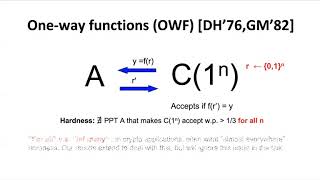
Is it Easier to Prove Statements that are Guaranteed to be True?
Explore the intricacies of proving statements in computational complexity, focusing on worst-case vs. average-case hardness and the challenges in NP-Search problems.