
Disjoint Sets: Operations, Simple Union, and Simple Find - Design and Analysis of Algorithms
Learn about disjoint sets, their operations, and simple union and find techniques in data structures and algorithms. Master fundamental concepts for efficient problem-solving.
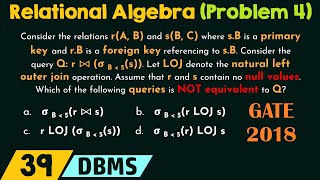
Relational Algebra - GATE 2018 Solved Problem - Part 4
Master relational algebra problem-solving techniques through a detailed walkthrough of a GATE 2018 examination question with step-by-step solutions.
Basic Category Theory - An Introduction to Mathematical Foundations
Explore fundamental concepts of Category Theory through clear explanations of composition, morphisms, and functors, with practical applications in functional programming.
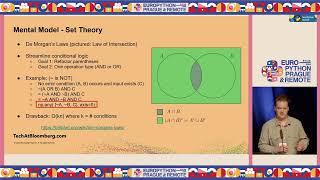
Vectorization Techniques for 1000x Python Speedups - No C or Spark Required
Discover techniques for achieving 1000x speedups in Python through vectorization, matrix operations, and creative optimization strategies. Learn to apply these methods to complex financial and ESG computations.
The Semantics of Plurals in Expression Languages - SLE
Explore the semantics of plurals in software languages, examining bunch theory and its integration with relations for seamless modeling and programming.
A Type System for Elixir
Explore progress in adding static and gradual typing to Elixir, including set-theoretic types, bug detection, and mixing typed/untyped code. Learn about potential benefits and future challenges.

Uncomputable Functions - Exploring the Limits of Computation
Explore the fascinating world of uncomputable functions, their implications for lambda calculus, and the limits of computation in this thought-provoking presentation.

Bringing Elixir to Life - ElixirConf EU 2023
Explore Elixir's latest features, set theoretic types, and improved developer experience with creator José Valim in this comprehensive keynote from ElixirConf EU 2023.
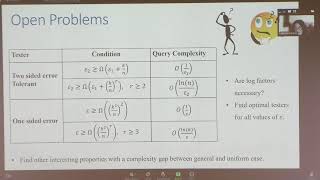
Testing Intersectingness of Uniform Families - How Dana and I Intersected
Explore efficient algorithms for testing intersecting k-uniform set families, including tolerant and one-sided error non-adaptive methods. Compare results to non-uniform families and discover optimal query complexities.
Compact Ordinals in Homotopy Type Theory and Univalent Foundations - Lecture
Explore compact ordinals in Homotopy Type Theory and Univalent Foundations with Martín Escardó's in-depth mathematical lecture at CIRM's thematic meeting.

Inductive Definitions, Predicativity, and the Mahlo Universe
Explore inductive definitions, predicativity, and the Mahlo universe in type theory with Peter Dybjer. Gain insights into advanced mathematical concepts and their applications.
A Reassessment of Gödel's Doctrine - The Necessity of Infinity
Delve into the philosophical examination of Gödel's Doctrine, exploring the necessity of infinity in mathematical proofs and its implications for finitary mathematics through multiple proof approaches.
Fractal Geometry of the Markov and Lagrange Spectra and Their Set Difference
Delve into the fractal geometry of Markov and Lagrange spectra, exploring their set differences and mathematical properties through advanced number theory and geometric analysis.
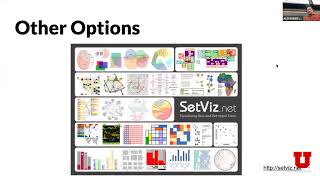
Visualization for Data Science: Evaluation, Sets, and Text Analysis
Explore advanced data visualization techniques for scientific analysis, focusing on evaluation methods, set theory applications, and text-based visualizations.
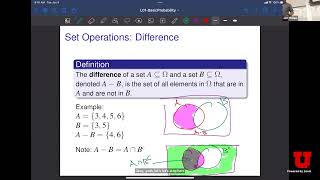
Probability and Statistics: Sets, Sample Spaces, and Events - Lecture 1
Explore fundamental concepts of probability theory including sets, sample spaces, and events to build a strong foundation in statistical analysis.
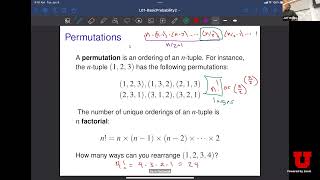
Probability and Statistics: Set Rules and Basic Probability Concepts - Lecture 2
Master fundamental probability concepts, set rules, and sample spaces through practical examples of repeated trials and permutations, building a strong foundation in statistical analysis.
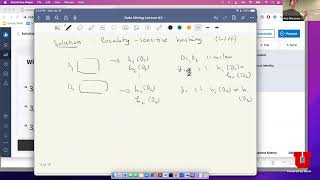
Data Mining: K-grams and Jaccard Similarity - Spring 2023
Dive into k-grams and Jaccard similarity concepts through practical examples and exercises, covering set similarities and fundamental data mining principles for effective text analysis.
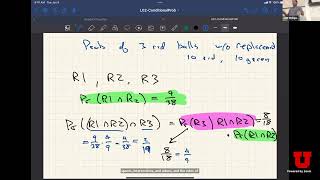
Conditional Probability - Lecture 3
Master conditional probability concepts through practical examples and theoretical foundations, enhancing your understanding of statistical dependencies and probabilistic reasoning.

Extremal Set Theory - Sperner's Theorem
Explore the fascinating world of Sperner's Theorem and learn how to determine the maximum number of subsets possible in an n-element set without subset containment.

Extremal Set Theory - Intersecting Families and the Erdős-Ko-Rado Theorem
Explore the probabilistic method in combinatorics through intersecting families of sets, featuring the Erdős-Ko-Rado theorem and its applications in extremal set theory.

The Mathematics Behind an Impossible Card Trick - A Combinatorial Analysis
Uncover the mathematical secrets behind a seemingly impossible card trick through combinatorial analysis and learn a practical method to perform this mind-bending illusion yourself.