
How to Build Custom Datasets for Text in PyTorch
Learn to build custom datasets for text in PyTorch, focusing on image captioning with the Flickr8k dataset. Covers dataset creation, vocabulary setup, batch padding, and data loading for various NLP tasks.

Automate Stocks and Crypto Research with Python and Deep Learning - Full Python Project
Learn to automate stock and crypto research using Python, web scraping, and deep learning. Build a pipeline to gather, summarize, and analyze financial news for various assets.
Deploy with FastAPI - Sentiment Analysis with BERT Using Huggingface, PyTorch, and Python Tutorial
Learn to deploy a pre-trained BERT model for sentiment analysis as a REST API using FastAPI, PyTorch, and Hugging Face. Covers project setup, API creation, model integration, and real-time predictions.

Sentiment Analysis with BERT Using Huggingface, PyTorch, and Python Tutorial
Learn to build a sentiment classification model using BERT, Hugging Face, and PyTorch. Covers BERT basics, fine-tuning for sentiment analysis, model training, evaluation, and prediction from raw text.
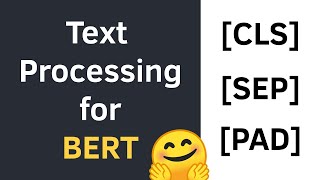
Sentiment Analysis with BERT Using Huggingface, PyTorch and Python Tutorial
Learn text preprocessing for sentiment analysis using BERT, Hugging Face, and PyTorch. Covers tokenization, padding, attention masks, dataset creation, and data splitting for NLP tasks.

Advanced Sentiment Analysis with NLP Transformers and Vector Search
Learn advanced sentiment analysis techniques using NLP transformers and vector search. Apply these methods to large datasets, generate insights, and create queryable databases for understanding customer perceptions in the hotel industry.
How to Add Machine Learning Capabilities With Just a Few Lines of Code
Discover how to integrate GitHub Copilot-like ML capabilities into products using the Hugging Face Inference API, demonstrated through building a VSCode extension for Python code comment generation.
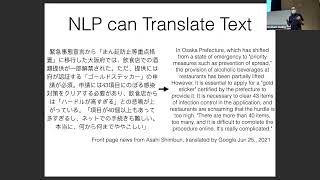
CMU Advanced NLP: Introduction to NLP
Explore key concepts, challenges, and applications of natural language processing, including feature extraction, sentiment analysis, and neural network models.

Sentiment Analysis with BERT Neural Network and Python
Learn to perform sentiment analysis using BERT and Python. Scrape Yelp reviews, calculate sentiment scores, and leverage pre-trained models for efficient NLP tasks. Ideal for those interested in advanced text analysis techniques.

Presidential Debate Twitter Sentiment Analysis Using Python and NLTK
Learn to analyze Twitter sentiment for presidential debates using Python, NLTK, and TextBlob. Extract polarity and subjectivity from tweets to gauge public opinion on candidates quickly and efficiently.
ML-Powered Web Apps - React, Javascript Tutorial with Gradio API - Hugging Face
Build ML-powered web apps using Gradio API on Hugging Face Spaces. Learn to integrate machine learning capabilities into vanilla JavaScript or React applications for free.
Sentiment Analysis in R with Sentimentr - Handling Negation and Valence Shifters
Explore sentiment analysis in R using {sentimentr}, handling negation and valence shifters for accurate text data analysis of emotions and profanity.

Supervised Machine Learning Tutorial - Logistic Regression - Naive Bayes Classifier
Explore logistic regression and Naive Bayes classifiers for supervised machine learning. Learn their advantages, applications, and implementation in classification tasks for data-driven decision making.
Sentiment Analysis - Key Milestones, Challenges and New Directions
Explore key milestones, challenges, and new directions in sentiment analysis, covering topics from polarity detection to multimodal analysis and sentiment reasoning.

Training Sentiment Model Using BERT and Serving It With Flask API
Learn to build and deploy a high-accuracy sentiment analysis model using BERT and Flask API, covering data preparation, model training, and serving the model for real-world applications.
Building Real-Time Sentiment Pipeline for Live Tweets
Learn to build a real-time predictive analytics pipeline for Twitter sentiment analysis using Azure ML, R, and Python. Covers model creation, cloud deployment, and live dashboarding with PowerBI.
Sentiment Analysis on Any Length of Text With Transformers - Python
Learn to perform sentiment analysis on long texts using transformers in Python, overcoming token limitations through chunking and processing techniques for NLP tasks.
Build a Transformer for Language Classification in TensorFlow
Build a transformer-based sentiment classifier using HuggingFace's library in TensorFlow. Learn to download data, tokenize inputs, prepare datasets, define the model architecture, and train for multi-class sentiment analysis.

Cohere AI's LLM for Semantic Search in Python
Learn to implement semantic search using Cohere's LLM for generating embeddings and Pinecone for vector indexing. Explore practical applications in NLP and efficient text data search.
Automated Insights in Finance Using Machine Learning & AI
Explore AI and ML techniques for extracting actionable insights from alternative data sources in finance, leading to profitable trading strategies and robust portfolio construction.
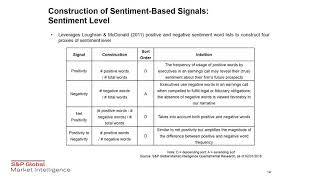
Natural Language Processing - Deciphering the Message Within the Message Stock Selection
Explore NLP techniques for stock selection using earnings call transcripts, focusing on sentiment and behavioral signals that have shown historical effectiveness in the U.S. market.