
CNN Applications, RNN, and Attention
Explore CNN applications in digit recognition, object detection, and semantic segmentation. Dive into RNNs, addressing their challenges with attention mechanisms, GRUs, LSTMs, and Seq2Seq models.
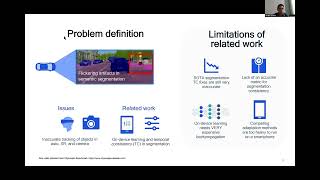
Enabling On-Device Learning at Scale
Explore on-device learning techniques for AI personalization, including few-shot learning, continuous learning, and federated learning, addressing privacy and efficiency challenges in edge computing.
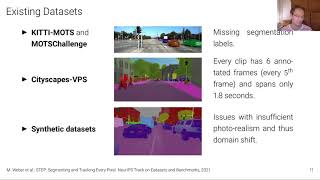
Segmenting and Tracking Every Pixel
Explore video panoptic segmentation with STEP datasets, focusing on real-world challenges in pixel-precise segmentation and tracking. Learn about new evaluation metrics and baseline methods.
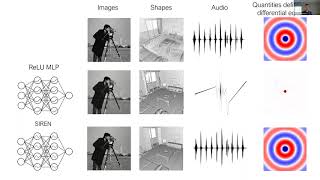
Implicit Neural Scene Representations
Explore implicit neural representations for complex signals, enabling 3D reconstruction from single images and fast inference through gradient-based meta-learning, with applications in scene understanding and semantic segmentation.
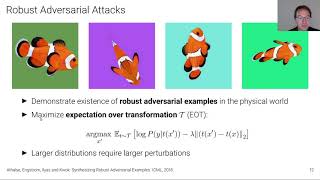
Attacking Optical Flow
Explores adversarial patch attacks on optical flow networks, revealing vulnerabilities in deep learning-based motion estimation crucial for autonomous driving safety.
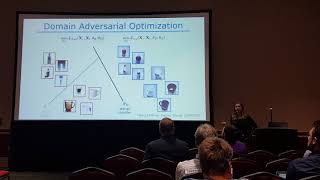
Making Our Models Robust to Changing Visual Environments
Explore techniques for making machine learning models robust to changing visual environments, covering domain adaptation, adversarial optimization, and continuous learning strategies.
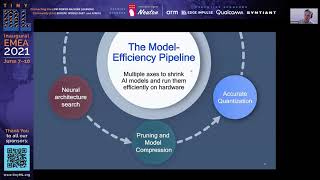
The Model Efficiency Pipeline: Enabling Deep Learning Inference at the Edge
Explore optimizing deep learning for edge devices through model efficiency techniques, including neural architecture search, pruning, quantization, and conditional processing.
Easterhegg 2019 - Generative Adversarial Networks für Anfänger
Einführung in Generative Adversarial Networks: Überblick, Geschichte und praktische Anwendungen für Entwickler. Erklärt Konzepte, Techniken und Herausforderungen anhand von Beispielen wie Pokémon-Generator und Gesichtsalterung.
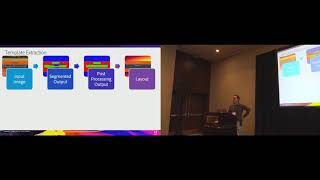
Exemplar Based Experience Transfer
Automatic approach to transfer user content into example banners, using semantic segmentation and energy-based optimization for optimal layout design.
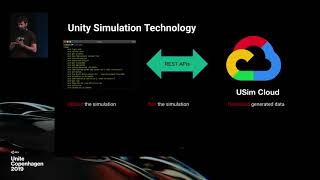
Overview of Unity Simulation
Accelerate autonomous system training with cloud-based Unity Simulation. Learn to set up and run multiple instances on Google GCP for rapid development and testing of new features.
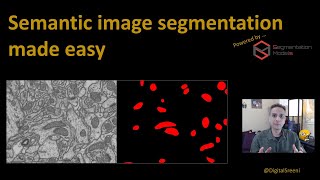
Semantic Segmentation Made Easy - Using Segmentation Models Library
Learn to implement semantic segmentation using the Segmentation Models library, covering model types, backbones, data augmentation, preprocessing, and training on electron microscopy datasets.
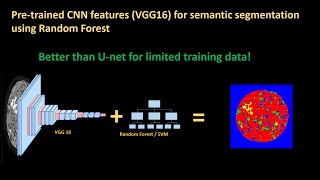
Pretrained CNN Features for Semantic Segmentation Using Random Forest
Explore semantic segmentation using VGG16 features and Random Forest, offering improved results for limited training data compared to U-net.
Unveiling Meta's Impressive CV Model - SAM 2: Segment Anything in Images and Videos
Explore Meta's advanced CV model SAM 2, featuring unified architecture for image and video segmentation. Learn its capabilities through demos and code samples for enhanced visual understanding.
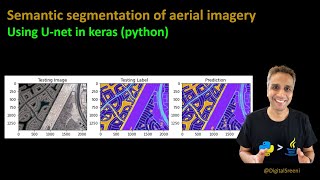
Semantic Segmentation of Aerial Imagery Using U-Net
Learn to preprocess aerial imagery, train U-net for semantic segmentation, and make predictions using Python, focusing on data preparation and model implementation for satellite image analysis.
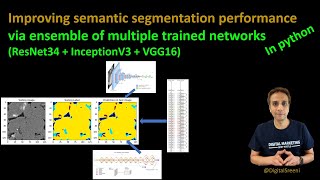
Improving Semantic Segmentation - U-Net Performance via Ensemble of Multiple Trained Networks
Enhance U-Net performance for semantic segmentation using ensemble methods with ResNet34, Inception V3, and VGG16 networks. Includes code, dataset, and practical implementation tips.
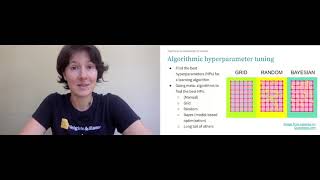
Hyperparameter Tuning with a Focus on Weights and Biases Sweeps
Explore hyperparameter tuning strategies and visualizations for deep learning models, focusing on Weights & Biases Sweeps. Accelerate progress in semantic segmentation and language understanding projects.

Domain Adaptation on Wheels: Closing the Gap to the Open-world
Explore domain adaptation techniques for autonomous driving, from standard unsupervised setups to practical approaches addressing open-world challenges in semantic segmentation and scene understanding.

3D Scenes - Understanding and Rendering
Explore 3D scene understanding and rendering techniques, from data acquisition to neural networks for point cloud classification and semantic segmentation, with insights on future research directions.