The Maths of Contagion: Why Things Spread and Why They Stop - With Adam Kucharski
Explore mathematical models for disease spread, misinformation, and internet memes. Learn how outbreaks occur, why some are predictable, and strategies for controlling epidemics and viral content.
How Not to Fall for Bad Statistics - With Jennifer Rogers
Uncover the truth behind misleading statistics in media. Learn to critically analyze data, understand risk, and differentiate between correlation and causation for informed decision-making.

What Happens When Maths Goes Wrong? - With Matt Parker
Explore real-world consequences of mathematical errors with comedian Matt Parker. From bridge collapses to plane crashes, discover how small miscalculations can lead to big disasters in this entertaining and eye-opening talk.

Geometry - An Interactive Journey to Mastery
Explore geometric concepts like polyhedrons, volume, and surface area through interactive lessons. Master logical reasoning and problem-solving skills applicable to various fields and everyday life.
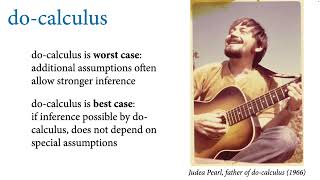
Statistical Rethinking 2023 - Good & Bad Controls
Explore causal inference, do-calculus, and the backdoor criterion. Learn to distinguish good and bad controls in statistical analysis, with insights on the Table 2 Fallacy.
Is Pure Mathematics Logically Viable? Five Challenges - Sociology and Pure Maths
Exploring five challenges to pure mathematics' logical viability, this talk critically examines the field's foundations and encourages reevaluation of its core principles and practices.
Sociology and Pure Mathematics - Pure Mathematics Relies on a Fake Arithmetic
Challenges modern pure mathematics' reliance on "fake arithmetic," proposing alternative approaches to calculus without infinite processes and calling for sociological analysis of mathematical practices.
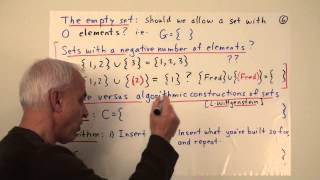
What Exactly Is a Set - Data Structures in Mathematics Math Foundations
Explores the concept of sets in mathematics, discussing definitions, challenges, and criticisms of modern set theory. Examines everyday usage, examples, and foundational issues in mathematical logic.
Steiner's Regions of Space Problem - Famous Math Problems
Exploration of Steiner's space division problem, analyzing how many regions n planes can create in space, with insights into the analogous 2D problem and mathematical reasoning.
How to Do CS Theory - Lecture 1b: Research Tips for Theoretical Computer Science
Insights and tips for aspiring theoretical computer science researchers, covering research methods, paper writing, presentation skills, and essential resources in the field.
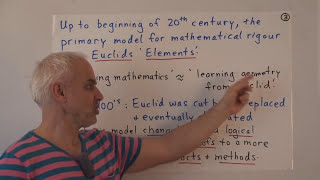
The Decline of Rigour in Modern Mathematics - Real Numbers and Limits
Explores the decline of mathematical rigor, discussing Euclid's Elements, proof concepts, and problematic topics in modern mathematics. Examines reasons for this decline and its impact on mathematical foundations.
How to Create the Best Contest Problems
Insights on crafting engaging math contest problems from two expert educators. Learn techniques for designing challenging, creative, and thought-provoking mathematical puzzles.
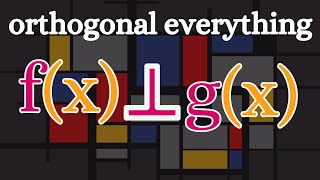
Generalizing the Right Angle
Explore the concept of generalizing right angles, extending geometric principles beyond traditional 90-degree angles for a deeper understanding of mathematical relationships.
Problem Solving - Techniques from Number Theory
Explore key Number Theory concepts and techniques for solving math competition problems, with practical examples including a 1985 AIME question.
No Simple Groups of Order 66 or 144
Explore advanced group theory using Sylow's Theorems to prove the non-existence of simple groups with specific orders, demonstrating powerful algebraic techniques.
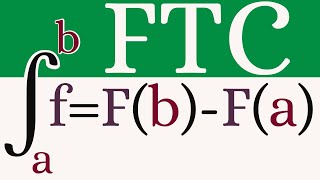
Real Analysis - The Fundamental Theorem of Calculus
Comprehensive proof of both parts of the Fundamental Theorem of Calculus, demonstrating the relationship between differentiation and integration in real analysis.
Vanessa Robins Interviewed by Elizabeth Bradley
Explore applied topology with Vanessa Robins as she discusses her career journey, research interests, and insights on granular materials, collaborations, and emerging areas in the field.
On the MLC Conjecture by Misha Lyubich
Explore the MLC Conjecture with Misha Lyubich in this interactive lecture, offering insights into complex dynamics and opportunities for audience engagement.
Dmitri Burago: A Mozaic from Geometry, Dynamics, PDEs, and Maybe More
Explore unsolved problems and recent progress in geometry, dynamics, and PDEs through a mosaic of interconnected topics, featuring insights from collaborative research.
Computing with or Despite the Computer - IPAM at UCLA
Explore the interplay between manual, computer-assisted, and formally verified computations in number theory, examining challenges and opportunities in mathematical research.
On Ulam's Problem 19 and Related Problems - IPAM at UCLA
Explore uniqueness problems related to Ulam's Problem 19 from the Scottish book, presented by Dima Ryabogin at IPAM's Calculus of Variations workshop.