
How to Evaluate Science and Health News - Fighting Misinformation
Learn to critically evaluate science and health news, understand the scientific method, and identify misinformation. Develop skills to assess validity in scientific journalism and navigate the challenges of social media information.
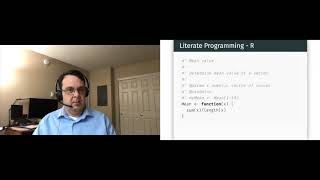
Literate Statistical Programming for Reproducible Data Science
Learn a reproducible, auditable workflow for data science projects using Literate Statistical Programming principles, tools, and techniques for improved experimentation and iteration.
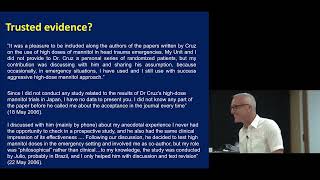
Research Integrity: Telling the Truth and Exposing Lies - Part 2
Explore the principles of research integrity and ethical conduct in academic work through expert insights on truth-telling and addressing scientific misconduct in research environments.
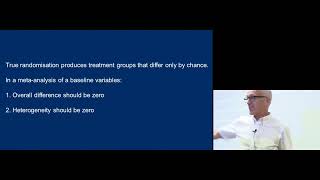
Research Integrity: Statistical Methods for Monitoring Data Integrity - Part 1
Discover statistical methods for monitoring data integrity in research, focusing on techniques to identify truthful results and detect potential research misconduct in clinical trials.
Truth and the Scientific Method by David Gross
Explore the nature of scientific truth, the scientific method's strengths and limitations, and its role in society. Gain insights into reductionism and the challenges facing modern science.
How Often Does a Polynomial Take Squarefree Values? by Manjul Bhargava
Explore the frequency of squarefree values in polynomials with Manjul Bhargava. Delve into number theory concepts, heuristic explanations, and recent developments in this fascinating mathematical topic.
Cause and Effect - Understanding Causation in Scientific Research
Exploring causal inference methods in epidemiology and their impact on scientific understanding, challenging traditional views on correlation vs. causation in data analysis.
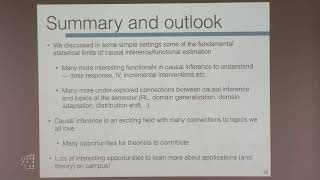
Statistical Limits of Causal Inference
Explore fundamental limits of causal effect estimation in observational data, examining personalized effects, non-smooth settings, and discrete scenarios without assuming prior causal inference knowledge.
Issues in Hypothesis Testing - Part 1
Explore key issues in hypothesis testing, including error types, biases, and experimental design strategies for more robust scientific research.
Changing Science by Asking Big Questions
Explore how curiosity-driven scientific inquiry and asking fundamental questions can revolutionize our understanding of time, consciousness, and the universe's deepest mysteries.
The Story of Deciphering the Ribosome - With Venki Ramakrishnan
Nobel Laureate Venki Ramakrishnan recounts his journey in deciphering the ribosome's structure, from early experiments to Nobel Prize-winning discoveries, highlighting the competitive nature of scientific research.

How We Measure the World - With Michael de Podesta
Explore the importance of measurement in science, focusing on the International System of Units and upcoming changes to key unit definitions. Learn about scientific progress through precise measurements.

Environmental Science - Introduction
Explore environmental science fundamentals, including natural resources, population impacts, sustainability, and the scientific method. Learn to differentiate environmental science from environmentalism.

Earth Science - Introduction to Earth Science
Comprehensive introduction to Earth Science, covering geology, oceanography, meteorology, and astronomy. Explores Earth's formation, systems, scientific methods, and the universe's scale and history.
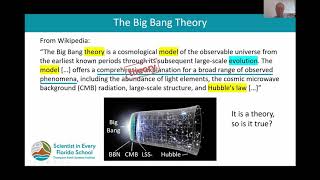
The Role of Theories, Laws, Hypotheses & Models - Dr. Bingkan Xue
Explore scientific concepts like Hubble's Law, the Big Bang Theory, and evolution, examining their roles as laws, models, and theories in our understanding of the universe.
Breaking Out of the Physics Silo
Exploring interdisciplinary approaches to physics education, emphasizing risk-taking and personal growth for teachers to enhance their effectiveness and student engagement.

Advice for Young Scientists: Think Like a Poet, Work Like a Bookkeeper
Renowned biologist E.O. Wilson shares wisdom and advice for aspiring scientists, emphasizing creativity, diligence, and the importance of stepping away from conventional thinking.

The Joy of Science - With Jim Al-Khalili
Explore the power of scientific thinking with Jim Al-Khalili. Learn how to navigate uncertainty, guard against bias, and embrace evidence-based reasoning for clarity and empowerment in decision-making.

What the World Gets Wrong About Science
Explore common misconceptions about science, its dynamic nature, and the scientific method. Gain insights into the evolving understanding of scientific knowledge and its impact on our world.
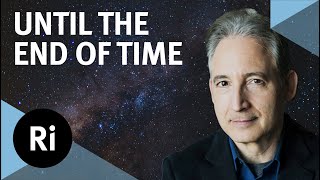
Our Quest to Understand the Cosmos - Brian Greene in Conversation with Jo Marchant
Explore the cosmos from its beginning to its end with physicist Brian Greene, discussing life, consciousness, free will, and the scientific method in this thought-provoking conversation.

The Inexplicable Universe - Exploring Cosmic Mysteries
Explore the universe's mysteries with Neil deGrasse Tyson, from quarks to galaxies. Discover modern scientific approaches to cosmic enigmas and potential future breakthroughs in astronomy and physics.