First Law of Thermodynamics - General Physics
Explore the First Law of Thermodynamics, covering internal energy, heat, work, and PV relationships. Master calculations for various thermodynamic processes and solve practical problems.
Heat and Calorimetry - General Physics
Master heat and calorimetry concepts, including specific heat, latent heat, and phase changes. Learn to calculate heat transfer in various scenarios and understand thermal equilibrium principles.
Ideal Gas Law and Kinetic Theory of Gases - General Physics
Explore the Ideal Gas Law and Kinetic Theory of Gases, covering fundamental postulates, individual gas laws, and practical calculations. Delve into molecular models and speed distributions.
Temperature and Thermal Expansion - General Physics
Explore temperature scales, thermal equilibrium, and expansion in solids and liquids. Master conversions between Celsius, Fahrenheit, and Kelvin while solving practical problems in thermal physics.
Nuclear Decay Processes and Energy of Nuclear Reactions - General Physics
Explore nuclear decay processes and reaction energies. Learn about alpha, beta, and gamma decay, Q-values, and energy calculations in nuclear reactions. Gain insights into exothermic and endothermic reactions.
Kinetics of Radioactive Decay - General Physics
Explore radioactive decay kinetics, including exponential decay, decay rates, half-life, and decay constants. Solve practice problems to reinforce understanding of these fundamental concepts.
Wave Functions and Atomic Orbitals - General Physics
Explore wave functions, atomic orbitals, and quantum principles. Understand electron behavior, orbital shapes, and energy levels. Learn quantum numbers and electron configurations for atomic structure insights.
Time Dilation and Length Contraction in Special Relativity - Lesson 25.2
Explore time dilation and length contraction in special relativity, deriving formulas and solving problems to understand these fundamental concepts of high-speed physics.
Double Slit Interference in General Physics - Lecture 24.1
Explore double slit interference, from basic wave concepts to Young's experiment. Learn interference formulas and solve practical problems in this comprehensive physics lesson.
Immersed Methods for Fluid-Structure Interaction
Explore advanced immersed boundary methods for fluid-structure interaction, focusing on large-deformation elasticity, peridynamics for material failure, and sharp-interface coupling techniques.
Openscapes: Supporting Better Science for Future Us
Discover how Openscapes fosters collaboration and efficiency in environmental research through mentoring and promoting code reuse in NASA and NOAA projects.
Nonlinear Bosonization of Fermi Surfaces - The Method of Coadjoint Orbits
Explore nonlinear bosonization of Fermi surfaces using coadjoint orbits. Gain insights into field-theoretical reformulation of Landau Fermi liquid theory and its implications for condensed matter physics.
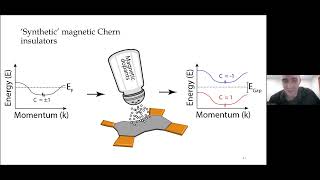
Electrical Switching of Magnetic Order in Intrinsic Chern Insulators
Explore electrical switching of magnetic order in intrinsic Chern insulators, focusing on mechanisms in twisted graphene and transition metal dichalcogenide heterostructures using transport measurements and nanoSQUID microscopy.
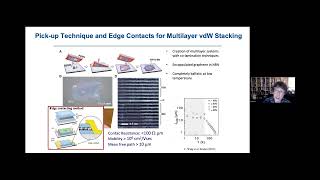
Induced Superconductivity in the Fractional Quantum Hall Edge in Graphene Heterostructures
Explore induced superconductivity in fractional quantum Hall edges of graphene heterostructures, paving the way for parafermions and advanced quantum computing applications.
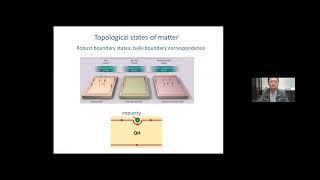
Recent Progress in Non-Hermitian Physics Beyond One Dimension
Explore non-Hermitian systems' unique topological physics beyond conventional Bloch band theory, focusing on multi-dimensional phenomena and recent advancements in non-Bloch band theory.
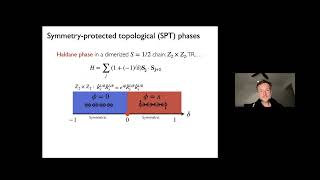
Quotient Symmetry Protected Topological Phenomena and Quantum Criticality
Explore quotient symmetry protected topological phenomena and quantum criticality, focusing on stable topological effects in trivial phases and emergent low-energy symmetries.
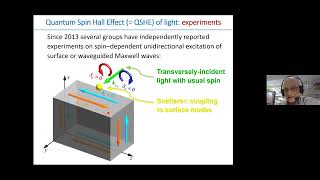
Topological Non-Hermitian Origin of Surface Maxwell Waves
Explore the topological origin of surface Maxwell waves, examining their significance in electromagnetism, metamaterials, and non-Hermitian wave physics.
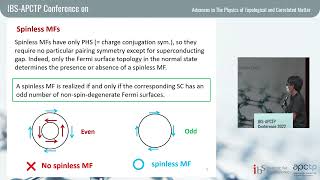
Bulk-Boundary Correspondence in Point-Gap Topological Phases
Explore non-Hermitian systems' point-gap topology, examining bulk-boundary correspondence and its impact on exotic surface states in open boundary conditions.
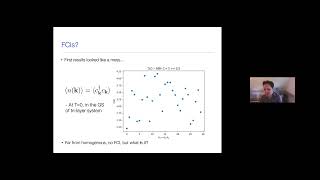
Quantum Geometry and Fractional Chern Insulators in Moiré Materials
Explore fractional Chern insulators in Moiré materials, examining quantum geometry, symmetry breaking, and novel competing states in flatband systems.
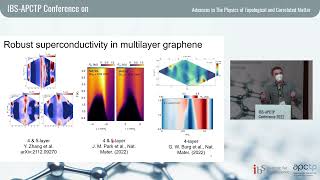
Local Thermodynamic Measurements of Topological States in Magic Angle Graphene
Explore local thermodynamic properties of magic-angle twisted trilayer graphene, uncovering topological correlated insulating states and novel phase transitions through compressibility measurements.
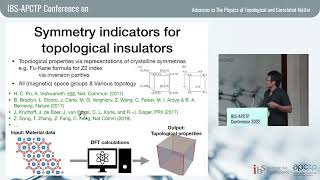
Topological Material Search via Symmetry Indicator and Filling Anomaly
Explore advanced methods for detecting topological insulators and superconductors, focusing on symmetry indicators and filling anomalies in crystalline materials.