Inclined Plane Problems - Application of Newton's Laws in General Physics
Master the application of Newton's Laws to inclined plane problems. Learn to draw free body diagrams, set up equations, and solve practice problems involving frictionless surfaces, static friction, and kinetic friction.
Gravity, Normal Force, and Friction - Introduction to Free Body Diagrams in General Physics
Explore gravity, normal force, and friction in physics. Learn to draw free body diagrams, solve problems, and apply Newton's laws in 1D and 2D scenarios.
Relative Motion in Physics - Lesson 3.3
Explore relative motion concepts in 1D and 2D, including train and river crossing problems. Learn to calculate relative velocities and solve physics problems effectively.
Projectile Motion - Kinematics in Two Dimensions
Master projectile motion in physics: analyze kinematics in two dimensions, calculate time of flight, maximum height, and range using real-world examples like baseball hits and arrow trajectories.
Freely Falling Bodies - General Physics Lesson
Explore freely falling bodies in physics, covering gravity concepts and solving various free fall motion problems to master kinematics with constant acceleration.
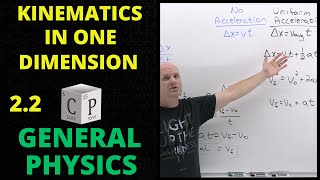
Kinematics in One Dimension - General Physics
Learn kinematics in one dimension, covering constant velocity and uniform acceleration scenarios. Master key equations and solve practice problems to build a strong foundation in physics calculations.
Displacement, Velocity, and Acceleration - Introduction to Kinematics
Explore displacement, velocity, and acceleration in kinematics. Learn key concepts, compare vector and scalar quantities, and understand motion diagrams for various types of motion.
Vectors in General Physics - Lesson 1.4
Explore vectors in physics: from trigonometry review to vector components, addition, and resultant vector calculations. Master essential concepts for understanding vector operations in physics.
Unit Conversions and the Metric System in General Physics - Lesson 1.3
Master metric system conversions, from basic to complex units. Learn prefixes, avoid pitfalls, and tackle area, volume, velocity, and density conversions for physics calculations.
Reactions of Monosaccharides in Organic Chemistry - Lesson 24.2
Explore monosaccharide reactions including ester and glycoside formation, oxidation, reduction, and carbon chain modifications. Learn to identify reducing sugars and understand key synthesis methods.
Classification of Monosaccharides in Organic Chemistry - Lecture 24.1
Explore monosaccharide classification, including aldoses, ketoses, stereochemistry, and cyclization. Learn to identify sugar types, distinguish D/L forms, and understand anomers and mutarotation.
Introduction to Nuclear Physics - General Physics
Explore nuclear physics fundamentals: particles, atomic symbols, stability, and binding energy. Gain insights into nuclear structure, forces, and energy conversion principles.
Bohr Model of the Atom and Atomic Spectra - Quantum Physics
Explore the Bohr Model of the Atom and Atomic Spectra. Learn about quantized electron orbits, energy levels, and spectral lines. Practice calculations for emission spectra series.
Blackbody Radiation, Photoelectric Effect, and de Broglie Relation in Quantum Physics
Explore quantum physics fundamentals: blackbody radiation, photoelectric effect, and de Broglie relation. Understand classical physics limitations and quantum models explaining observed phenomena.
Relativistic Velocity, Momentum, and Energy - General Physics Lesson 25.3
Explore relativistic velocity, momentum, and energy concepts. Learn equations for relativistic addition of velocities, momentum, and energy. Calculate rest energy of an electron using E=mc^2.
Introduction to the Special Theory of Relativity - Lesson 25.1
Explore Einstein's Special Theory of Relativity, its postulates, and consequences. Understand how constant light speed affects time and distance measurements in different inertial frames.
Single Slit Diffraction and Diffraction Gratings - General Physics
Explore single slit diffraction and diffraction gratings, deriving formulas for dark and bright fringes, and solve problems to determine light wavelength using these phenomena.
Thin Film Interference - General Physics Lesson 24.2
Explore thin film interference, including constructive and destructive interference conditions, phase shifts, and practical applications through derivations and problem-solving.
RL Circuits - Current, Potential Energy, and Practice Problems
Explore RL circuits, including current behavior, time constants, and inductor energy storage. Learn formulas and solve practice problems to master this fundamental concept in electrical engineering.
Generators and Motors in General Physics - Lesson 20.2
Explore the principles of generators and motors, including emf generation, AC current, and back emf. Learn how these devices convert energy and their key components.
Magnetic Fields in Current-Carrying Loops and Ideal Solenoids - General Physics
Explore magnetic fields in current-carrying loops and ideal solenoids. Learn formulas, right-hand rules, and solve practice problems to calculate field magnitudes at loop and solenoid centers.