Sound Intensity Level and the Decibel Scale - General Physics
Explore sound intensity levels, decibel scales, and their relationship to distance. Learn to calculate sound intensity and understand its logarithmic nature for practical applications in physics.

Sound Waves - Introduction and Speed in Different Mediums - Lecture 14.1
Explore sound waves, their properties, and speed in various mediums. Learn equations for calculating sound velocity in solids, liquids, gases, and air, with practical examples.
Waves in Physics - Transverse, Longitudinal, and Interference
Explore wave types, speed equations, and interference patterns in physics. Master key concepts like transverse and longitudinal waves, wave speed calculations, and constructive/destructive interference.
Springs and Trigonometry Review for Simple Harmonic Motion - General Physics
Review springs, Hooke's Law, and trigonometry concepts essential for understanding simple harmonic motion. Explore relationships between force, energy, displacement, and periodic functions.
Moment of Inertia and Rotational Dynamics - General Physics
Explore moment of inertia and rotational dynamics, covering Newton's laws, derivations, comparisons, and practical applications in physics problems.
Center of Mass and Center of Gravity - Lesson 8.2
Explore center of mass and gravity concepts, learn to determine irregular object centers, and solve point mass calculations for enhanced physics understanding.
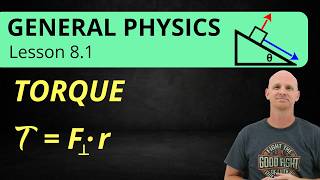
Torque - Definition and Problem Solving in General Physics
Explore torque's definition, calculation, and application through demonstrations and problem-solving. Learn how force and lever arm affect rotational motion in various scenarios.
Rotational Kinematics - General Physics
Explore rotational kinematics, comparing angular and linear motion concepts. Learn equations, unit conversions, and problem-solving for constant velocity and uniform acceleration scenarios.

Momentum and Impulse in General Physics - Lesson 6.1
Explore linear momentum and impulse concepts, including definitions, formulas, and problem-solving techniques. Master the Impulse-Momentum Theorem and its applications in physics.
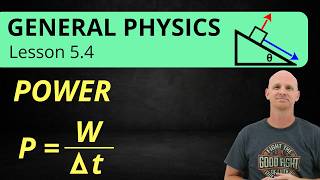
Power in Physics - Definitions, Formulas, and Practice Problems
Explore power in physics: definitions, formulas, and practical applications through elevator and motorcycle engine problems. Master key concepts and problem-solving techniques.
Newton's Laws of Motion - General Physics
Explore Newton's Laws of Motion, fundamental forces, and types of forces. Learn how these principles govern object behavior and interactions in physics.
Displacement, Velocity, and Acceleration in Two Dimensions - General Physics
Explore displacement, velocity, and acceleration in 2D motion. Learn to calculate 2D displacement using velocity components and the Pythagorean theorem. Prepare for projectile motion concepts.
Physics Motion Diagrams - Position, Velocity, and Acceleration
Explore physics motion diagrams: position vs. time, velocity vs. time, and acceleration vs. time. Learn to interpret graphs, calculate key values, and understand their relationships in motion analysis.
Significant Figures and Scientific Notation in General Physics - Lesson 1.2
Master significant figures and scientific notation for precise calculations in physics and beyond.
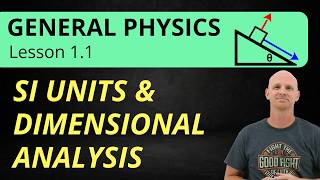
SI Units and Dimensional Analysis in General Physics - Lesson 1.1
Master SI units and dimensional analysis for effective problem-solving in physics. Learn base and derived units, their importance in calculations, and practical application techniques.
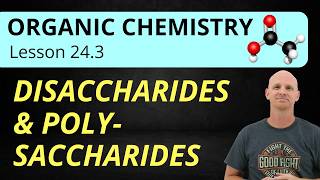
Disaccharides and Polysaccharides in Organic Chemistry - Lecture 24.3
Explore disaccharides and polysaccharides, including structures, glycosidic linkages, and common examples like sucrose, starch, and cellulose. Learn about DNA and RNA nucleosides as N-glycosides.
Theoretical Structures in Classical Scattering Amplitudes and Observables
Explore theoretical structures in classical scattering amplitudes and observables with Radu Roiban's in-depth lecture on advanced physics concepts.
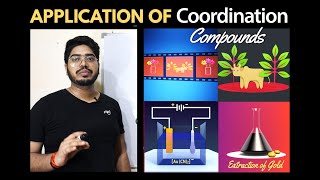
Application of Coordination Compounds in Chemistry
Explore diverse applications of coordination compounds in analysis, water treatment, metal extraction, biological systems, catalysis, and more. Gain insights into their practical uses across industries.

Double Bond Equivalent and Isomer Structures in Organic Chemistry
Master Double Bond Equivalent (DBE) concepts and isomer structures in organic chemistry. Explore various molecular configurations, from chain isomers to ring structures, enhancing your understanding of chemical compounds.
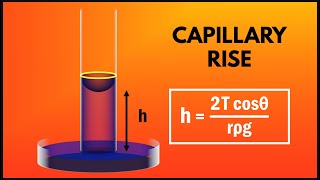
Capillarity and Surface Tension in Fluid Mechanics
Explore capillarity and surface tension in fluid mechanics. Learn derivations, factors affecting capillary rise, and key concepts like adhesion, cohesion, and meniscus shape.
Bernoulli's Theorem in Fluid Physics - Easy Explanation and Numerical Examples
Explore Bernoulli's Theorem through easy explanations, animations, and practical numerical examples. Master fluid dynamics concepts and their real-world applications in aerodynamics and engineering.