New Perspectives on the Emergence of Multiple Equilibria in Large Highly Interacting Ecosystems
Explore new insights on multiple equilibria emergence in large, highly interactive ecosystems, focusing on theoretical advancements and practical implications.
Evolution in Spatially Structured Populations
Explore spatial population dynamics and their impact on evolutionary processes, focusing on genetic diversity and adaptation mechanisms.
Sequencing Error and Phylogenetics - SARS-CoV-2 Transmission in Hospitals
Explore sequencing errors, phylogenetics, and SARS-CoV-2 transmission in hospitals with insights from a Cambridge researcher.
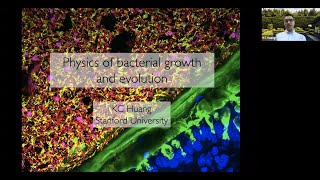
Bacterial Evolution in Complex Environments
Explore bacterial evolution in complex environments, uncovering adaptive strategies and genetic mechanisms shaping microbial populations over time.
Toward Prediction and Control of Microbial Evolution: Analysis of Phenotypic Constraints in Laboratory Evolution
Analyze phenotypic constraints in laboratory evolution to predict and control microbial evolution, focusing on research from the University of Tokyo.
The Evolution of Virulence in the Commensal Bacteria Escherichia Coli
Explorez l'évolution de la virulence chez Escherichia coli, une bactérie commensale, et ses implications pour la santé humaine et la microbiologie.
What Processes Explain Genetic Diversity Within Species?
Explore genetic diversity within species, examining key processes and mechanisms driving variation in populations.
New Methods for Large-Scale Species Tree Estimation Addressing Gene Duplication and Loss
Explore cutting-edge techniques for estimating large-scale species trees, addressing gene duplication and loss challenges in phylogenetics.
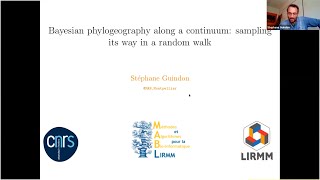
Bayesian Phylogeography Along a Continuum: Sampling Its Way in a Random Walk
Explore Bayesian phylogeography techniques for analyzing species distribution patterns using continuous spatial models and random walk sampling methods.
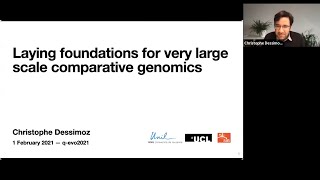
Laying Foundations for Very Large Scale Comparative Genomics
Explore foundations for large-scale comparative genomics, focusing on techniques and challenges in analyzing vast genomic datasets across species.
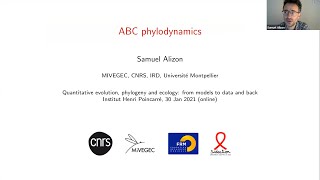
ABC Phylodynamics
Explore ABC phylodynamics with Samuel Alizon, delving into advanced techniques for analyzing evolutionary dynamics of pathogens using phylogenetic data.
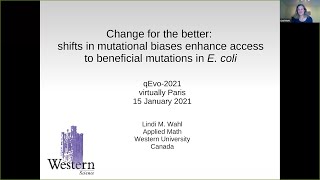
Change for the Better: Shifts in Mutational Biases Enhance Access to Beneficial Mutations in E. coli
Explore shifts in E. coli's mutational biases and their impact on beneficial mutations, enhancing understanding of bacterial evolution and adaptation.
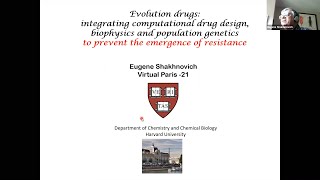
Understanding Evolution on Multiple Scales: From Protein Physics to Population Genetics
Explore protein physics and population genetics to grasp evolution's multifaceted nature and combat drug resistance through integrated computational approaches.
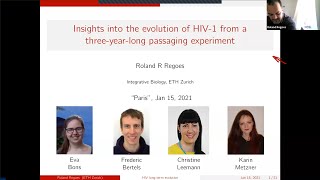
Insights into the Evolution of HIV-1 from a Three-Year-Long Passaging Experiment
Explore HIV-1 evolution through a groundbreaking three-year passaging experiment, uncovering key insights into viral adaptation and persistence.
Physical Constraints on Epistasis
Explore physical constraints on epistasis in biological systems, examining how interactions between genes influence evolutionary outcomes and phenotypic expression.
Inferred Epistasis Enhances Neutral Models of Sequence Evolution
Explore how inferred epistasis improves neutral models of sequence evolution, enhancing understanding of evolutionary processes.
Ecological Chaos and Evolution of Intra-Species Diversity
Explore ecological chaos and its impact on intra-species diversity evolution, delving into complex interactions shaping biodiversity within populations.
Metabolic Fitness Landscapes Predict the Evolution of Antibiotic Resistance
Explore metabolic fitness landscapes and their role in predicting antibiotic resistance evolution, presented by Fernanda Pinheiro from the University of Cologne.
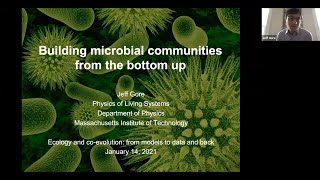
Building Microbial Communities from the Bottom Up
Explore bottom-up approaches to constructing microbial communities, examining assembly processes and interactions that shape complex ecosystems.
A Sparse Mapping from Structure to Function in Microbial Communities
Explore the relationship between structure and function in microbial communities through a sparse mapping approach, uncovering key insights into complex ecological systems.
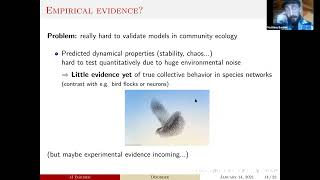
Disorder and Order in Ecological Interactions
Explore ecological interactions, examining disorder and order in natural systems to gain insights into complex ecosystem dynamics.