Dynamics of Biological Systems - Lecture 4
Explore biological dynamics using physics tools to model predator-prey oscillations, ecosystem chaos, and microbial swimming. Learn to predict species competition, population changes, and collective behavior in fluids.
Dynamics of Biological Systems - Lecture 1
Explore biological dynamics using physics tools to model complex living systems, from predator-prey oscillations to bacterial motility, in this introductory course for undergraduates.
Dynamics of Biological Systems - Lecture 2
Explore biological dynamics using physics tools to model predator-prey oscillations, ecosystem chaos, and microbial swimming. Learn to predict species competition, population changes, and collective behavior in fluids.
Dynamics of Biological Systems - Lecture 3
Explore biological dynamics using physics tools to model predator-prey oscillations, ecosystem chaos, and microbial swimming. Learn to predict species competition, population changes, and collective behavior in fluids.
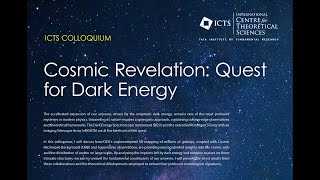
Cosmic Revelation - Quest for Dark Energy
Explore the universe's accelerated expansion and dark energy through cutting-edge observations and theoretical frameworks, including insights from DESI and eROSITA projects.
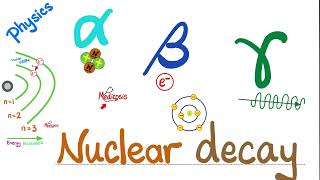
Alpha, Beta and Gamma Nuclear Decay - Energy Absorption vs Emission in Radioactivity
Comprehensive exploration of nuclear decay types, energy processes, and radiation principles. Covers key concepts for physics and chemistry exams, emphasizing practical applications in medicine and science.
Universality of Dynamic Processes Using Drinfel'd Twisters
Explore universality in dynamic processes using Drinfel'd twisters, examining long-time asymptotics and Tracy-Widom fluctuations through quantum group duality and asymptotic analysis.
Elliptic Orthogonal Polynomials and Their Integrability
Explore elliptic orthogonal polynomials and their integrability through Riemann-Hilbert analysis, examining discrete and continuous integrable systems and connections to the sixth Painlevé equation.
Exact Three- and Four-Point Correlation Functions in O(n) and Potts Loop Models
Explore exact three- and four-point correlation functions in O(n) and Potts loop models, combining CFT symmetry, lattice discretization, and conformal bootstrap for insights into 2D conformally invariant systems.
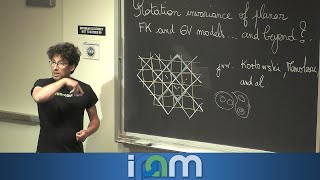
Rotational Invariance of Planar Random Cluster Models and Beyond
Exploration of rotational invariance in planar random cluster models, discussing its applications and potential for new insights into critical models on Z^2.
Neutrino Beams for Accelerator Experiments - Lecture 3
Explore neutrino beam production, focusing on accelerator experiments. Learn about beam characteristics, flux measurements, and their impact on neutrino physics research.
Neutrino Phenomenology: Atmospheric and Long-baseline Experiments - Lecture 2
Explore atmospheric and long-baseline neutrino phenomenology, delving into oscillations, interactions, and experimental insights to advance understanding of these elusive particles.
Neutrino Scattering: Why and How - Lecture 2
Explore neutrino scattering mechanisms, their importance in particle physics, and experimental techniques for studying these elusive particles in this advanced physics lecture.
Neutrino Beams for Accelerator Experiments - Lecture 1
Explore the creation and characteristics of neutrino beams for accelerator experiments, focusing on their role in advancing our understanding of these elusive particles.
Neutrino in Cosmology - Lecture 3
Explore the role of neutrinos in cosmology, their impact on the early universe, and their significance in understanding cosmic evolution and structure formation.
Neutrino Mass Models - Lecture 3
Explore neutrino mass models in this advanced lecture, delving into the physics beyond the Standard Model and the implications for our understanding of fundamental particles.
Neutrino-less Double Beta Decay Experiments
Explore neutrino-less double beta decay experiments, a crucial area in particle physics research investigating the nature of neutrinos and potential physics beyond the Standard Model.
Dark Matter in Neutrino Facilities
Explore dark matter detection possibilities in neutrino experiments. Learn about innovative approaches to uncover hidden particles and expand our understanding of the universe's composition.
Neutrino in Cosmology - Lecture 2
Explore neutrinos' role in cosmology, their impact on the early universe, and their significance in understanding cosmic evolution and structure formation.
Neutrino Detectors - Lecture 3
Explore neutrino detection techniques, challenges, and advancements in this lecture on neutrino detectors, part of a comprehensive series on understanding the universe through neutrino physics.
Phenomenology of Neutrino Propagation - Lecture 2
Explore neutrino propagation phenomenology, covering oscillations, interactions, and behavior in matter. Gain insights into this fundamental aspect of particle physics from a renowned expert.