
Harnessing Chaos and Predicting the Unpredictable with Artificial Intelligence
Explore how Reservoir Computing and AI can predict chaotic systems like weather and brain dynamics, pushing beyond traditional forecasting limits and combining knowledge-free and knowledge-based approaches.

Genetically Modified Foods - Monsters or Miracles?
Explore the science, history, and controversies surrounding genetically modified foods, examining their potential benefits and risks for global food security and environmental impact.

The Jumping Genome - Changing Ideas about Heredity and Evolution
Explore the evolution of genetics, from Mendel's pea experiments to modern genomics, including McClintock's revolutionary "jumping gene" discovery and its impact on our understanding of heredity and evolution.

How Plants See, Feel, and Smell - The Perceptual Apparatus of the Plant
Explore the fascinating sensory world of plants, from their perception of light and touch to their responses to gravity and chemicals in the environment.
More than You Know - Finding Financial Wisdom in Unconventional Places
Explore how diverse disciplines like sports, biology, and history can enhance decision-making skills, particularly in investing and personal growth.

Forecasting Natural Disasters in Complex Earth Systems - SFI Lecture
Explore forecasting natural disasters using satellite data, nonlinear dynamics, and numerical simulations. Learn about ensemble forecasting and pattern methods for predicting extreme events.
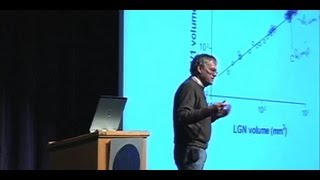
Why Barry Bonds is Better at Hitting Home Runs - Neural Circuit Scalability
Explore the neural basis of exceptional athletic performance, focusing on how brain region size and specialization contribute to elite skills in sports like baseball.
A Cooperative Species: Why Policies Designed for "Wicked Men" Fail - Part 3
Explore how ethical dispositions and cooperative motivations impact societal challenges, challenging Machiavelli's approach and examining the interplay between policy and human behavior.

A Cooperative Species - Altruism, Parochialism, and War
Explore how war and hostility may have shaped human morality through computer simulations of alternative historical trajectories, challenging our understanding of altruism and cooperation.
A Cooperative Species - Evolutionary Origins of Human Altruism - Lecture 1
Explore the evolutionary origins of altruistic cooperation, challenging traditional notions of 'selfish genes' and Homo economicus through archaeological, genetic, and climatic evidence.

The Post-Darwinian World - Expanding Darwin's Theories in Modern Science
Explore post-Darwinian complexities in biology, economics, and politics, examining ecosystems, food webs, origin of life, HIV/AIDS, and sociobiology to expand on Darwin's evolutionary theories.

Will It Cost the Earth to Save the Planet?
Experts discuss the economic implications of addressing climate change, exploring strategies, costs, and potential returns on investment for mitigating global warming's impacts.
The Search for the Nature of Matter
Explore the evolution of particle physics, from ancient Greek theories to modern concepts like the Standard Model and string theory, with insights on fundamental forces and the universe's origins.
The Rise of the Speaking Machine - Human Language Evolution
Explore the fascinating journey of human language evolution, from its origins to modern complexities, with insights into cognitive development and cultural impacts.

The Swine Flu and You: Predicting and Controlling the H1N1 Pandemic
Explore the H1N1 pandemic: its impact, control strategies, and mathematical modeling for prediction and prevention. Learn about public health responses and the science behind epidemic management.
The Decline of Classic Maya Civilization - A Systems Perspective
Explore the systemic factors behind the decline of Southern Maya Lowlands cities around 800 AD, challenging previous collapse theories and examining new archaeological and environmental insights.
Big Data, Global Development, and Complex Systems
Explore how big data from everyday technologies can reveal human behavior patterns and societal trends, with applications in global development, health, and socioeconomic analysis.

The Inevitability of Life: Geochemistry and the Emergence of Living Systems
Explore the inevitability of life's emergence and persistence on Earth through geochemistry, challenging the notion of improbable events in life's origin.

The Club of Rome and Limits to Growth - Achieving the Best Possible Future
Explore future challenges and solutions related to climate change and resource depletion. Learn about growth limits, their impacts, and potential regional initiatives for a sustainable future.

Devil or Angel - Genetic Conflicts in Brain and Behavior
Explore genetic conflicts in the brain, self-defeating behaviors, and evolutionary clashes between maternal and paternal genes influencing decision-making and behavioral patterns.

Evolution in Action: A 50,000 Generation Experiment
Explore a groundbreaking 50,000-generation experiment revealing evolutionary processes in action, offering insights into adaptation, genetic changes, and long-term population dynamics.