
An Overview of Toolmarks on Bones and Cartilages in Crime Scene Investigation
Explore tool mark identification in forensics, focusing on bones and cartilages. Learn about implement classification, tissue analysis, and key aspects of violent death investigations.

Sexual Violence in South Africa - Day 2
Dr. Steve R. Naidoo explores sexual violence in South Africa, discussing definitions, legal aspects, challenges, and interventions like the Thuthuzela model. The talk covers consent, LGBTQ+ issues, and forensic analysis.

Awareness of Virtual Autopsy for Forensic Nurses - Day 1
Explore virtual autopsy technology in forensic nursing, its advantages, and impact on non-invasive post-mortem examinations using advanced 3D imaging techniques.
Importance of Statistics in Forensic Science - Dr. Rajesh Verma
Detailed analysis of data presentation and variable correlation in forensic science, with case studies. Builds on Session 1's coverage of uncertainty in scientific evidence and basic statistics.
Importance of Statistics in Forensic Science - Dr. Rajesh Verma
Explore the crucial role of statistics in forensic evidence interpretation, covering uncertainty, key concepts, and practical applications through case studies and hypothesis testing.

Unusual Work Accident - Forensic Challenges in Evidence Collection - Terri Armenta
Explore forensic challenges in unusual work accident evidence collection, focusing on crime scene photography and Los Angeles County medical examiner practices.
One to One Facial Comparison for Civil and Criminal Investigations - Michael W Streed
Explore facial comparison techniques for legal investigations, including software tools, assessment procedures, and real-world case studies. Gain insights into this crucial forensic method.

The Role of Police Sketch Artists During Criminal Investigations - Michael W. Streed
Explore the crucial role of police sketch artists in criminal investigations, their techniques, and real-world case examples. Gain insights into this unique forensic career path.
Facial Identification Through Somatometry and Somatoscopy - Dr. Ranjeet Singh
Explore forensic photo facial identification techniques, including somatometry and somatoscopy. Learn lab procedures, comparison parameters, and essential requirements for reliable results in various case types.
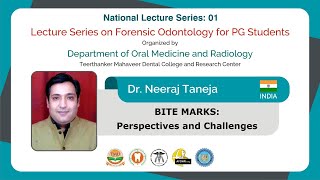
Bite Marks - Perspectives and Challenges
Comprehensive lecture on bite mark evidence in forensic investigations, covering analysis methods, classifications, ABFO guidelines, and challenges faced in the field of forensic odontology.

Importance of Research in Forensic Odontology - Practicing with Evidence-Based Tools
Explore the crucial role of research in forensic odontology, focusing on evidence-based tools and methodologies to enhance its value in criminal justice and improve forensic evidence processing.
Isotope Analysis in Teeth - A Novel Forensic Tool for Human Identification
Explore isotope analysis in teeth as a novel forensic tool for identifying unknown remains, overcoming limitations of traditional methods in longstanding cases.

Serious Crime Investigation - Expert Insights on Techniques and Advances
Expert insights on serious crime investigation techniques, legal considerations, and evolving forensic science advancements for solving complex cases and cold cases.

Challenges in Fingerprint Analysis by INAFIS
Explore challenges in fingerprint analysis using INAFIS, including accuracy rates, digital imaging techniques, and database comparison methods for establishing individual identities.

The Significance of Fingerprints and Dermatoglyphics
Explore fingerprints and dermatoglyphics: their formation, unique characteristics, and applications in forensics and genetic studies. Learn how they reveal drug use and hereditary addictions.

Comparison and Analysis of Third-Level Fingerprint Details on Transplant Tape
Explore third-level fingerprint details on transplant tape, analyzing irregularities and characteristics for enhanced forensic understanding. Expert insights on comparison techniques and analysis methods.

Latent Print Development - Blood Impressions and Reagents
Explore techniques for developing bloody fingerprints, including reagents like Amido Black and Leukocrystal Violet. Learn about fixatives, fluorescence, and considerations for different surfaces in forensic investigations.
Inheritance of Fingerprint Patterns in Malaysian Indian Families
Explore fingerprint pattern inheritance in Malaysian Indian families, revealing insights into parent-child relationships through biometric analysis and regression techniques.

Demystifying the Role of Fingerprint Science in Justice Delivery System
Explore fingerprint science's crucial role in justice through real case studies, expert witness insights, and global legal perspectives on this unique forensic evidence.

Fingerprint Examination - An Aid to Investigation
Explore latent fingerprint examination techniques for crime scene investigation, focusing on cognitive approaches to improve examiner decision-making and connect criminal cases effectively.

The Future of Fingerprint Analysis - Historical Tools to Digital Comparison Software
Explore the evolution of fingerprint analysis, from historical tools to modern digital techniques. Learn about specialized software and comparison methods for effective criminal investigations.