Gas Dynamics
This course discusses topics in gas dynamics. Review of fundamentals: concepts from fluid mechanics, basic thermodynamic relations. Compressible flow: the concept of waves in a fluid, mach waves, compression waves, expansion waves.

Brain Computer Interface With Python and OpenBCI
Explore brain-computer interfaces using Python and OpenBCI for EEG data analysis. Learn to collect, process, and interpret neural signals for innovative applications.
Engineering Thermodynamics
The main emphasis in this course is placed on the precise and logical presentation of the basic concepts and principles, which are essential for a better understanding of engineering thermodynamics.
Chemistry - Heterocyclic Chemistry
Explore heterocyclic chemistry through nomenclature, structure determination, reactions, and synthesis methods. Learn about various heterocycles and their properties.
Applied Thermodynamics for Engineers
Comprehensive exploration of thermodynamic principles, cycles, and applications in engineering, covering power generation, refrigeration, and combustion processes.
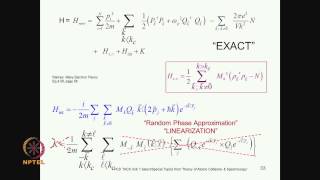
Special - Select Topics in the Theory of Atomic Collisions
Explore quantum collision theory, many-body problems, and advanced scattering concepts. Covers perturbation methods, Feynman diagrams, resonances, and applications in atomic physics.

Chemistry I - Introduction to Quantum Chemistry and Molecular Spectroscopy
Explore quantum chemistry and molecular spectroscopy, covering topics from Bohr's atom to polyatomic vibrations, with a focus on mathematical foundations and practical applications.
Thermodynamics & Kinetics
Comprehensive exploration of chemical thermodynamics and kinetics, covering laws, equilibrium, electrochemistry, and reaction dynamics. Ideal for deepening understanding of fundamental chemical principles.
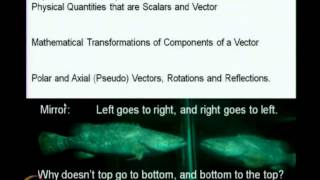
Special - Select Topics in Classical Mechanics
Explore advanced topics in classical mechanics, from equations of motion to chaotic systems. Gain deep insights into oscillators, relativity, fluid dynamics, and electrodynamics.
Special Topics in Classical Mechanics
Comprehensive exploration of advanced classical mechanics topics, including equations of motion, oscillations, relativity, electrodynamics, and chaotic systems.
Quantum Mechanics I
This course is a first-level course in the Dirac’s bra(ket) notation which will set the foundation to take up advanced level courses
Modern Algebra
Explore fundamental concepts and advanced topics in modern algebra through a comprehensive series of lectures by Prof. Manindra Agrawal, covering key principles and applications.
Thermodynamics
Comprehensive exploration of thermodynamic principles, from basic concepts to advanced applications, covering laws, processes, and cycles in engineering systems.
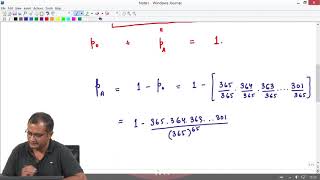
Statistical Mechanics
Comprehensive exploration of probability, statistical ensembles, and quantum mechanics, covering discrete and continuous distributions, entropy, and applications to physical systems.
Quantum Chemistry of Atoms and Molecules
The course introduces students to quantum Chemistry. The syllabus is as follows. Black body radiation. Failure of classical mechanics. Marsden experiment and Rutherford theory. Hydrogen atom spectrum. Bohr Sommerfeld theory. etc.

Combustion
Comprehensive exploration of combustion principles, from chemical reactions and kinetics to flame dynamics, diffusion processes, and advanced topics like turbulent combustion and detonations.

Andrea Wulf on The Invention of Nature - Humboldt's Dangerous Idea
Exploring Humboldt's legacy: interdisciplinary science, ecology, and the interconnectedness of nature. Discusses his influence on modern thought, politics, and the challenges of holistic understanding in an increasingly complex world.
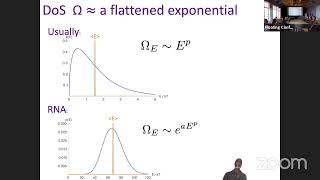
RNA Macrostates and Landscapes
Explore RNA macrostates, scaling of base-pair probabilities, and optimization for protein over-expression. Gain insights into advanced RNA folding concepts beyond minimum free energy structures.

Jonas Dalege on the Physics of Attitudes & Beliefs
Exploring statistical mechanics to understand belief formation and attitude dynamics. Insights into cognitive dissonance, ambivalence, and social interactions through physics-inspired models of opinion networks.

Everything Is a Network, but the Network Is Not Everything - Dynamics of Stage-Structured Food Webs
Explore how stage-structured food web models challenge traditional views on ecological community stability, offering new insights into the relationship between biodiversity and ecosystem resilience.
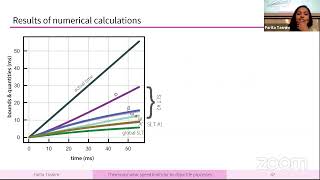
Thermodynamic Speed Limits for Multiple, Coevolving Subsystems
Explore thermodynamic speed limits for coevolving subsystems, focusing on tighter bounds for composite systems and their applications in cell sensing dynamics.