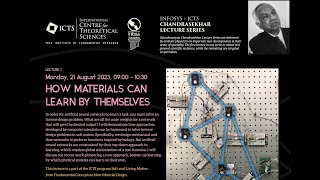
Materials that Learn by Themselves: Fundamental Concepts for New Materials - Lecture 1
Explore how physical systems can learn autonomously through bottom-up approaches, challenging traditional artificial neural networks and solving inverse design problems in soft matter.

Different Types of Motorcycles - Explained
Explore diverse motorcycle types, from cruisers to sport bikes, learning unique features and performance characteristics for various riding styles and preferences.
Liquid Crystals - Lecture 2
Comprehensive exploration of liquid crystal properties, phases, and applications in materials science, focusing on advanced concepts and recent developments in the field.
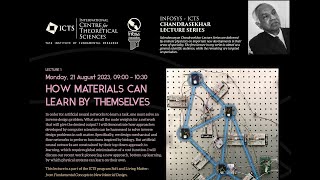
Materials that Learn by Themselves - Fundamental Concepts for New Material Design - Lecture 2
Explore fundamental concepts of self-learning materials, focusing on bottom-up learning approaches in soft matter physics and their applications in designing mechanical and flow networks.
How Motor Arrangement on Cargo Surface Influences Collective Transport by Ambarish Kunwar
Explores how motor protein arrangement on cargo surfaces affects collective transport in cells, examining factors influencing efficiency and coordination in intracellular movement.
Liquid Crystals Fundamental Aspects - Lecture 1
Explore fundamental aspects of liquid crystals, including their unique properties, classifications, and applications in various fields of science and technology.

Drawing Organic Chemistry Condensed Structural Formulas and Skeletal Structures
Learn to draw and convert between organic chemistry structural formulas, including Lewis, condensed, and skeletal structures. Master techniques for both acyclic and cyclic compounds with practice problems.
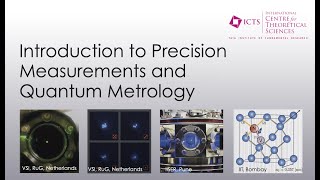
Applications of Atomic Clocks by Tanja Mehlstäubler
Explore cutting-edge applications of atomic clocks in precision measurements and quantum metrology. Discover how these advanced timekeeping devices revolutionize scientific research and technological innovation.

How and Why Earth Went From Purple to Green - Twice
Explore Earth's colorful past, from purple to green, as ancient microbes shaped our planet's appearance. Discover the fascinating evolution of photosynthesis and its impact on Earth's visual history.
Modern Numerical Methods in Computational Relativity - Lecture 5
Explore advanced numerical techniques in computational relativity, focusing on simulating black hole mergers and other high-energy astrophysical phenomena for gravitational-wave astronomy.
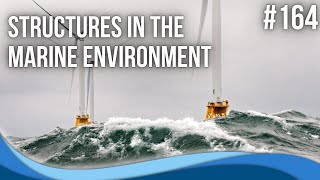
Structures in the Marine Environment
Explore offshore wind energy: environmental considerations, design parameters, and construction of wind turbine generators in open oceans. Learn about foundation types, regulatory aspects, and key engineering challenges.
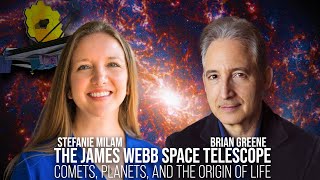
James Webb Space Telescope - Comets, Planets, and the Origin of Life
Explore JWST's groundbreaking discoveries about comets, planets, and Earth's water origins. Join Brian Greene and lead scientist Stefanie Milam for cutting-edge insights into our cosmic neighborhood.
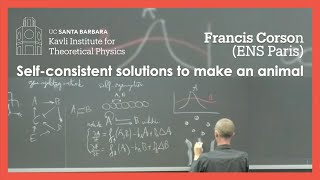
Self-Consistent Solutions to Make an Animal - KITP Blackboard Talk by Francis Corson
Explore self-consistent solutions in animal development through Francis Corson's theoretical physics lecture, bridging biological concepts with mathematical modeling and pattern formation principles.
Large-Scale Ocean Circulation and Climate - Interannual Climate Variability by Anand Gnanadesikan
Explore interannual climate variability and its connection to large-scale ocean circulation. Gain insights into the complex interactions between oceans and climate systems, enhancing understanding of global climate patterns.
The Role of Convection and Turbulence in Melting of Polar Ice-Shelves
Explores convection and turbulence in polar ice-shelf melting, discussing fluid dynamics of oceans and their impact on climate processes. Aimed at students, no prior background required.
The Inconstant Nature of Climate Feedback and Climate Sensitivity by Angshuman Modak
Explore climate feedback mechanisms and sensitivity, examining their variable nature and impact on climate modeling and predictions in this insightful lecture by Angshuman Modak.

Physiology
Comprehensive exploration of human body systems, covering anatomy, physiology, and key processes from cellular to organ level, with focus on homeostasis and clinical applications.
What Has the James Webb Space Telescope Discovered in Its First Year? – With Naomi Rowe-Gurney
Explore the James Webb Space Telescope's groundbreaking discoveries in our Solar System, from Mars to the Kuiper Belt, and learn about its unique capabilities, launch, and future missions in this comprehensive presentation.
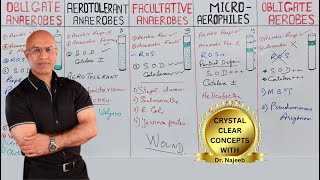
Classification of Bacteria - Aerobes and Anaerobes
Comprehensive exploration of bacterial classification based on oxygen requirements, covering various types from obligate anaerobes to aerobes, with practical applications in microbiology.
The Imaging Story - Black Holes to MRI by Rajaram Nityananda
Explore modern imaging techniques beyond traditional cameras, from medical MRI to radio telescopes. Learn how optics, computation, and statistics revolutionized image creation across various fields.

Quantum to the Cosmos - A Brief Tour of Everything
Join Sean Carroll and Brian Greene for a captivating exploration of the universe, from quantum mechanics to cosmic scales, offering insights into the fundamental nature of reality and our place within it.