Nonequilibrium Response Theory - Lecture 1
Explore nonequilibrium response theory, covering fluctuations, linear response, and the fluctuation-dissipation theorem. Gain insights into equilibrium and dynamic responses in statistical physics.
Motility-Regulation and Self-Organization in Active Matter by Julien Tailleur
Explore self-organization principles in active matter systems, from bacterial colonies to colloids. Learn about motility regulation, quorum sensing, and pattern formation in non-equilibrium physics.
Mesoscopic Aspects of Classical Transport - Lecture 1
Explore mesoscopic aspects of classical transport, covering equilibrium models, time reversal, entropy, and non-equilibrium states. Gain insights into fluctuations in nonequilibrium systems and their applications.
Light and Beyond - Lecture 2: Optical Phenomena and Wave Propagation
Explore advanced concepts in optics, from electromagnetic waves to quantum physics, through lectures, demonstrations, and simulations. Gain insights into optical phenomena in nature and technology.
Light and Beyond - Lecture 1: Introduction to Optics and Geometrical Principles
Explore light as electromagnetic waves, optical phenomena, and underlying concepts through math, experiments, and simulations. Covers geometrical optics, least action principle, and introduces quantum physics.
Physics and Astrophysics of Gamma-Ray Bursts - Part 1
Comprehensive exploration of gamma-ray bursts, covering discovery, observational facts, physics, and astrophysical implications. Delves into prompt emission, afterglows, and theoretical models, providing insights for researchers and students.
Numerical Relativity - Mathematical Formulation by Harald Pfeiffer
Explore mathematical formulation of numerical relativity, focusing on simulating binary black hole coalescence, gravitational waves, and advanced computational techniques in astrophysics.
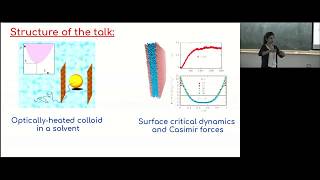
Non-Equilibrium Dynamics of Inhomogeneous Fluids by Sutapa Roy
Explore non-equilibrium dynamics of inhomogeneous fluids, focusing on colloidal particles in binary solvents. Learn about phase transitions, critical points, and phenomena like coalescence, nucleation, and aging.
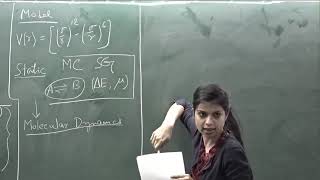
Surface Critical Dynamics and Casimir Forces in a Binary Fluid by Sutapa Roy
Explore critical dynamics and Casimir forces in binary fluids through molecular dynamics simulations, focusing on surface properties, scaling behavior, and correlation functions in confined fluid systems.
Exotic Patterns in Faraday Waves
Explore exotic patterns in Faraday waves through advanced numerical simulations and theoretical analysis. Discover fascinating phenomena like quasipatterns, superlattices, and dynamic pattern evolution in vibrated fluid layers.
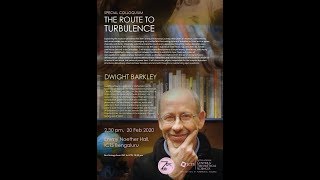
The Route to Turbulence by Dwight Barkley
Explore the fascinating journey to understanding turbulence in shear flows, from historical observations to modern insights on phase transitions, intermittency, and universal scaling laws.
Drift, Inbreeding, and Ne
Explore genetic drift, inbreeding, and effective population size through probability theory, distributions, and evolutionary concepts. Gain insights into population genetics and its applications in evolutionary biology.
Topological Phases of Quantum Matter
Explore topological phases in quantum matter, from quantum Hall effect to topological insulators and superconductors. Learn about edge states, bulk-boundary correspondence, and current frontiers in this fascinating field of physics.
Geometric Phases and the Separation of the World by Michael Berry
Explore geometric phases in physics, from historical discoveries to modern applications. Delve into mathematical foundations, experimental demonstrations, and implications for optics and quantum mechanics.
Modular Theory and Quantum Field Theory - Lecture 1
Explore modular theory in quantum field theory, covering observables, operators, and superselection sectors. Gain insights into correlation functions and state sewing in QFT.
Magnetic Reconnection - Plasmoid Instability in an Experimentally Accessible Regime by Pallavi Bhat
Explore magnetic reconnection and plasmoid instability in the semi-collisional regime, with theoretical and numerical investigations validating its existence at lower, experimentally accessible Lundquist numbers.
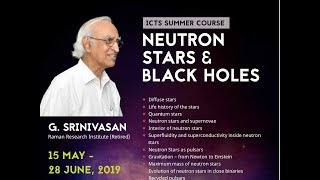
Maximum Mass of Neutron Stars - Lecture 8
Explore the physics of neutron stars, including their maximum mass, equation of state, and exotic internal states. Delve into key concepts like Fermi gas, Bose-Einstein condensation, and gravitational implosion.
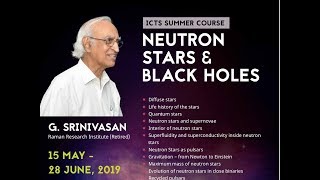
Supernovae and Neutron Stars - Lecture 3
Explore the formation and evolution of neutron stars, supernovae, and their remnants. Delve into stellar physics, cosmic rays, and the violent interstellar medium in this comprehensive lecture.
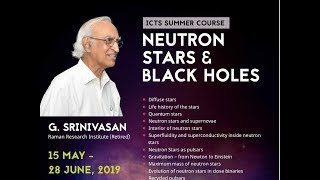
Neutron Stars and Black Holes - Lecture 6: Pulsars and Their Properties
Explore pulsars, neutron stars, and their remarkable properties. Delve into the Crab Nebula's history, pulsar discovery, and radiation mechanisms. Gain insights into magnetospheres and electrodynamics of these fascinating cosmic objects.
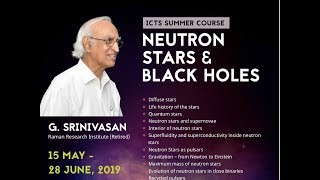
Neutron Stars and Black Holes - Lecture 1: Diffuse Stars
Explore the physics of stars, from their structure and energy production to their lifetimes, in this comprehensive lecture on stellar astrophysics by G Srinivasan.
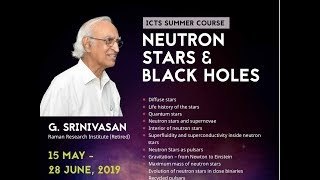
Neutron Stars and Black Holes - Radiation from Relativistic Particles - Lecture 5
Explore radiation from relativistic particles, covering Maxwell's equations, synchrotron radiation, and applications to astrophysical phenomena like pulsars and supernova remnants.