Machine Learning for Determining Protein Structure and Dynamics from Cryo-EM Images
Explore machine learning techniques for analyzing cryo-EM images to determine protein structure and dynamics, focusing on the cryoDRGN algorithm and its applications in structural biology.
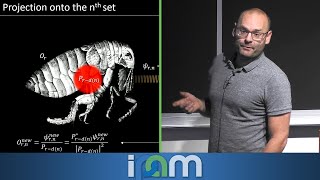
Ptychographic Imaging via Set Projection Algorithms - IPAM at UCLA
Explore ptychographic imaging and set projection algorithms for diffractive imaging, with applications in visible light, X-ray, and electron experiments.
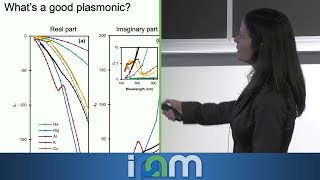
Electron and Optical Microscopy of Magnesium Nanoparticles - IPAM at UCLA
Explore advanced microscopy techniques for analyzing magnesium nanoparticles, including tomography, electron diffraction, and hyperspectral optical spectroscopy, with insights on plasmon resonances and photothermal effects.
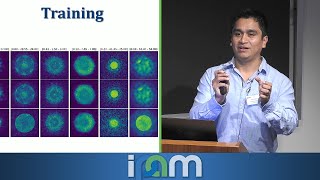
Application of Machine Learning to Electron Microscopy Data - IPAM at UCLA
Explore machine learning applications in electron microscopy, focusing on data modeling and neural networks for distortion compensation in experimental datasets.
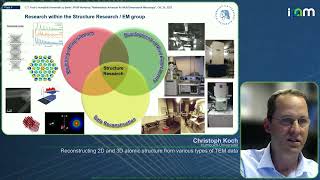
Reconstructing 2D and 3D Atomic Structure From Various Types of TEM Data
Explore advanced techniques for reconstructing atomic structures using transmission electron microscopy data, comparing phase imaging methods and discussing recent experimental results in 2D and 3D materials analysis.

Building the Microscopes of Tomorrow - IPAM at UCLA
Explore cutting-edge microscopy techniques for visualizing nanoscale processes in real-time, enabling advancements in nanotechnology, antimicrobials, and vaccine development.
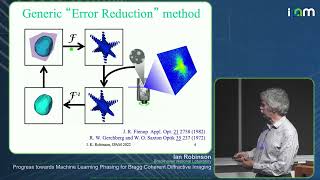
Progress Towards Machine Learning Phasing for Bragg Coherent Diffractive Imaging
Explores machine learning approaches for solving the phase problem in Bragg Coherent Diffractive Imaging, discussing current methods, challenges, and potential ML solutions for 2D and 3D data inversion.
Capturing the First Portrait of Our Milky Way's Black Hole & Beyond
Explore the groundbreaking methods used to capture the first image of Sagittarius A*, our galaxy's central black hole, and future directions in black hole imaging technology.
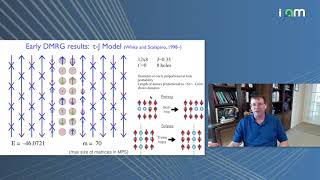
Phase Diagram of the 2D T-T'-J Model
Explore the phase diagram of the 2D t-t'-J model, including novel striped phases and coexistence of pairing and antiferromagnetic order. Gain insights into cuprate physics and superconductivity.
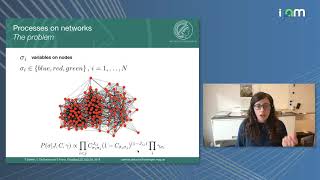
Matrix Product States for Modeling Dynamical Processes on Networks
Explore matrix product states and dynamic message-passing algorithms for modeling network dynamics, reducing computational complexity from exponential to polynomial in system size and duration.
Matrix Product States for Real Materials
Explore recent advances in combining MPS algorithms with DMFT and DFT to study strongly correlated materials, focusing on applications to transition metal and rare earth oxides.
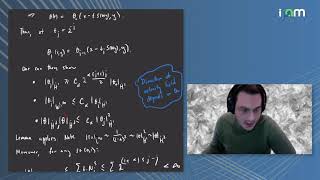
Anomalous Dissipation for Passive Scalars
Explore anomalous dissipation in hydrodynamic turbulence for passive scalars, examining a rough divergence-free velocity field and its connections to scalar turbulence theories and inviscid mixing.
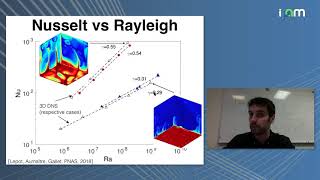
Heat Transport Efficiency Beyond the So-Called 'Ultimate' Regime
Explores innovative approaches to thermal convection, challenging traditional Rayleigh-Bénard models with radiative heating techniques to achieve more efficient heat transport in turbulent flows.
Polymer Partition Functions and the Geometric RSK Correspondence
Explore geometric RSK correspondence, polymer partition functions, and their connections to discrete Gibbs fields in this advanced mathematics lecture by Ivan Corwin.
Nonlinear Reduced Basis Methods and Transport in Electronic Structure Calculation
Explore nonlinear reduced basis methods and optimal transport for efficient electronic structure calculations, focusing on a 1D toy model with potential extensions to larger systems.
Uncertainty-Aware Machine Learning Models of Many-Body Atomic Interactions
Explore symmetry-aware machine learning models for atomic interactions, focusing on E(3)-equivariant neural potentials and Bayesian force fields for improved accuracy in materials modeling.
Peridynamic Fracture Across Scales - Large Scale Computations With Fast Methods
Explore peridynamic modeling for fracture and damage across scales, enabling large-scale computations with fast convolution-based methods. Learn about new approaches to simulating dynamic fracture and corrosion damage.
Density Functional Theory - IPAM at UCLA
Comprehensive exploration of density functional theory, covering advanced concepts and applications in materials science, presented by Prof. Vikram Gavini at IPAM's exascale mathematics workshop.
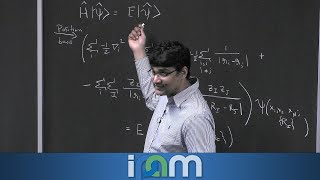
Density Functional Theory - IPAM at UCLA
Comprehensive introduction to density functional theory, exploring its principles and applications in materials science and computational physics.

Go EAST, Young Scientist - First Principles View on Chemical Compound Space
Explore chemical compound space through first principles and machine learning, gaining insights into atomistic and electronic structures for efficient materials discovery and understanding.
Fully Quantum (Bio)Molecular Simulations: Dream or Reality?
Explore the convergence of quantum mechanics and machine learning in molecular simulations, addressing challenges and future developments for complex (bio)molecular systems.