The Relevance of Being Irrelevant - Stefano Negro
Explore the concept of irrelevance in integrable models across mathematical physics, condensed-matter physics, and string theory. Gain insights into recent advances and their implications for various fields.
Tilting the Cusp Anomalous Dimension in Planar N=4 SYM - Lance Dixon
Explore cutting-edge research on planar N=4 SYM scattering, focusing on the cusp anomalous dimension and its connections to integrable models in theoretical physics.
Non-Equilibrium Green's Function Method for Energy, Momentum, and Angular Momentum Transfer Mediated by Photons
Explores non-equilibrium Green's function method for energy, momentum, and angular momentum transfer via photons, covering applications in graphene, nanotubes, and molecular systems.
Casimir Force Between Weyl Semimetals in a Chiral Medium - Maria Belen Farias
Explores Casimir force between Weyl semimetals in chiral media, discussing electrodynamics, current materials, reflection matrices, and results. Offers insights into quantum electrodynamic fluctuations and their implications.
Effect of the Optical Response of Nanostructured Materials - Victoria Esteso Carrizo
Explores nanostructured materials' optical response and its impact on Casimir-Lifshitz force, covering multilayer structures, absorption, and interference effects in quantum electrodynamics.
Polarized Thermal Emission from Metamaterials Described by Stokes Parameters Based on Fluctuational Electrodynamics - Zhuomin Zhang
Explore polarized thermal emission from metamaterials using Stokes parameters and fluctuational electrodynamics, with focus on optical properties, near-field heat transfer, and novel 2D materials.
Cost-Effective Multifunctional Photonic Metamaterial for Energy Applications - Yi Zheng
Explores cost-effective photonic metamaterials for energy applications, focusing on passive cooling, solar-driven water evaporation, and high-temperature stability in various materials and systems.
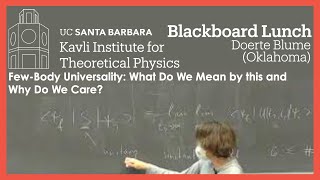
Few-Body Universality - What Do We Mean by This and Why Do We Care?
Explore few-body universality in physics, its significance, and applications. Uncover unitary interactions, scaling laws, and universal numbers in quantum systems across different fields.
DMRG Description of the Island of Inversion Isotopes 28-33F - Kevin Fossez
Explore low-energy nuclear physics, focusing on the island of inversion isotopes 28-33F. Learn about nuclear stability, emergent phenomena, and advanced theoretical methods like DMRG.
Nuclear Structure Effects in Muonic Atoms - Sonia Bacca
Explore nuclear structure effects in muonic atoms, focusing on experimental investigations, calculations, and the proton radius puzzle. Gain insights into few-body physics and its applications across scientific disciplines.
Probing Open Quantum Systems with Open Questions Using Rare Isotopes Along the Dripline at High Energies - Paul Gueye
Explore open quantum systems and rare isotopes at high energies, focusing on few-body physics near unitarity. Discover insights from atomic and nuclear physics with cross-disciplinary applications.
Universal Clusters and Crystalline Correlation in Mass-Balanced Fermion Mixtures - Xiaoling Cui
Explore universal clusters and crystalline correlations in mass-balanced fermionic mixtures, examining bound states, angular momentum, and phase transitions in few-body physics.
Short Range Correlations in Nuclear Physics - Nir Barnea
Explore short-range correlations in nuclear physics, focusing on lambda particles, bionic EFT, and charge symmetry breaking. Gain insights into methodology, applications, and experimental data analysis.
Boson Droplets Close to the Unitary Limit - Mario Gattobigio
Explore Boson droplets near unitarity, examining free-body parameters, effective range expansion, binding energy, and related concepts in few-body physics. Insights from atomic and nuclear physics perspectives.
Helium Dimers and Trimers - From Imaging of Structure to Movies of Ultrafast Dynamics - Reinhard Dorner
Exploring helium dimers and trimers: from structural imaging to ultrafast dynamics visualization, focusing on few-body physics near unitarity and its implications across various scientific disciplines.
Bosons and Multi-Component Fermions Near Unitarity - Ubirajara van Kolck
Explore bosons and multi-component fermions near unitarity, focusing on few-body physics challenges in atomic and nuclear systems, with insights on universality and organizing principles.
Gas-Embedded Binaries - A Link Between Stars, Black Holes and Gravitational Waves - Lucio Mayer
Explore the connection between gas-embedded binaries, stellar evolution, and gravitational waves. Gain insights into supermassive black holes and merging binaries in this comprehensive lecture.
What is Love? New Physics at the State of the Art with Spins - Michèle Levi
Explore gravitational wave modeling and its impact on physics, connecting field theory, relativity, and scattering amplitudes. Learn about emerging tools and techniques for next-gen experiments.
Twistor Amplitudes - Alfredo Guevara - Harvard
Exploring twistor amplitudes in gravitational wave modeling, connecting field theory and classical relativity to advance precision in gravitational wave signal interpretation and new physics searches.
Circumbinary Disks Across Different Scales - Roman Rafikov
Explores circumbinary disks across stellar and black hole binary systems, discussing gas evolution, observational signatures, and numerical modeling techniques to understand these complex astrophysical phenomena.
Orbital Evolution I - Selma De Mink, Sophie Schroder
Explore orbital evolution in binary systems, from stars to black holes. Learn about circumbinary gas, observational signatures, and numerical modeling techniques across astrophysical scales.