Heegaard Branes and Exact Results for Non-perturbative Complex Chern-Simons Theory
Explore Heegaard branes in moduli spaces of Higgs bundles and their applications in mathematics, from geometric Langlands to low-dimensional topology and complex Chern-Simons theory.
Holomorphic Floer Theory and Resurgence - Lecture 3
Explore holomorphic Floer theory and its connection to resurgence, examining the Riemann-Hilbert correspondence and its implications for perturbative expansions in mathematics and physics.
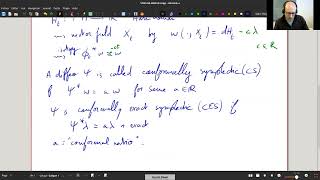
A Higher Dimensional Generalization of the Birkhoff Attractor
Explore higher-dimensional generalizations of the Birkhoff attractor using spectral metrics for conformal symplectic maps and damped Hamiltonian systems.
Multiscale Methods for High-Contrast Heterogeneous Sign-Changing Problems
Explore multiscale methods for high-contrast heterogeneous sign-changing problems, focusing on CEM-GMsFEM tailored for these scenarios. Learn about numerical effectiveness and error estimation.
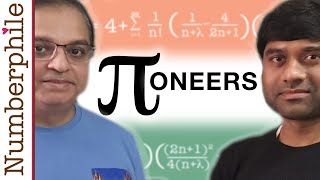
New Pi Formula Discovery - Interview with Sinha and Saha
Interview with physicists who discovered a new formula for Pi, discussing their groundbreaking research and its implications for mathematics and physics. Insights into the process of scientific discovery and collaboration.
Spontaneous Stochasticity in Multi-Scale Dynamics
Explore spontaneous stochasticity in multi-scale dynamics, focusing on turbulence models and the formalization of stochastic solutions using renormalization-group operator attractors.
Construction of Invariant Measures for 2D Euler and Slow Growth of Sobolev Norms
Explore the growth of Sobolev norms in 2D Euler equations, examining invariant measures and their impact on solution behavior in highly regular spaces.
Enumerative Geometry Through Sheaves
Explore enumerative geometry, sheaf counting, and their applications in algebraic geometry. Discover new approaches to generalized Donaldson-Thomas invariants on Calabi-Yau threefolds.
Real Loci of Non-Real Varieties - Mathematics Department Colloquium
Explore cooriented submanifolds in real algebraic geometry, focusing on their properties, intersections, and linking numbers. Gain insights into the geometry of pencils and real projective spaces.
Towards a Mathematical Theory of 3D Mirror Symmetry
Explore the mathematical implications of 3D mirror symmetry, connecting quantum field theory dualities to algebraic geometry and symplectic topology. Uncover links to geometric Langlands and symplectic duality.

The Formulation of the Navier-Stokes Equations on Riemannian Manifolds
Explore advanced formulations of Navier-Stokes equations on Riemannian manifolds, focusing on Ebin and Marsden's approach and recent developments in this complex field of fluid dynamics.
On the Applications of Topology
Explore topological methods for analyzing complex data sets, focusing on persistent homology and mapper, with applications in computer vision, biology, and medicine.

ME3255 - Quantitative Descriptions on Monte Carlo Models
Explore Monte Carlo models through quantitative descriptions, enhancing understanding of statistical simulation techniques and their applications in engineering and science.

ME3255 - Building Moore's Prediction and Using Monte Carlo Buckling Analysis
Explore Moore's prediction and Monte Carlo buckling analysis techniques for advanced engineering applications. Enhance structural design skills.
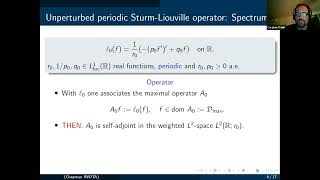
Perturbations of Periodic Sturm-Liouville Operators
Explore perturbations of periodic Sturm-Liouville operators, focusing on Hill's equation and its applications in crystal physics. Analyze spectral changes under L1-assumptions and finite first moment conditions.
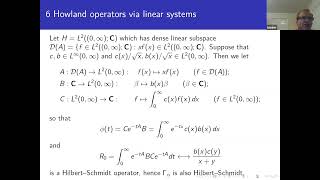
Linear Systems and Differential Equations in Random Matrix Theory
Explore linear systems and differential equations in random matrix theory, focusing on solving nonlinear equations using Hankel operators, Fredholm determinants, and tau functions.
Beauty of Life Seen Through Keyhole of Mathematics - Lecture 2
Explore molecular structures, mathematical thought in genetics, and the nature of life through a mathematical lens. Discuss bioengineering's future and human impact on Earth's ecology.
Beauty of Life Seen Through Keyhole of Mathematics - Part 1
Explore the intersection of mathematics and biology, from molecular structures to ecological impact, in this thought-provoking lecture on life's fundamental nature.
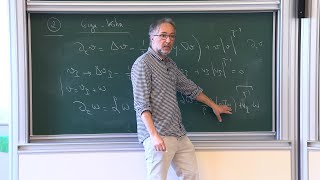
An Introduction to Super Critical Singularities - Lecture 4: Stability of Implosion
Explore advanced concepts in non-linear PDE singularities, focusing on defocusing problems and their connection to fluid mechanics. Gain insights into key results, open problems, and proof techniques.
An Introduction to Super Critical Singularities - Lecture 3: On Self Similar Solutions for Compressible Euler
Explore self-similar solutions for compressible Euler equations and their role in singularity formation for non-linear PDEs, with connections to fluid mechanics.
An Introduction to Super Critical Singularities - Lecture 2: Front Singularities
Explore front singularities in non-linear PDEs, focusing on defocusing problems and their connection to fluid mechanics. Gain insights into key results, open problems, and proof techniques.