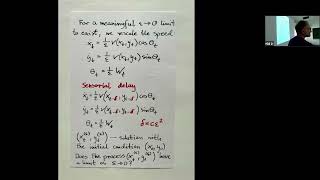
Exploring a Terrain with Random Direction Changes
Explore stochastic modeling of an explorer's movement in inhomogeneous environments, analyzing delay equations and their implications for swarm behavior and aggregation transitions.

Christoffel Symbols, Curvature, and Riemann Tensor - Lecture 8
Zgłęb zaawansowane koncepcje geometrii różniczkowej, w tym symbole Christoffela, krzywiznę i tensor Riemanna. Poznaj ich właściwości algebraiczne i zastosowania w fizyce teoretycznej.

Levi-Civita Connection, Christoffel Symbols, and Geodesics - Lecture 7
Explore advanced concepts in differential geometry, including Levi-Civita connections, Christoffel symbols, and geodesics. Delve into covariant derivatives, parallel transport, and variational principles in this graduate-level lecture.
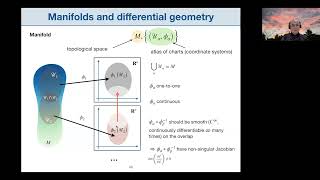
Manifolds, Coordinates and Tensors - Lecture 5
Explore manifolds, coordinates, and tensors in this graduate-level physics lecture, covering key concepts and transformations for advanced theoretical understanding.

Hyperbolic versus Elliptic Equations and Electromagnetic Field as 4D-Differential Two-Form - Lecture 9
Explore hyperbolic and elliptic equations, differential geometric notation, and electromagnetic fields as 4D-differential two-forms in this advanced theoretical physics lecture.

Affine and Euclidean Geometry - The Modern Approach
Explore modern approaches to affine and Euclidean geometry, with applications to electrodynamics and relativity theory in this advanced physics lecture.
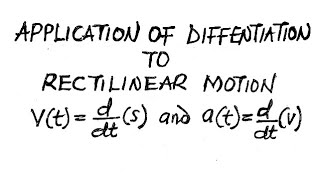
Application of Derivatives to Rectilinear Motion - Differentiation
Explore differentiation's role in solving rectilinear motion problems, enhancing your calculus skills and problem-solving abilities.
Mathematical Modelling of Clonal Dynamics of Acute Myeloid Leukemia: Model-Based Approach to Understand Within-Tumour Heterogeneity
Explore mathematical models of acute myeloid leukemia's clonal dynamics to understand tumor heterogeneity using a model-based approach.
Mathematical Models and Tools for Personalized Medicine
Explore mathematical models for personalized medicine, focusing on glioblastoma and immunotherapy. Learn how these tools aid in optimizing individual cancer treatments and predicting tumor evolution.
Quantitative Modeling of Metastasis: Cancer at the Organism Scale
Explore mathematical models for metastasis development, including spontaneous spread, tumor interactions, and therapy effects. Gain insights into predictive tools for personalized oncology.
A Fluid-Based Model for Single-Cell Migration
Explore a deterministic model of single-cell migration using fluid dynamics and molecular interactions. Analyze static and motile behaviors through mathematical and numerical approaches.
Microtubules as a Key Target in Oncology: Mathematical Modeling of Anti-MT Agents on Cell Migration
Explore mathematical modeling of microtubule-targeted agents in cancer cell migration. Gain insights into anti-migratory effects and potential therapeutic applications through fluid-based simulations.

Operads and the Blob Complex in Topological Quantum Field Theory
Explorez la théorie des opérades et le complexe blob en TQFT, en examinant la résolution de barre opéradique et les catégories opéradiques unaires.
The Extremal Point Process of Branching Brownian Motion in Rd
Explore the behavior of particles in multidimensional branching Brownian motion, focusing on extremal points and their distribution over time.
Time-Reversal of the Spine of Branching Processes Near Stationarity
Explore homogenization in time-reversed spine processes for branching processes approximating PDEs at stationarity, with focus on biological applications.
Front Initiation in Continuous Neural Fields
Explore front initiation mechanisms in continuous neural fields, examining mathematical models and their applications in neuroscience and cognitive science.
Fluctuation Limits for Mean-Field Interacting Nonlinear Hawkes Processes
Explore fluctuation limits in mean-field interacting nonlinear Hawkes processes, delving into advanced mathematical concepts and their applications.
Graph Rules and Topological Insights for Inhibitory Network Dynamics
Explore graph rules and topological insights for inhibitory network dynamics, uncovering mathematical principles behind neural networks.
Maximally Predictive Ensemble Dynamics from Data
Explore maximally predictive ensemble dynamics, uncovering data-driven insights for complex system analysis and forecasting.
Marked Point Process Modeling and Estimation Problems in Neural Data Analysis
Explore marked point process modeling and estimation techniques for analyzing neural data, focusing on advanced statistical approaches in neuroscience research.
Mathematical Models of Electroporation Validated on Medical Data
Explore mathematical models of electroporation, focusing on medical data validation. Learn to evaluate treatments using numerical simulations and data assimilation strategies.