Cubic and Non-cubic Dirac Operators - Applications in Algebraic and Differential Geometry
Explore algebraic Dirac operators, their cohomology, and applications in differential geometry. Delve into Vogan's construction and its generalizations.

Graphs in the Modern World: Analyzing Infectious Disease Dynamics
Explore graph-based models for analyzing infectious diseases, from deterministic compartmental models to agent-based simulations in modern epidemiology.
Finite Fields and Their Applications
Explore new Mathematica 13.3 features for finite field computations, including arithmetic, mappings, and polynomials. Learn about upcoming linear algebra and equation solving capabilities.

Integral Transforms through Mellin-Barnes Integration
Explore special functions, Mellin-Barnes integration, and integral transforms using advanced computational techniques for math and physical science applications.
Nutrients by the Numbers - Statistical Analysis of Food and Nutrient Data
Explore statistical analysis of food and nutrient data relationships, visualize distributions through informative plots and histograms with Gay Wilson.
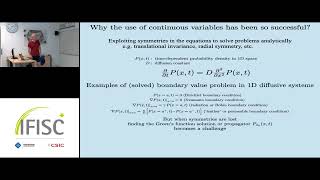
Resolution of a Hundred Year Old Problem on Lattice Random Walks and Its Application to Study Inelastic Collisions
Explore a century-old lattice random walk problem and its implications for inefficient diffusion in complex systems.
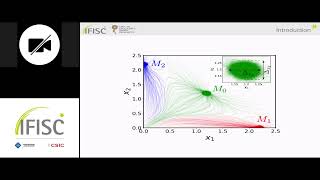
Generation of Stochastic Trajectories - Applications to Complex Systems
Explore stochastic trajectory generation and its applications in complex systems, focusing on interdisciplinary physics concepts and advanced modeling techniques.
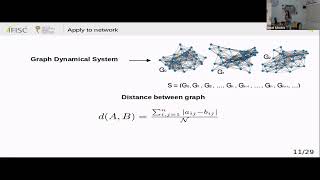
Maximum Lyapunov Exponent for Temporal Networks
Explore the Maximum Lyapunov Exponent concept in temporal networks, delving into complex systems analysis and network dynamics.
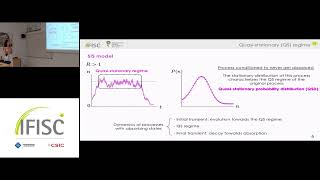
Numerical Methods for Quasi-Stationary Distributions
Explore numerical techniques for calculating quasi-stationary distributions in complex systems, enhancing understanding of long-term behavior in stochastic processes.
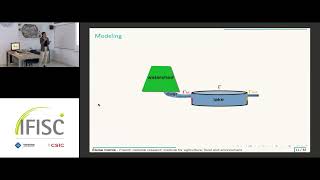
Optimal Control of Lake Eutrophication
Explore strategies for managing lake ecosystems, focusing on controlling eutrophication through mathematical modeling and optimal control theory techniques.
A Tutorial on Causal Representation Learning
Explore Causal Representation Learning: combining machine learning with causal assumptions to identify causal variables from low-level data. Gain insights into core problems and future directions in scientific discovery.
Identifiability of Causal Models and Applications to Perturb-Seq Data
Explore causal model identifiability, structure learning, and applications to Perturb-seq data. Delve into interventions, latent variables, and causal disentanglement for advancing AI in drug discovery.
Likelihood Training of Schrödinger Bridge Using Forward-Backward SDEs Theory
Explore likelihood training of Schrödinger Bridge using Forward-Backward SDEs theory for deep generative modeling, offering mathematical flexibility and optimization principles.
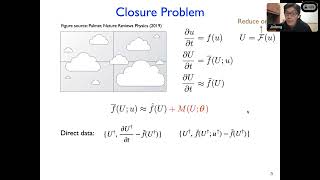
Data-Driven Closure Modeling Using Derivative-free Kalman Methods
Explore data-driven closure modeling for complex dynamical systems using derivative-free Kalman methods. Learn to improve predictions in turbulence and cloud dynamics with advanced machine learning techniques.
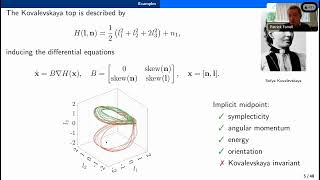
Designing Conservative and Accurately Dissipative Numerical Integrators in Time
Explore innovative framework for structure-preserving time steppers using finite elements and auxiliary variables. Discover applications in Kepler, Kovalevskaya, Navier-Stokes, and Benjamin-Bona-Mahony problems.
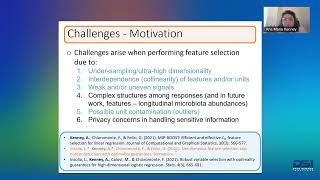
Simultaneous Feature Selection and Outlier Detection Using Mixed-Integer Programming
Explore mixed-integer programming for simultaneous feature selection and outlier detection in high-dimensional regressions, with applications to biomedical research and microbiome studies.
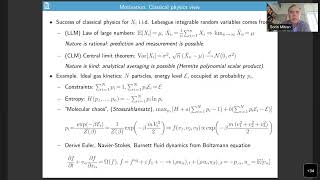
Data-Driven Information Geometry Approach to Stochastic Model Reduction
Explore data-driven information geometry for stochastic model reduction, extending least squares to curved statistical manifolds. Learn adaptive computation techniques for rapidly varying stochastic phenomena.
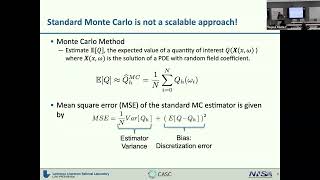
Uncertainty Quantification, Software Ecosystems, and Infrastructure Resilience - Technical Talk
Explore uncertainty quantification, exascale software ecosystems, and infrastructure resilience in this technical talk by Sarah Osborn at WiDS Livermore 2024.
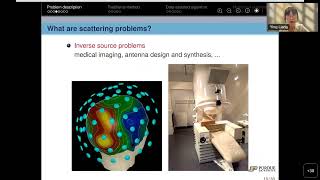
Data-assisted Algorithms for Inverse Random Source Scattering Problems - DDPS
Explore data-assisted algorithms for inverse random source scattering problems, enhancing reconstruction accuracy with fewer realizations and comparing performance of various data-driven methods.

Topological Perspectives on Networks
Explore algebraic topology tools for network analysis, focusing on their application in neuroscience to understand structure-function relationships.

Topological Perspectives on Networks
Explore algebraic topology tools for network analysis, focusing on their application in neuroscience to understand structure-function relationships.