Geometric Objects Associated to Planar Bipartite Graphs
Explore topological and geometric data associated with planar bipartite graphs, including knots, cluster varieties, and critical varieties, and their interconnections.
Planar Site Percolation via Tree Embeddings
Explore planar site percolation and tree embeddings in infinite graphs. Discover novel proofs for Bernoulli percolation and confirm a 1996 conjecture by Benjamini and Schramm.
Limit Shapes for Random Young Tableaux via Determinantal Point Processes
Explore limit shapes for random Young tableaux using determinantal point processes. Discover new insights on limiting surfaces for multirectangular shapes, including potential discontinuities.
Scaling Exponents in Stationary Random Graphs
Explore scaling exponents in stationary random graphs, examining relationships between fractal dimension, walk dimension, resistance, spectral dimension, and extremal growth in statistical physics.
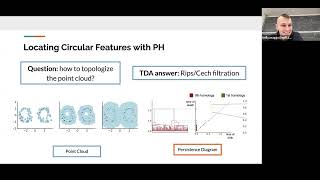
Cohomology Classes in the RNA Transcriptome
Explore how cohomology classes in single-cell sequencing data can model transient biological processes, using persistent cohomology and differential forms to infer gene expression dynamics.
Branching Random Walks on Zd for d ≥ 4 - Excess Folding and Branching Capacity
Explore estimates for excess folding in Branching Random Walks and the role of branching capacity in higher dimensions, presented by Amine Asselah at IPAM's Statistical Mechanics Workshop.
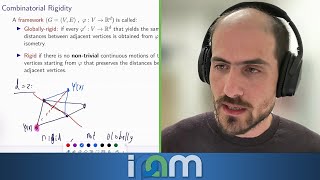
Sharp Threshold for Rigidity of Random Graphs
Explore the evolution of random graphs and discover key moments when they become rigid and globally rigid, with implications for vertex embedding and distance preservation.
Cutoff for Biased Transpositions in Card Shuffling
Explore card shuffling algorithms and mixing times with biased transpositions, extending Diaconis and Shahshahani's work on random transpositions in deck shuffling.
Minkowski Content of the Scaling Limit of 3D Loop-Erased Random Walk
Explores Minkowski content of 3D loop-erased random walk's scaling limit, focusing on discrete space analysis, one-point function estimates, and ball-hitting probabilities in Z^3.
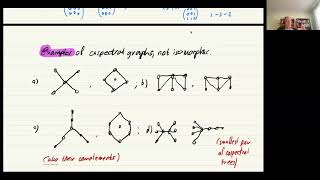
Algebraic Graph Theory and Quantum Computing - Lecture 8
Explore the intersection of algebraic graph theory and quantum computing, delving into advanced mathematical concepts and their applications in quantum information science.
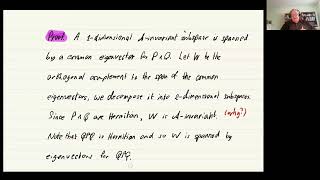
Algebraic Graph Theory and Quantum Computing - Lecture 19
Explore the intersection of algebraic graph theory and quantum computing, uncovering mathematical connections and potential applications in quantum information science.
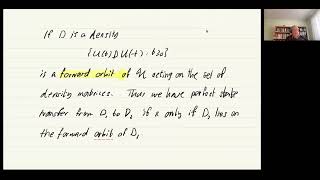
Algebraic Graph Theory and Quantum Computing - Lecture 16
Explore connections between algebraic graph theory and quantum computing, examining mathematical concepts and their applications in quantum information science.
Linear Algebra - Part I
Explore fundamental concepts of linear algebra, including vector spaces, matrices, and linear transformations, laying the groundwork for advanced mathematical applications.
Random Aggregation on the Complex Plane and the Hastings-Levitov Models
Explore random aggregation on complex planes through ALE models, including Hastings-Levitov models. Discover scaling limits, fluctuations, and connections to fundamental discrete models in statistical mechanics.
Homological Percolation in a Torus
Explore homological percolation on tori, examining phase transitions in higher dimensions using algebraic topology. Discover new perspectives on percolation beyond traditional giant components.
Linear Algebra II
Explore advanced linear algebra concepts and their applications in data analysis, machine learning, and scientific computing. Enhance problem-solving skills and mathematical reasoning.
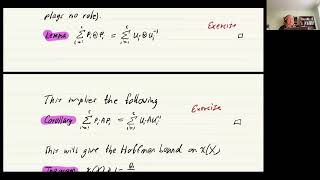
Algebraic Graph Theory and Quantum Computing - Lecture 25
Explore the intersection of algebraic graph theory and quantum computing, delving into advanced mathematical concepts and their applications in quantum information science.
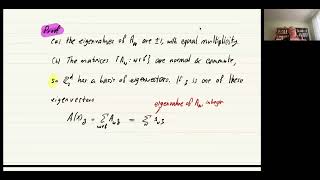
Algebraic Graph Theory and Quantum Computing - Lecture 12
Explore connections between algebraic graph theory and quantum computing, delving into mathematical concepts that bridge these fields and their practical applications.

Global Asymptotics of Jack-Deformed Random Young Diagrams via Lukasiewicz Paths
Explores discrete analogues of log-gas systems, examining universal formulas for global asymptotics in various temperature regimes, using weighted lattice paths and revealing phase transition phenomena.
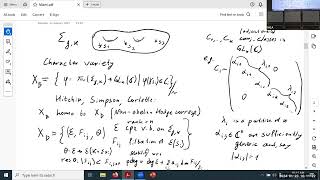
Cohomology Rings of Character Varieties
Explore cohomology rings of character varieties, including P=W conjecture proof and zero-dimensional COHA computation. Discover connections to Hilbert scheme of C^2 for punctured sphere case.
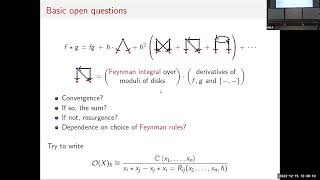
Hodge Theory for Poisson Varieties and Nonperturbative Quantization
Explore Hodge theory for Poisson varieties and nonperturbative quantization, focusing on K-theory and mixed Hodge structures to simplify complex calculations in deformation quantization.