Promoting Global Stability in Models of Quadratic Nonlinear Dynamic
Explore innovative algorithm for identifying globally stable fluid and plasma flow models, featuring presentation and Q&A on recent research in nonlinear dynamics and vortex shedding.
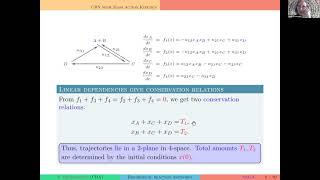
Families of Polynomials in Biochemical Reaction Networks
Exploring polynomial systems in biochemical reaction networks, focusing on computational techniques for analyzing families of polynomials with combinatorial structures derived from reaction digraphs.
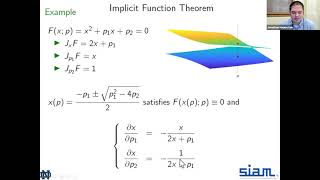
Applications of Homotopy Continuation in Science and Engineering
Explore homotopy continuation in numerical algebraic geometry and its applications in chemistry, mechanical engineering, and biological modeling. Learn about tracking solutions to parameterized nonlinear equations.
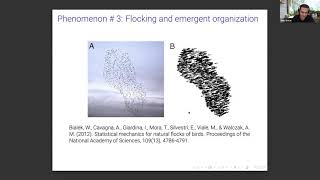
Comprehensive Fluids, Entropy Hierarchies, and Flocking - SIAM PDE Seminar
Exploring compressible fluid equations, entropy hierarchies, and flocking dynamics. Covers Navier-Stokes models, nonlocal collective dynamics, and mathematical proofs for fluid behavior and emergent organization.
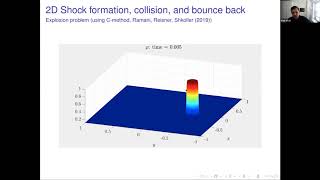
Shock Formation and Vorticity Creation for Compressible Euler
Exploration of shock formation and vorticity creation in compressible Euler equations, featuring constructive proofs, self-similar variables, and analysis of singularities in multiple dimensions.
Mathematics in Computer Animation - Pixar's Approach
Pixar engineer explores mathematical techniques behind computer-animated effects, including dynamic simulations for clothing, hair, and 3D interactive animation, showcasing real-world applications in film production.
New Frontiers in Topology: Multilevel Systems and Out-of-Equilibrium Dynamics - Lecture 2
Explore advanced topology concepts in multilevel systems and out-of-equilibrium phenomena. Delve into complex theoretical physics and gain insights from cutting-edge research in this field.
Introduction to Theory and Numerics of Partial Differential Equations - Lecture 5
Explore numerical methods for solving partial differential equations, focusing on techniques essential for gravitational wave astronomy and computational relativity.
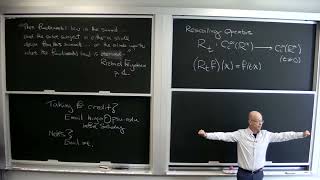
Graduate Course on the Tangent Groupoid in Noncommutative Geometry - Lecture 2
Explore advanced concepts in noncommutative geometry, focusing on the tangent groupoid and its applications in mathematical physics and operator algebras.
What Can Categorical Local Langlands Do for You?
Explore conjectures linking categorical and classical local Langlands correspondences, examining their relationships and current understanding in this advanced mathematics lecture.
Tony Feng- A New Approach to Breuil-Mezard Cycles
Explore a novel local and group-theoretic approach to the Breuil-Mezard Conjecture, connecting it to quantum groups and homological mirror symmetry in algebraic number theory.

Introduction to Theory and Numerics of Partial Differential Equations - Lecture 2
Explore numerical methods for solving partial differential equations, focusing on techniques essential for gravitational wave astronomy and computational relativity.
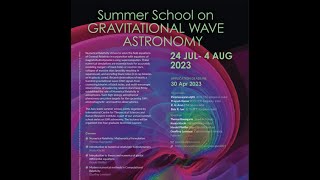
Introduction to Theory and Numerics of Partial Differential Equations - Lecture 3
Explore numerical methods for solving partial differential equations, focusing on techniques essential for gravitational wave astronomy and computational relativity.
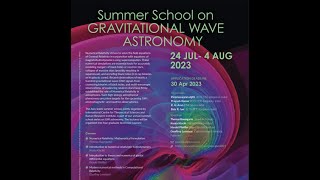
Introduction to Theory and Numerics of Partial Differential Equations - Lecture 1
Explore fundamental concepts and numerical techniques for solving partial differential equations, essential for modeling complex physical phenomena in gravitational-wave astronomy and astrophysics.
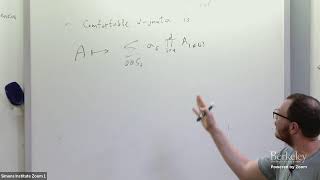
Product Mixing, Quantum Separation, and Comfortable Juntas
Explores product mixing in special unitary groups, solving Gowers' problem and its applications in quantum communication, with sharp results on subset distributions in SU_n.
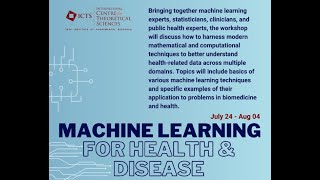
Survival Analysis of Cancer Patients Using Machine Learning Technique by Shakuntala Baichoo
Explore machine learning techniques for survival analysis of cancer patients, focusing on predicting outcomes and analyzing clinical data to enhance patient care and treatment strategies.

Statistics for Data Analysis with Exercises - Lecture 3
Explore advanced statistical methods for data analysis in high-energy physics, focusing on practical applications and exercises to enhance understanding and skills in this specialized field.
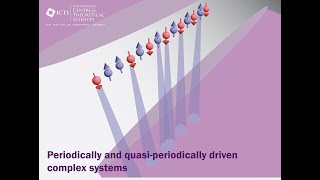
Quasi-Crystals, Fractals, and Other Beauties by Cristiane Morais Smith
Explore quasi-crystals, fractals, and related mathematical structures in this lecture by Cristiane Morais Smith, delving into their fascinating properties and applications in physics and beyond.
Chaos Theory and Geometry - Can They Predict Our World? With Tim Palmer
Explore chaos theory's geometry to predict uncertain phenomena like weather, pandemics, and quantum physics. Discover insights into the universe and ourselves through fractal patterns and probabilistic approaches.
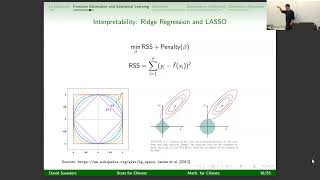
Statistics for Complex Climate Problems
Explore statistical approaches for addressing complex climate issues, focusing on advanced techniques and their applications in environmental research and policy-making.
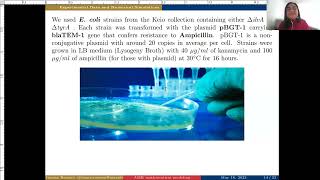
Mathematical Modeling of AMR in Complex Microbial Communities
Explore mathematical approaches to model antimicrobial resistance in complex microbial ecosystems, focusing on advanced techniques and their applications in public health.