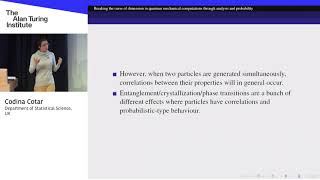
Breaking the Curse of Dimension in Quantum Mechanical Computations Through Analysis and Probability
Explore quantum mechanical computations, focusing on breaking dimensional constraints through analysis and probability. Learn about density functional theory and recent approaches to tackle existing issues.
Data Science and Data System - Dr. Amy Braveman, NASA Jet Propulsion Laboratory
Explore NASA's Earth observation data systems, statistical challenges in climate science, and innovative approaches to analyzing complex environmental datasets.
Is There a Post-Pandemic AI Panacea
Exploring AI's limited impact on pandemic response, challenges in health data science, and lessons from COVID-19. Experts discuss AI strengths, weaknesses, and future potential in healthcare.
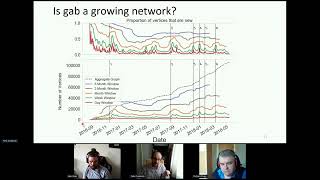
AIUK 2022 Workshop - Raphtory: Real-Time Graph Analytics
Explore real-time graph analytics with Raphtory, covering social networks, time-based graphs, and advanced features like historical properties and query languages.
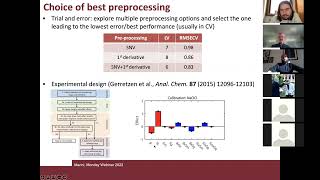
Preprocessing Revisited
Explore new developments in chemometric preprocessing, including multi-block strategies and Variable Sorting for Normalization, to reduce unwanted variability in experimental data.

What Is Time - Professor Sean Carroll Explains Presentism and Eternalism
Explore the nature of time through presentism and eternalism, examining scientific experiments, philosophical concepts, and thought experiments to understand our perception of past, present, and future.

Great Utopian and Dystopian Works of Literature - The Great Courses
Explore H.G. Wells' influence on science fiction and utopian literature, examining key themes like time travel, evolution, and the role of scientists in shaping societal visions.

How to Evaluate Science and Health News - Fighting Misinformation
Learn to critically evaluate science and health news, understand the scientific method, and identify misinformation. Develop skills to assess validity in scientific journalism and navigate the challenges of social media information.

What Does It Mean to Die - Technology and Death
Explore how technology reshapes our understanding of mortality, from social media's digital afterlife to brain transplants, challenging traditional notions of life, death, and the pursuit of immortality.

How Occam's Razor Changed the World of Science - With Johnjoe McFadden
Explore how William of Occam's principle of simplicity revolutionized scientific thinking, from medieval metaphysics to modern physics, and its enduring impact on problem-solving across disciplines.
A Series of Fortunate Events – With Sean B. Carroll
Explore the profound impact of chance on life's evolution and diversity. Sean B. Carroll reveals how random events shape our world, challenging traditional views on purpose and design in nature.
How to Think About Feelings – With Leonard Mlodinow
Explore the science behind emotions, their evolutionary purpose, and their impact on success. Learn about emotional intelligence and techniques for emotional regulation.

What Can Science Tell Us About Dogs? - With Jules Howard
Explore the fascinating world of canine cognition, emotions, and behavior through scientific research, historical studies, and modern discoveries in this engaging zoological lecture.

Why Is It So Hard to Control Your Impulses?
Explore the science behind aggressive behavior, its predictors, and the role of self-control in violence. Learn proven strategies to build impulse control and reduce anger in various contexts.

Dune - The Science of Science Fiction
Explore the ecological concepts and scientific foundations behind Frank Herbert's Dune, examining its unique planetary ecosystem, the spice melange, and its connections to real-world environmental theories and challenges.

Mind-Body Philosophy of the East and West - Spiritual Dualism in the History of Thought
Explore the historical evolution of the soul concept in Eastern and Western thought, from ancient Greek philosophy to modern psychology, and its gradual dismissal in contemporary science.

How to Find Your "Aha!" Moment - The Science of Inspiration
Discover the science behind "Eureka!" moments, explore problem-solving methods, and learn how to tap into your subconscious for creative solutions. Unlock your inner genius and enrich your life through creativity.
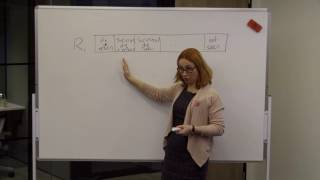
Data Science Applications - Environment/Ecology
Explore statistical modeling techniques for ecological data, focusing on hidden Markov models, Bayesian inference, and capture-recapture methods. Learn to analyze and interpret complex environmental datasets.
Can Data Make a Medicine? - With Patrick Vallance
Explore how real-time data and open-source information revolutionize medicine development, from identifying molecules to conducting clinical trials and improving patient care.
Alok Jha - Science and the Media - Discussion
Explore the dynamic between scientists and journalists in science communication through an engaging panel discussion led by Dr Alice Bell at the Royal Institution.
Black Scientists - Past, Present and Future
Panel discussion exploring diversity in science, focusing on Black scientists' contributions, challenges, and the impact of representation on research and society.