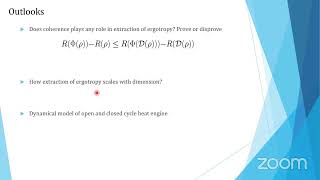
Extraction of Ergotropy: Free Energy Bound and Application to Open Cycle Engines
Explore ergotropy extraction in microscopic systems, its fundamental bounds, and applications to open-cycle heat engines. Gain insights into thermodynamics at the quantum scale.
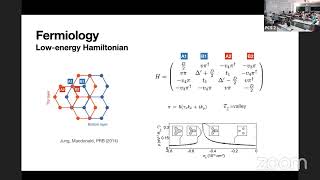
Superconductivity from Repulsive Interactions in Bernal Bilayer Graphene
Explore superconductivity in Bernal-stacked bilayer graphene, examining its emergence under specific conditions and the underlying electronic instability mechanism.
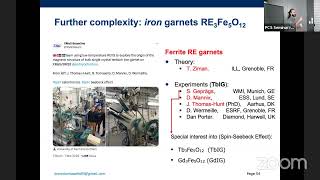
Role of Magneto-Crystalline Anisotropies in Complex Rare-Earth Systems
Explore magneto-crystalline anisotropies in rare-earth crystals, examining their impact on phenomena like emergent gauge theories, topological phases, and unconventional ordering in pyrochlores and garnets.
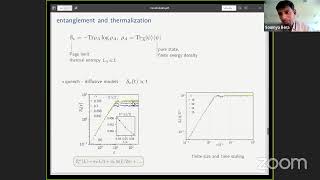
Internal Clock for Many-Body Delocalization
Explore the concept of internal clock in many-body delocalization, examining relaxation of charge imbalance and entanglement entropy in 1D disordered fermion systems.
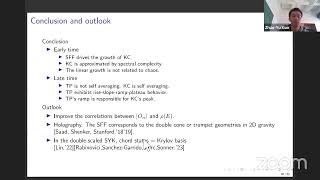
Chaos and Krylov Complexity
Explore the relationship between Krylov complexity and chaos in quantum systems, examining wave function evolution and transition probabilities to uncover universal behaviors in chaotic Hamiltonians.
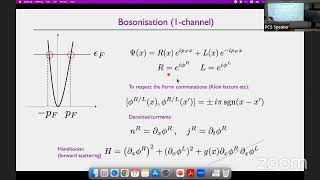
Fractional Conductance in One-Dimensional Constrictions
Explore theoretical models and Luttinger approach for fractional conductance in one-dimensional constrictions, examining recent experimental observations and potential fractions.
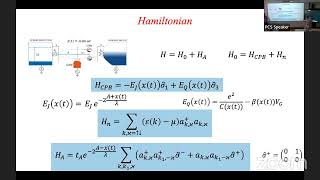
Mechanically Assisted Andreev Reflection in Cooper Pair Box Systems
Explore quantum mechanics through mechanically assisted Andreev reflection, Cooper pair boxes, and flying qubit states. Discover how mechanical motion impacts electric current in superconducting systems.

Chiral Induced Spin Selectivity and Time-Reversal Symmetry Breaking
Explore chiral-induced spin selectivity in helical molecules, examining theoretical explanations and experimental findings. Analyze various models to overcome Bardarson's theorem and achieve spin polarization.
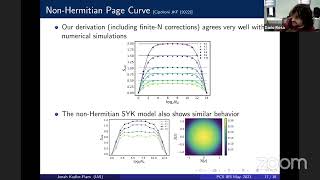
Explorations of Dissipative Quantum Chaos from Non-Hermitian Random Matrix Theory
Explore dissipative quantum chaos through non-Hermitian random matrix theory. Examine volume-law entanglement entropy and eigenstate thermalization hypothesis modifications in open quantum systems.
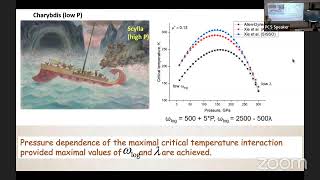
Electron-Phonon Interaction in Metals: Limits and Implications
Explore the limits of electron-phonon interaction in metals, its impact on superconductivity, and potential metal-insulator transitions through advanced theoretical analysis.
Ferrodark Solitons in a Spin-1 Bose-Einstein Condensate
Explore exact propagating topological excitations in ferromagnetic spin-1 Bose-Einstein condensates, including kinks in transverse magnetization and two types of ferrodark solitons with unique properties.
Quantifying Dinosaur Pee - Expressing Probabilities as Floating-Point Values in C++ - Lecture
Explore floating-point precision in C++ through probability calculations, from birthday paradoxes to dinosaur urine, with insights on numerical pitfalls and expected value concepts.
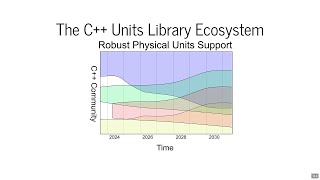
The Au C++ Units Library: Handling Physical Units Safely, Quickly, and Broadly - Lecture 1
Explore Au, a new C++ units library offering fast compilation, simple errors, and wide compatibility. Learn its unique features and how it compares to other libraries for efficient physical quantity handling.
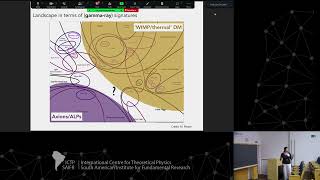
Indirect Detection of Dark Matter - Class 2
Explore indirect detection methods for Dark Matter, focusing on advanced techniques and recent developments in the field of astrophysics and particle physics.
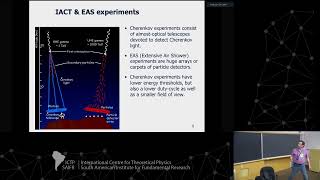
Introduction to the IACT Technique - Class 1
Explore the fundamentals of Imaging Atmospheric Cherenkov Telescope (IACT) technique in this comprehensive lecture by Francesco Longo from the Latin-American School on CTA Science.
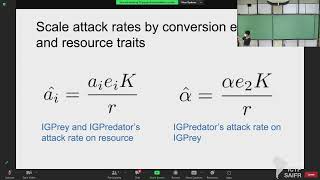
Non-linearity, Variability and Diversity in Quantitative Ecology - Class 02
Explore non-linearity, variability, and diversity in ecological systems through advanced quantitative methods and theoretical frameworks.
Quantitative Foundations of Ecological and Evolutionary Dynamics - Class 07
Explore quantitative foundations of ecological and evolutionary dynamics through advanced mathematical concepts and modeling techniques.
Minicourse on Cosmological Phase Transitions and Gravitational Waves - Class 2
Explore cosmological phase transitions and gravitational waves, focusing on advanced concepts and their implications for our understanding of the early universe.
Minicourse on Cosmological Phase Transitions and Gravitational Waves - Class 1
Explore cosmological phase transitions and gravitational waves in this comprehensive minicourse, focusing on fundamental concepts and their implications for early universe physics.
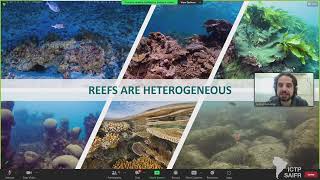
Can We Predict the Future of Brazilian Reefs? - QEco Program Seminar
Explore Brazilian reef ecosystems, their future predictions, and conservation strategies through expert insights and quantitative ecological approaches.
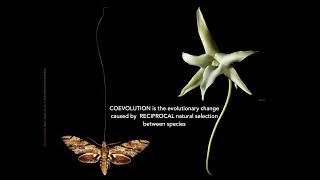
Evolution of Complex Traits: From Genotypes to Phenotypes to Ecosystem Services
Explore the evolution of complex traits, from genetic foundations to ecological impacts, in this comprehensive lecture on quantitative biology and ecology.