Effective Mentoring Practices - LPI Professional Development Seminar
Explore evidence-based practices for building effective mentoring relationships with experts from Boston University and the Postdoc Academy. Gain valuable resources and insights for professional development.
Exploring the Creative Union of Artificial Intelligence and Pure Mathematics
Explore the fusion of AI and pure mathematics, uncovering how machine learning can predict complex mathematical structures and potentially revolutionize theorem proving and scientific discovery.
Future of Computer Progress: Trends in Technology and Computing Economics
Explore future computing trends with MIT's Neil Thompson. Gain insights on algorithm progress, specialized hardware, and quantum computing's potential impact on technological advancements.
Geometric Algebra Transformers: Revolutionizing Geometric Data
Explore GATr's revolutionary approach to geometric data processing, enhancing computer vision, robotics, chemistry, and physics with efficient 16-dimensional vector space representations and E(3) equivariance.
Meeting Societal Challenges: Scalable Big Data-driven, AI-enabled Approaches
Explore scalable big data-driven, AI-enabled approaches for societal challenges. Learn about innovative solutions in healthcare, agriculture, and smart cities using advanced analytics and deep learning techniques.
Delivering Impactful Science, Deploying Aurora, and Partnering with ECP at the ALCF
Explore Argonne's role in advancing high-performance computing, deploying Aurora, and collaborating with ECP to drive scientific breakthroughs and exascale computing.
Lessons Learned Developing Performance-Portable QMCPACK
Explore strategies for developing performance-portable scientific applications, focusing on QMCPACK's redesign for GPU and CPU compatibility in materials property prediction.
Taking HACC into the Exascale Era - New Code Capabilities and Challenges
Explore HACC's evolution for exascale systems, new capabilities, and performance optimization in cosmology simulations.
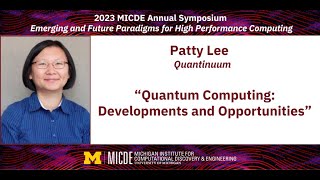
Quantum Computing: Developments and Opportunities
Explore quantum computing's current capabilities, applications, and future potential, including hardware advancements and software tools for quantum programmers.
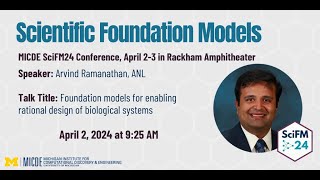
Foundation Models for Enabling Rational Design of Biological Systems - Lecture 3
Explore foundation models for rational design of biological systems with Arvind Ramanathan, advancing understanding in computational biology and system engineering.
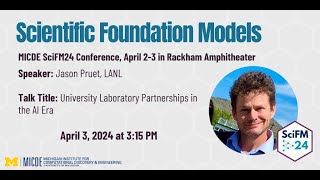
University Laboratory Partnerships in the AI Era - Lecture 13
Explore university-laboratory collaborations in the AI era, examining their impact on research, innovation, and education in scientific computing.
Introduction to Tokenizing Scientific Data - Omics - Tutorial 2
Explore tokenization techniques for scientific data in omics, focusing on applications in genomics and bioinformatics.
Foundation Models for Materials Discovery
Explore foundation models for materials discovery, focusing on their applications and potential in advancing scientific research and innovation.
Foundation Models for a Sustainable Planet
Explore how foundation models can address sustainability challenges and drive positive environmental impact through AI-powered solutions.
Tree Learning: Optimal Algorithms and Sample Complexity - Hierarchical Clustering and PAC Learning
Explore optimal algorithms and sample complexity for learning hierarchical tree representations from labeled data, covering PAC learning, online learning, and efficient tree classifier construction.
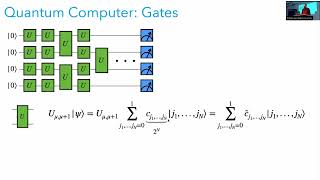
Quantum Computing Today and Tomorrow - Current State and Future Applications
Explore quantum computing's current state, potential applications, and future developments with insights from Prof. Dr. Michael Hartmann's seminar on recent advancements and upcoming challenges.
Processing Very Large Image Volumes with the Adaptive Particle Representation
Explore advanced techniques for processing massive image datasets using adaptive particle representation, enabling efficient visualization and analysis of terabyte-scale biomedical data.
Bridging Domain Science and HPC with Julia
Explore Julia's potential in HPC, combining scientific ecosystem with high performance. Gain insights on its strengths, limitations, and notable international projects from an experienced user.
Is Serverless Powerfully Powerless? - Measuring Energy Efficiency
Explore energy efficiency of serverless solutions through real-world measurements. Uncover the truth behind resource savings claims using Kepler for data-driven insights.
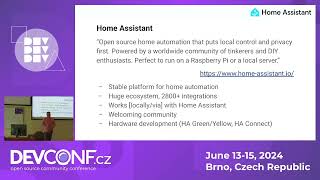
Home Automation Crash Course - 2024
Explore Home Assistant's architecture, ecosystem, and capabilities for building secure, privacy-focused local home automation systems.
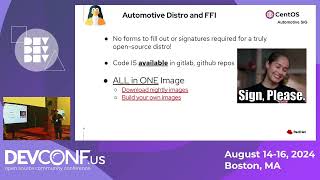
Paving the Way for Uninterrupted Car Operations
Explore Freedom of Interference in containers and its impact on next-gen vehicles and embedded devices. Witness the future of mobility with enhanced efficiency, safety, and performance.