On the Origin of Fat Tailed Distribution Functions in Driven Complex Systems
Explore the origin of fat-tailed distributions in driven complex systems through sample space reducing processes, offering insights into various statistical phenomena and their applications.
Anomalous Thermal Relaxation for Over-damped Langevin Dynamics
Explore anomalous thermal relaxation phenomena, focusing on the Mpemba effect in over-damped Langevin dynamics. Examine theoretical results and link to physical system properties.
Engineered Swift Equilibration: Applications and Optimization - Lecture
Explore Engineered Swift Equilibration (ESE) applications in physics, including particle compression, first passage time optimization, and atomic force microscopy enhancements.
A Large Deviation Perspective on Nanoscale Transport Phenomena
Explore nanoscale transport phenomena through large deviation theory, examining current fluctuations in nonequilibrium states and their relation to nonlinear responses in complex systems.
Stochastic Resetting: Overview and Recent Developments
Explore stochastic resetting in dynamical processes, its impact on system behavior, and applications in chemical reactions and search processes.
Entropy Growth During Free Expansion of an Ideal Gas
Explore entropy growth in free expansion of ideal gas, examining macrostates, irreversibility, and factors influencing entropy increase in non-equilibrium systems.
Quantum Bounds and Fluctuation-Dissipation Relation
Explore quantum bounds for transport coefficients and their connection to the Fluctuation-Dissipation relation, with insights from high-energy physics and String Theory.
Coarsening, Condensates and Extremes in Aggregation-Fragmentation Models
Explore coarsening in aggregation-fragmentation models, focusing on condensate formation, extreme value statistics, and scaling behavior in zero range and conserved mass aggregation systems.
Anomalous Transport in Nonlinear Lattices: Quasi-Integrability and Long-Range Interactions
Explore anomalous heat diffusion in low-dimensional classical anharmonic lattices, focusing on perturbed integrable systems and long-range forces in nonequilibrium steady states.
The Ising Model and Its Quantum Interface Dynamics - A Centennial Perspective
Explore quantum Ising model's interface dynamics, examining domain evolution, quantum nucleation, and false-vacuum decay. Discover connections to mathematics and classical statistical physics.
Ordering of Diffusing Spins in Brownian Spin Models
Explore phase transitions in Brownian spin models, examining continuous transitions in Potts models and BKT transitions in clock models. Analyze numerical simulations and discuss extensions to active particles.
The Casimir Energy as a Trace
Explore the Casimir effect's connection to spectral geometry and microlocal analysis. Learn to define Casimir energy as an operator trace and compute it using boundary layer operator determinants.
Convergence of the Ising-Kac Model to Φ4 in Three Dimensions
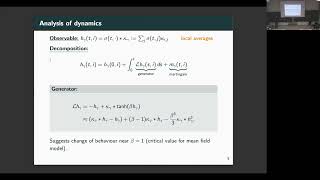
Explore the convergence of the Ising-Kac model to $\Phi^4$ in 3D, analyzing Glauber dynamics and applying regularity structure theory to discrete particle systems.
Casimir-Polder Interaction at Finite Temperature: Concepts and Challenges
Explore dispersion forces, van der Waals interactions, and Casimir-Polder effects, focusing on temperature dependence and quantum field theory challenges in describing material absorption.
Interactions Induced by Fluctuating Electromagnetic Fields
Explore interactions induced by fluctuating electromagnetic fields, from dispersion forces to blackbody radiation effects. Learn about light-matter interactions and potential applications in colloidal systems.
Collective Cold-Atom Interactions and Astrophysical Perspectives
Explore collective cold-atom interactions and their astrophysical applications through experiments on light scattering, random lasing, and long-range forces in atomic vapors.
The Physical Processes Governing Structure Formation in Our Universe
Explore the physical processes shaping cosmic structures, from large-scale web formations to galaxy and star evolution, examining gravitational forces, hydrodynamics, and radiative effects.
Semi-Discrete Modeling of Systems of Disclinations and Dislocations in Crystalline Materials
Explore disclinations in crystalline materials, their modeling, and the relationship between disclination dipoles and edge dislocations through variational methods and energy minimization.
Injectivity in Second-Gradient Nonlinear Elasticity
Explore injectivity in second-gradient nonlinear elasticity, delving into advanced mathematical concepts and their applications in materials science.
MaZe: A New Approach for Simulating Adiabatic Systems - Lecture
Explore MaZe, a novel approach for simulating adiabatic systems in physics. Learn about its applications in first principles simulations, polarizable systems, and ionic transport studies.
Phase Transitions and Self-Assembly in Active Matter
Explore phase transitions and self-assembly in active matter systems, from bird flocks to nanorobots. Analyze statistical models, emergent behaviors, and out-of-equilibrium dynamics in collective motion phenomena.