Sequence Data - Part 2
Explore advanced techniques for analyzing and interpreting sequence data, enhancing your bioinformatics skills and research capabilities.
Sequence Data - Part 1
Explore fundamental concepts and techniques for analyzing sequence data in bioinformatics, focusing on DNA and protein sequences.
Physics Informed Neural Networks - BC Incorporation
Explore Physics Informed Neural Networks and learn techniques for incorporating boundary conditions in these advanced machine learning models.
Introduction to Neuron and Perceptron: Working Principle - Lecture 1
Explore the working principle of perceptrons in neural networks, laying the foundation for understanding artificial neurons and their role in machine learning.
D-H Parameters in Robotics
Explore Denavit-Hartenberg parameters for robotic arm kinematics, understanding their role in describing spatial relationships between adjacent links.
Unit 1: Phenols - Structure, Preparation, Properties and Reactions - Part 2
Explore phenol structures, preparation methods, properties, and reactions in this comprehensive chemistry lesson.
Introduction to Radio Astronomy
Explore the fundamentals of radio astronomy, including electromagnetic spectrum and its significance in astronomical research. Learn course structure and logistics.
Historical Perspective: Renaissance to the Development of Mechanical Materialism - Part 1
Explore philosophical currents from ancient India to European Renaissance, tracing the evolution of scientific thought and mechanical materialism.
Overview of Systematic Review and Meta-Analysis
Explore principles of evidence synthesis, comparing narrative and systematic reviews, and learn about resources for conducting systematic reviews and meta-analyses.

Daly's Operational Principle of Sustainable Development and Impact of Environmental Regulation - Part 5
Explore Daly's operational principle, sustainable development indicators, and Porter hypothesis in environmental regulation's impact on firm competitiveness.
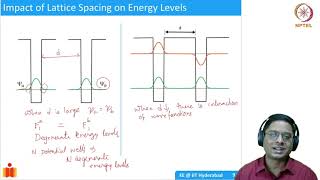
1.5 Covalent Bonds and Inter-Atomic Interactions in Silicon
Explore covalent bonding and interatomic interactions in silicon lattices, focusing on the bonding model and its implications for material properties.
Conservation of Mass in Fluid Dynamics - Governing Equations Review
Explore conservation of mass principles in fluid dynamics, covering compressible and incompressible flows, mass flow rate, and governing equations for heat transfer.
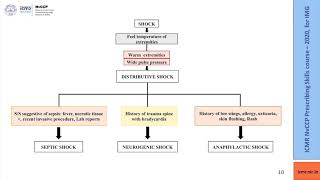
Management of Shock
Learn essential strategies for managing shock, including diagnosis, treatment, and patient care techniques from an expert in the field.
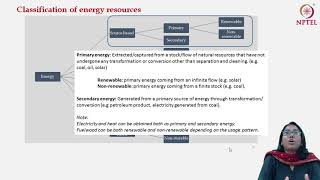
Energy as an Economic Resource - Classification of Energy Resource
Explore the classification and economic significance of energy resources, gaining insights into their impact on global economies and sustainable development.
Laminar and Turbulent Flows - Part 1 - Lecture 32
Explore laminar and turbulent flows, understanding velocity, Reynolds experiment, and typical flow regimes. Gain insights into fluid dynamics concepts.
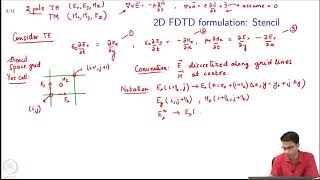
Finite Difference Time Domain Methods: 2D FDTD Formulation and Stencil
Explore 2D FDTD formulation and stencil techniques in finite difference time domain methods for electromagnetic wave simulation.
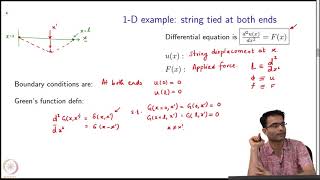
Introduction to Green's Function - A One-Dimensional Example
Explore Green's Function through a one-dimensional example, gaining insights into this mathematical concept and its applications in physics and engineering.
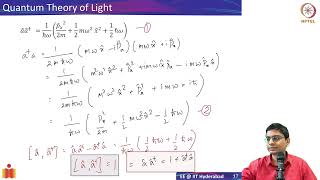
Quantum Theory of Light - Operator Approach to Solving Harmonic Oscillator Problem
Explore the operator approach to solving quantum harmonic oscillator problems in the context of quantum theory of light.
Code Walkthrough for PINNs in Burgers Equation
Explore Physics-Informed Neural Networks (PINNs) applied to the Burgers equation through a detailed code walkthrough.
Physics Informed Neural Networks - Introduction
Explore the fundamentals of Physics Informed Neural Networks in this concise introduction.
Composite Rotation Matrix and Relative Orientations
Explore composite rotation matrices and relative orientations in aerospace engineering, enhancing understanding of aircraft dynamics and control systems.