Open Challenges in AI for Molecular Design: Representation, Experimental Alignment, and Oracle Reliability
Explore AI challenges in molecular design: representation, experimental alignment, and oracle reliance. Learn about new workflows and approaches to address real-world complexities in molecular discovery.
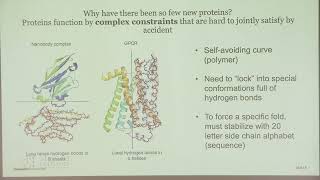
Illuminating Protein Space with Generative Models
Explore generative modeling for protein design, focusing on building learning systems that can generalize, scale, and create fit-for-purpose protein complexes on demand.
Deep Learning and Numerical Methods Intersections for Improving Molecular and Fluid Dynamics
Explore intersections of deep learning and numerical methods to enhance molecular and fluid dynamics simulations, improving accuracy and efficiency in scientific computations.
Large ML Potentials for Chemistry - Generalization, Inductive Biases, and Error Cancellation
Explore machine learning potentials in chemistry, focusing on generalization, inductive biases, and error cancellation techniques for improved accuracy and efficiency.
Machine Learning Gradients in Molecular Simulations
Explore ML gradients in molecular simulations, including surrogate functions, active learning, and differentiable programming for enhanced scientific modeling and optimization.
From Entropy to Artistry: Thermodynamics and Generative AI
Explore connections between diffusion models and physics, focusing on non-equilibrium thermodynamics and its applications in image/video generation and climate modeling.
Harnessing the Properties of Equivariant Neural Networks for Materials Science
Explore equivariant neural networks for materials science, covering applications, advantages, and future directions in understanding and designing atomic systems.
How We Are Building Trustworthy AI for Weather and Climate in AI2ES
Explore innovative approaches to developing reliable AI systems for weather and climate prediction, enhancing forecasting accuracy and environmental understanding.
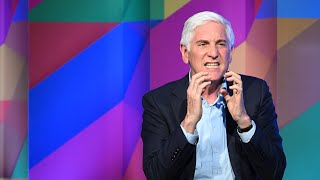
Promise and Perils of Artificial Intelligence in Healthcare
Explore AI's transformative impact on healthcare, from disease detection to personalized treatments, while examining ethical concerns and the irreplaceable human touch in patient care.
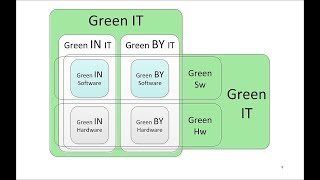
Green Software Architecture - Dos, Don'ts, and Some Surprises
Explore green software architecture principles, practices, and surprising insights to design environmentally-friendly systems. Learn to integrate sustainability into daily coding for reduced energy consumption and environmental impact.
Advancing Responsible AI: Unveiling the Software Carbon Efficiency Rating for LLMs
Explore the SCER initiative for measuring and improving carbon efficiency of Large Language Models, promoting sustainable AI development and renewable energy adoption.

Self-Driving Cars and the Human Brain - The Missing Link to Intelligence
Explore the connection between self-driving cars and human cognition, uncovering insights into AI decision-making and the future of autonomous vehicles with Minus Zero's CEO.

Solvable Entanglement Dynamics in Quantum Circuits with Generalized Dual Unitarity
Explores solvable entanglement dynamics in quantum circuits using generalized dual unitarity, advancing understanding of quantum matter stability and non-equilibrium physics.
Fink on Kubernetes - Efficient Management of Massive Alert Streams for Astronomical Object Identification
Explore how Kubernetes enables real-time processing of massive astronomical data streams, facilitating scientific discoveries through cloud-based infrastructure and distributed computing frameworks.
Empowering Efficiency: PEAKS - Orchestrating Power-Aware Kubernetes Scheduling
Innovative Kubernetes scheduler optimizing power efficiency through ML-driven node recommendations, reducing energy consumption in cloud-native environments while maintaining performance.

How Connections Build Intelligence - Human and Artificial
Explore the fundamental role of connections in building intelligence, both in human brains and artificial systems, with insights from AI entrepreneur Nigel Toon on information processing and knowledge creation.
Crafting a Physics-Informed Loss Function for AI/ML in Physics - Part 4
Explores designing physics-informed loss functions in AI/ML, including case studies on fluid dynamics, sparse modeling, and equivariant loss, to enhance model performance and incorporate physical constraints.

Quantum Information Phases in Space-time: Measurement-induced Entanglement and Dynamics
Explore quantum information phases in space-time, focusing on measurement-induced entanglement and related phenomena. Gain insights into cutting-edge research in quantum many-body systems and their stability.
Tutorial on Bosonic Codes
Explore bosonic codes in quantum computing with Victor Albert, covering advances in quantum coding theory and their applications in error correction.
Panel Discussion on Neutral Atoms
Explore the cutting-edge field of neutral atom technology in this insightful panel discussion featuring leading experts in quantum computing and atomic physics.
Fault Tolerance of Stabilizer Channels
Explore quantum error correction and fault tolerance in stabilizer channels, focusing on recent advancements and their implications for quantum computing systems.