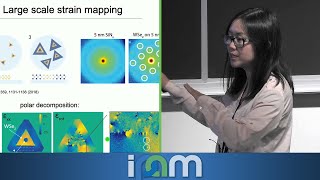
Assisting 4D-STEM Data Processing by Machine Learning and Bayesian Optimization
Explore machine learning and Bayesian optimization techniques for processing 4D-STEM data, enhancing efficiency in materials analysis and electron ptychography reconstruction.
Unified Understanding of E(3)-Equivariant Interatomic Potentials - Theory and Applications
Explore E(3)-equivariant interatomic potentials, covering theory, applications, and advancements in machine learning approaches for quantum mechanics and molecular dynamics simulations.
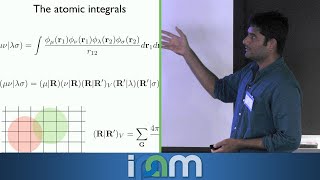
Auxiliary Field Quantum Monte Carlo - AFQMC with Multi Slater Wavefunctions
Explore advanced quantum Monte Carlo techniques, focusing on AFQMC with multi-Slater wavefunctions and efficient exchange matrix evaluation for large-scale quantum systems.
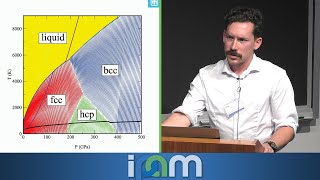
Machine Learning in Equation of State and Transport Modeling at Extreme Conditions
Explore machine learning applications in equation of state and transport modeling for extreme conditions, enhancing accuracy and efficiency in material science and astrophysics research.
Fermionic Neural-Network Quantum States - IPAM at UCLA
Explore fermionic neural-network quantum states, their efficient representations, and applications in quantum mechanics with Giuseppe Carleo's insightful presentation at IPAM's workshop.
Contracted Quantum Eigensolver for the Quantum Simulation of Many-Electron Systems
Explore a novel quantum algorithm for many-body systems, comparing it to existing methods and demonstrating its advantages in molecular simulations and quantum computing applications.
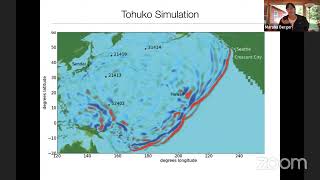
Marsha Berger - Towards Adaptive Simulations of Dispersive Tsunami Propagation
Explore adaptive simulations for tsunami propagation, focusing on shallow water equations, mesh refinement, and Boussinesq models. Learn about computational techniques for predicting tsunami impacts from various sources.

Quantum Simulation - IPAM at UCLA
Explore quantum simulation's origins, relevance, and key concepts with Nathan Wiebe. Delve into Schrödinger equations, Hamiltonian simulation, and Taylor's theorem in this comprehensive lecture.
End-to-End Learning and Auto-Differentiation - Forces, Uncertainties, Etc.
Explore deep learning and auto-differentiation in molecular simulations, covering surrogate functions, sampling distributions, and time-propagation of differential equations for scientific problem-solving.
Advancing Molecular Simulation with Deep Learning - IPAM at UCLA
Explore cutting-edge applications of deep learning in molecular simulation, covering quantum chemistry, force fields, and Markov State Models for advanced scientific research.
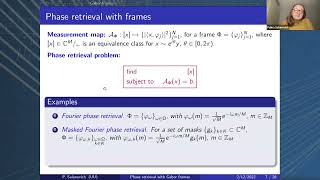
STFT Phase Retrieval - Robustness and Generative Priors - IPAM at UCLA
Explore STFT phase retrieval, focusing on robustness and generative priors. Learn about stable reconstruction techniques, application of generative models, and reducing required measurements in imaging and acoustics applications.
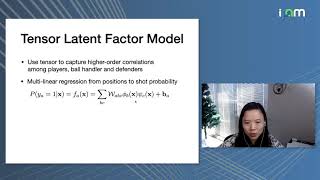
Multiresolution Tensor Learning for Efficient and Interpretable Spatial Analysis
Explore efficient and interpretable spatial analysis using multiresolution tensor learning, with applications in geology, sports, and climate science. Discover improved methods for handling complex spatial data.
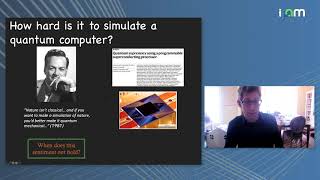
Phase Transitions in the Complexity of Simulating Random Shallow Quantum Circuits
Explores phase transitions in simulating random shallow quantum circuits, discussing computational complexity, tensor network contraction, and mapping 2D circuits to 1D processes with implications for quantum computing.
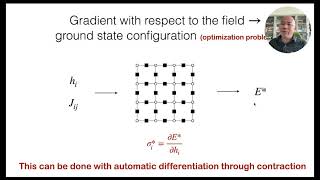
Tropical Tensor Networks
Unified tensor network approach for spin glasses using tropical algebra, enabling ground state energy computation, optimal configuration identification, and solution counting. Combines graphical models and quantum circuit simulation.
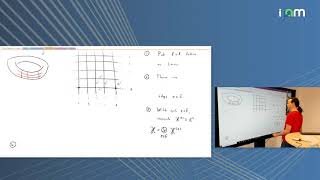
David Gross: Stabilizer Formalism & Quantum Error Correction Through the Lens of Tensors
Explore advanced quantum error correction techniques, focusing on the stabilizer formalism and its applications in quantum fault tolerance, using tensor-based approaches and group theory.
Oscillator-to-Oscillator Codes Do Not Have a Threshold
Explores limitations of oscillator-to-oscillator codes in quantum information, proving they lack a threshold property for error correction when using constant squeezing and maximum likelihood decoding.
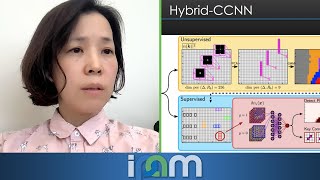
Machine Learning for Quantum Simulation - IPAM at UCLA
Explore machine learning applications in quantum simulation, focusing on neural networks for phase recognition and insights into complex quantum systems.
Tensor Networks -QC-DMRG- in a Complete Active Space Coupled Cluster Method
Explore tensor networks in quantum mechanics, focusing on their application in coupled cluster methods for modeling strongly correlated systems and computing dynamical correlations.
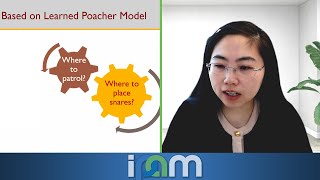
Machine Learning and Game Theory for Social Impact
Explore machine learning and game theory applications in security, sustainability, and food rescue, featuring real-world deployments and innovative solutions for societal challenges.
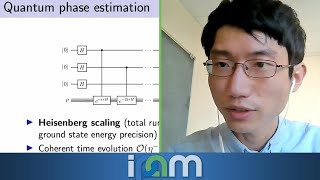
Heisenberg-Limited Ground State Energy Estimation for Early Fault-Tolerant Quantum Computers
Explore Heisenberg-limited ground state energy estimation for early fault-tolerant quantum computers, featuring a simplified circuit and classical post-processing for improved efficiency.
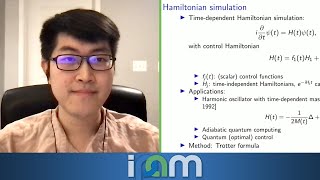
Improved Complexity Estimation for Hamiltonian Simulation with Trotter Formula
Explore improved complexity estimation for Hamiltonian simulation using Trotter formula, focusing on time-dependent effective mass and near adiabatic dynamics scenarios with potential for enhanced efficiency.