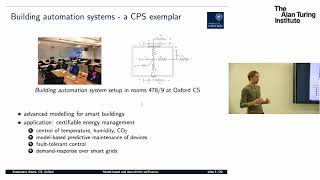
Formal Verification and Learning of Complex Systems - Professor Alessandro Abate
Exploring formal verification techniques for complex systems, combining model-based and data-driven methods to address scalability issues and provide system-level assertions in Cyber-Physical Systems.
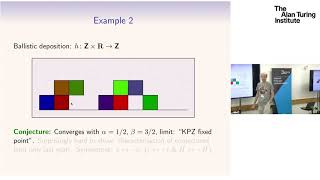
Universality Classes for 1+1 Dimensional Systems
Explore universality classes in 1+1 dimensional systems, focusing on weak universality conjecture, graphical construction, and links to Brownian web. Gain insights into complex systems modeling.
Optimisation
Explore optimization techniques for neural networks, including gradient descent, SGD, momentum, adaptive methods, and normalization layers, with real-world applications in MRI technology.
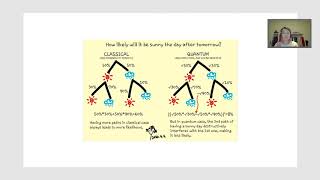
Intro to Quantum Computing - Interference, Measurement
Explore quantum computing concepts like interference, measurement, complex numbers, and wave equations in this advanced lecture by Dr. Kitty Yeung.

Navigating the AI Council's AI Roadmap
Experts discuss AI's role in UK society, addressing climate change, resilience, mental health, diversity, and skills development while exploring strategies to build public trust and make actionable impact.
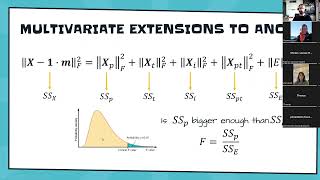
Statistical Inference of Omics Data with Variable-Selection
Learn statistical inference techniques for omics data analysis, focusing on variable selection methods to enhance spectral matching and predict molecular structures from LC-MS/MS spectra using chemometrics and deep learning approaches.
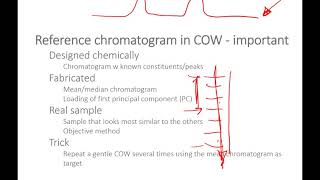
Preprocessing - Warping Data
Learn about Correlation Optimized Warping (COW) for aligning misaligned data, including its principles, parameters, and applications in bilinear models and data preprocessing.
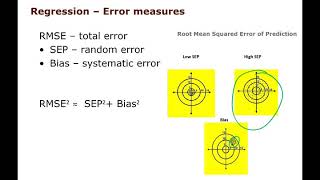
PLS Number of Components
Learn validation techniques for PLS models, including outlier detection, error measures, cross-validation, and practical tips for selecting the optimal number of components.
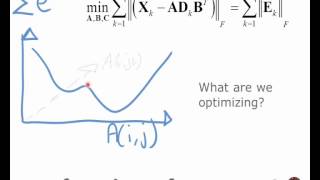
Multi-Way Analysis - The Algorithm
Explore the alternating least squares algorithm for multi-way analysis, focusing on PARAFAC modeling in chemometrics. Learn about notation, potential problems, and alternative approaches.
Advanced Tutorials - Runtime Analysis of Population-Based Evolutionary Algorithms
Explore advanced techniques for runtime analysis of population-based evolutionary algorithms, covering selection mechanisms, random family trees, and level-based analyses to optimize algorithm performance.

Learning Symbolic Equations with Deep Learning
Explore deep learning techniques to extract symbolic equations from Graph Neural Networks, with applications in physics and cosmology. Discover novel analytic formulas and improve model interpretability.

AI- From Algorithms to Ethics - ACM WomENcourage 2020
Explore AI agents designed for human interaction, combining machine learning, behavioral models, and game theory. Learn about applications in emergency triage and evaluation methodologies.

Machine Learning and the Earth David Hall
Explore machine learning's potential in addressing urgent global challenges like climate change, with insights on strategies, risks, and implications for various fields.

Complexity I
Explore multiplicity theorem, programsized complexity, and algorithmic questions in this deep dive into computational complexity theory and its applications.
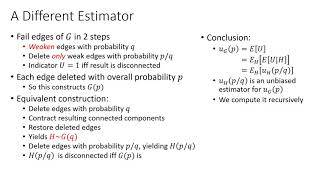
A Phase Transition and Quadratic Time Estimator for Network Reliability
Explore network reliability estimation, including a novel quadratic-time approach, phase transitions, and unbiased estimators for efficient analysis of complex networks.
Estimating Normalizing Constants for Log-Concave Distributions - Algorithms and Lower Bounds
Explore algorithms and lower bounds for estimating normalizing constants in log-concave distributions, covering annealing, Monte Carlo methods, and Langevin dynamics.
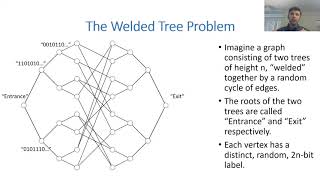
Computations with Greater Quantum Depth Are Strictly More Powerful - Relative to an Oracle
Explore the power of quantum depth in computation, examining conjectures, hybrid systems, and key results through an oracle-based approach and simulation algorithms.
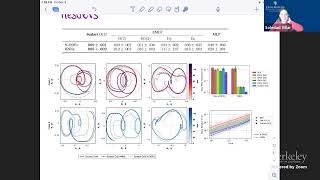
Equivariant Machine Learning Structured Like Classical Physics
Explore equivariant machine learning and its connection to classical physics, focusing on graph neural networks, spectral methods, and symmetry in optimization problems.

Towards Practical Quantum Advantage - Quantum Colloquium
Explore quantum computing's potential for practical advantage, focusing on small data problems with superquadratic speedups. Discusses progress in quantum algorithms for chemistry and simulation challenges.
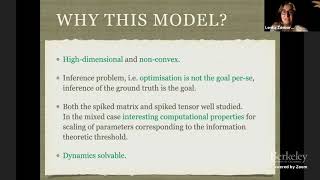
Insights on Gradient-Based Algorithms in High-Dimensional Learning
Explore gradient-based algorithms in high-dimensional learning, covering statistical physics solutions for performance analysis in nonconvex settings like spiked mixed matrix-tensor model, perceptron, and phase retrieval.

A Theory of Trotter Error
Explores advanced theory of Trotter error in quantum simulation, providing tighter error bounds and improved algorithms for various quantum systems and observables.