The Best and Most 'Stealable' Mechanics from Tabletop RPGs
Explore innovative tabletop RPG mechanics and their potential adaptation to digital game design, focusing on unique features and the influence of Game Masters on computer RPGs.
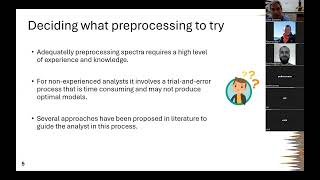
ExpertPLS - A MATLAB Toolbox for Spectral Preprocessing Selection
Automated MATLAB toolbox for spectral preprocessing selection, quantifying noise and scatter effects to optimize PLS models efficiently and objectively, surpassing trial-and-error methods.
Responding to Threats in AWS Linux and Kubernetes Environments
Explore real-life attack techniques in AWS Linux and Kubernetes environments and learn efficient cloud incident response strategies through automation and enhanced visibility.

Linux on Mars and Software Supply Chain Security - OSS Keynotes Day 3
Explore Mars exploration, open source insights, and software supply chain security with NASA, Microsoft, and Linux Foundation experts in this keynote series.
Welcome to JavaScriptLandia
Explore the vibrant world of JavaScript with Jory Burson from the Linux Foundation, uncovering its ecosystem, community, and latest developments.
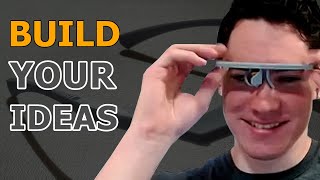
Designing and Building a Custom AR Headset
Explore the journey of creating custom AR headsets, from initial development to final mechanics. Learn about microcontrollers, displays, optics, and the learning process behind this innovative project.
Building a Green Supercomputer in the Cloud
Explore green software principles and best practices for reducing carbon emissions in high-performance computing, using a case study of wind turbine simulations scaling to 400k cores and petabytes of data.

Implementing Elastic Collisions in JavaScript - Coding Challenge 184
Learn to implement elastic collisions in p5.js without a physics library. Explore the math behind circle collisions and create a JavaScript simulation, supplementing the Nature of Code book series.

PyCon US Lightning Talks - May 18
Diverse Python-focused talks covering AI dining, data science journeys, perfect pitch, steganography, counting techniques, subinterpreters, physics discovery, and self-explanation.
Explainable AI for Climate Science - Opening the Black Box to Reveal Planet Earth
Discover how explainable AI techniques can revolutionize climate science research, from weather prediction to understanding human impacts on Earth's systems through advanced machine learning applications.

Distributed Mesh Processing and Geometric Deep Learning for Wind Prediction
Discover how Ray's distributed computing powers real-time wind prediction in urban design through mesh processing, geometric deep learning, and CFD data analysis for architectural innovation.
Identifying Candidates for Advanced Heart Failure Therapies Using Machine Learning
Discover how artificial intelligence can revolutionize early identification of heart failure patients for advanced therapies, improving survival rates through timely interventions and referrals.
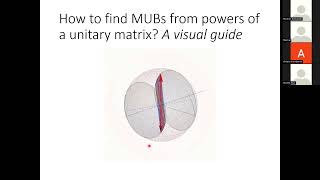
Cyclic Projective t-Designs and How to Find Them
Explore complex projective t-designs in quantum states and their applications in optimal quantum tomography, focusing on cyclic designs generated through unitary operations.

Establishing Endurance and Data Retention Metrics in DNA Data Storage Systems
Explore the standardization of DNA data storage systems, focusing on metrics for endurance, reliability, and data retention, including preservation methods and labeling systems for optimal sequencing solutions.
Building Green and Low-Carbon Telecom Cloud Native Infrastructure for Sustainability
Discover how to build sustainable telecom cloud data centers through intelligent management, power optimization, and resource efficiency for reduced carbon footprint and energy savings.
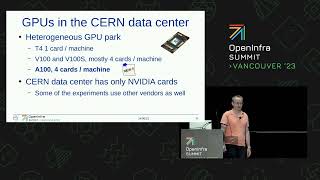
Multi-Instance GPU Deployment for Machine Learning and Particle Beam Simulations at CERN
Explore CERN's implementation of Multi Instance GPU technology using NVIDIA A100s, covering deployment strategies, virtualization approaches, and practical applications in machine learning and particle physics.
Neurosymbolic Programming - An Emerging Subarea of AI
Explore neurosymbolic programming's fusion of deep learning and program synthesis, discovering how it enhances AI robustness, interpretability, and efficiency through symbolic and neural approaches.

HDD Computational Storage Performance Analysis and Benchmarking - From System Tests to IPC
Dive into computational storage benchmarking techniques, exploring IPC analysis, SIMD programming, and inline assembler for optimizing genomics research performance on HDD systems.
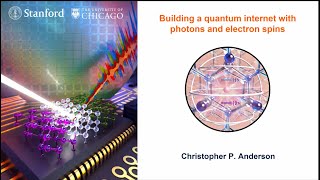
Building a Quantum Internet with Photons and Electron Spins
Explore groundbreaking research on quantum internet development using photons and electron spins in silicon carbide, featuring advances in spin coherence and single photon emission for long-distance quantum communication.
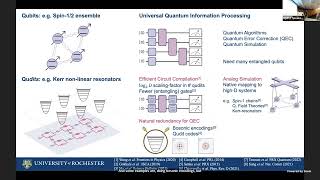
Beyond Binary Quantum Information: Controlling the Excited States of Artificial Atoms in Superconducting Circuits
Explore advanced quantum information processing through higher energy levels of transmon circuits, focusing on qu-trit systems, Fock states, and non-Gaussian operations in superconducting quantum computing.
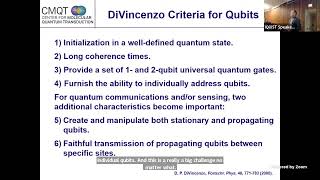
Photogeneration of Electron Spin Qubit Pairs in Molecular Materials for Quantum Information Applications
Explore groundbreaking research on photogenerated electron spin pairs in molecular materials, their applications in quantum computing, and the impact of chirality-induced spin selectivity on quantum information systems.