
Designing for Change with Vertical Slice Architecture
Explore Vertical Slice Architecture as an alternative to traditional layered approaches, focusing on its advantages for building scalable, adaptable software in fast-paced development environments.
Kubernetes and MLOps for Scalable and Reproducible Generative AI
Explore how Kubernetes and MLOps practices enable scalable, reliable, and reproducible generative AI workflows, empowering organizations to unlock the full potential of AI with seamless scalability and operational excellence.
Running an API Gateway on Istio - Pitfalls and Learnings
Explore challenges and solutions for running large-scale API Gateway on Istio, including performance optimization, cost management, and implementing region failovers using Argo workflows.
Unraveling Istio - A Tale of Scale, Challenges and Triumphs at DevRev
Explore DevRev's journey with Istio service mesh, from implementation challenges to scaling solutions. Learn best practices for maximizing Istio's potential in globally-distributed SaaS products.
Architecting Ambient Mesh for Scale
Explore Ambient mesh's architecture for improved Istio scalability, covering sidecar removal, Kubernetes controller redesign, and new configuration protocols for enhanced service mesh performance.
Multi-Tenancy Architecture Lessons Learned
Explore multi-tenancy architecture approaches, their pros and cons, and how to handle unique configurations. Learn about hidden costs, long-term impacts, and recent advancements in tooling for better support.
Orchestrating Multi-Tenancy Kubernetes Environments with Flux
Explore Flux's capabilities for orchestrating multi-tenancy Kubernetes environments, enabling efficient and secure software delivery across diverse tenant workloads in complex application landscapes.
Embracing Multi-Tenancy While Scaling MLOps
Learn strategies for implementing multi-tenancy in MLOps, covering resource sharing, isolation, security, and efficient scaling using open-source tools like Flyte for improved ML operations.
Running Kubernetes at the Wellsite - Lessons from Distributed Edge Deployments
Explore challenges and solutions for running Kubernetes in distributed edge environments, focusing on wellsite automation and equipment control in the oil industry. Learn about EVE for secure, scalable edge deployments.
Lessons from Scaling AI-Powered Translation Services Using Istio
Explore how Lilt leveraged Istio to scale AI-powered translation services, improving system stability and product velocity through microservices architecture and Kubernetes integration.
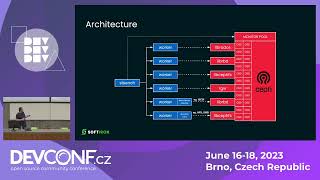
Open Source Benchmarking for Ceph
Explore Ceph benchmarking complexities, tools, and protocols. Learn scalable techniques for Librados, RBD, CephFS, and RGW to optimize performance at large scale.
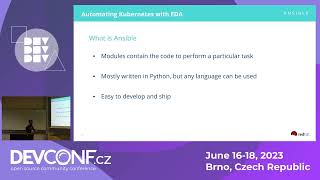
Automating Kubernetes with Event-Driven Ansible
Explore Event-Driven Ansible for automating day 2 operations of Kubernetes clusters at scale, enhancing management and maintenance across multiple environments.
Event-Driven Services as Neural Synaptic Networks
Explore synaptic services: a revolutionary approach modeling components as neurons and connections as synapses for robust, efficient event-driven architectures.
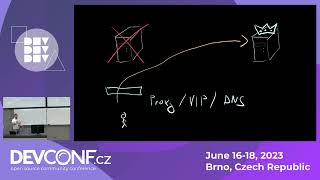
Distributed SQL Transactions
Explore distributed SQL transactions and two-phase commits, learning implementation over PostgreSQL and handling server failures in large-scale data systems.

Orchestrating RAG: Retrieval, Canopy, and Pinecone
Explore orchestrating RAG pipelines, optimizing retrieval strategies, and leveraging Canopy and Pinecone for scalable AI applications with billions of documents.

What Comes After Microservices? - Exploring Post-Microservice Architectures
Explore post-microservices approaches and Uber's non-microservices systems for maintaining developer productivity in large-scale engineering environments.

Shifting Gears: From Events to Event-Driven Architecture
Explore Motorway's journey from coupled systems to event-driven architecture, focusing on team collaboration, domain boundaries, and asynchronous APIs for rapid, decoupled implementation.
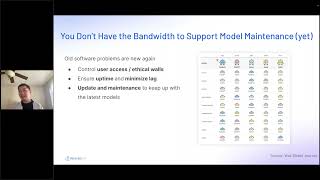
How to Reduce LLM Costs by 98% - Practical, Scalable Solutions
Discover advanced techniques to leverage LLMs cost-effectively. Learn strategies for using SLMs, LLM distillation, and prompt unit testing to overcome budget constraints while maintaining quality in GenAI projects.
Several Components Are Rendering - Performance Optimization in Complex Applications
Explore performance bottlenecks in Slack's desktop app, examining architectural decisions and strategies to mitigate inefficiencies causing system strain.

When to Know You've Outgrown Your Monolith - StaffPlus New York 2024
Discover key indicators for transitioning from a monolithic architecture to microservices, enhancing system scalability and efficiency in software development.

How to Implement Platform Engineering at Scale
Overcome cultural barriers and team silos to successfully adopt platform engineering practices in large organizations.