Implementing Continuous Offense to Measure and Monitor Cybersecurity Defenses - DefCamp - 2019
Explore continuous offense techniques to assess and enhance cybersecurity defenses. Learn about breach simulation tools, vulnerability assessment, and practical strategies for improving network security.
Navigating the Sandbox Buffet
Explore diverse sandboxing techniques to isolate risky software, balancing performance, security, and developer experience. Learn to choose the right combination for your workloads.

The Limits of Sandboxing and Next Steps
Exploring sandboxing limitations in Chrome security, discussing OS constraints, and introducing memory safety as a complementary approach to enhance software resilience.

Defensive Security Research is Sexy Too - Real Sign of Skill
Explore defensive security research's importance, goals, and applications across tech levels. Discover past challenges, current solutions, and future opportunities in this critical field.
The Windows Sandbox Paradox
Explore Windows sandboxing challenges, security vulnerabilities, and OS limitations. Learn about unexpected behaviors, bugs in popular applications, and strategies for auditing sandbox implementations.
Chrome Security Secret Sauce
Explore Chrome's security features, threats, and protective measures. Learn about browser exploits, phishing, SSL attacks, and defense strategies from Google's "Security Princess".
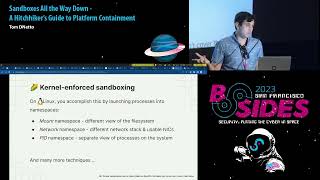
Sandboxes All the Way Down - A Hitchhiker's Guide to Platform Containment
Explore modern sandboxes and isolation primitives for enhanced security. Learn when and how to use containment tools, with practical insights for immediate implementation.

You Don't Have to Patch
Explore sandboxing and isolation as effective alternatives to rapid patching in cybersecurity. Learn strategies to enhance defense without solely relying on immediate updates.

Sandboxing in Linux with Zero Lines of Code
Explore Linux sandboxing techniques without coding, focusing on process startup stages and practical examples. Learn to enhance security and control system calls effectively.

Easy Ways to Bypass Anti Virus Systems
Discover simple techniques to evade antivirus systems, including signature detection, emulation, sandboxing, and firewalls. Learn how attackers can bypass popular security measures with minimal effort and resources.
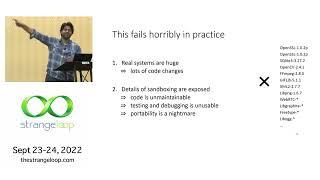
Don't Get Owned by Your Dependencies
Explore innovative techniques for mitigating memory safety vulnerabilities in third-party C libraries, focusing on Firefox's lightweight in-memory sandboxing approach and the RLBox framework for efficient, secure application development.
The Irrelevance of K-Bytes Detection - Building a Robust Pipeline for Malicious Documents
Learn best practices for building a robust document analysis pipeline to detect malicious content, covering file type detection, sandboxing, content inspection, and evasion techniques used by attackers.

Don't Trust Anything - Real-world Uses For WebAssembly
Explore WebAssembly's real-world applications beyond browsers, focusing on secure execution of untrusted code. Learn about WASI, sandboxing techniques, and case studies from Shopify and Mozilla Firefox.
Break Me20 Stretching the Sandbox with Malware Feature Vectors
Explore malware analysis techniques using feature vectors and sandbox environments to enhance threat detection and classification capabilities.

A New Take at Payload Generation Empty Nest
Explore advanced payload generation techniques, focusing on first-party and third-party approaches, encryption plugins, and sandboxing. Learn about the Empty Nest tool for enhanced security testing.
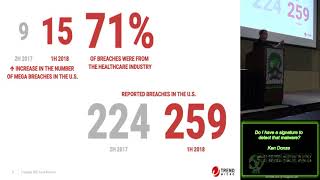
Do I Have a Signature to Detect That Malware
Explore malware detection techniques, signature-based approaches, and modern challenges in cybersecurity. Learn about monitoring processes, machine learning models, and sandbox customization for effective threat analysis.
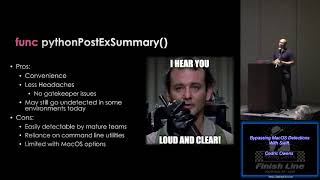
Stable 00 Bypassing MacOS Detections With Swift
Learn techniques for bypassing macOS detections using Swift, including command-line processes, API calls, and sandbox manipulation, with practical examples and developer insights.

Sandboxing - Containerizing Alternatives to Snap for Printer Applications or CUPS
Explore alternatives to Snap for sandboxing and containerizing Printer Applications and CUPS, discussing security, performance, and compatibility considerations for Linux systems.
Sharing Clusters - Learnings From Building a Namespace On-Demand Platform
Explore multi-tenancy in Kubernetes, covering authentication, RBAC, admission control, namespace provisioning, network isolation, and resource management for shared cluster environments.

In a Container, Nobody Hears Your Screams - Next Generation Process Isolation
Explore next-gen process isolation techniques, comparing containers and micro VMs for secure workload execution. Learn about emerging technologies and their suitability for different applications.

Sandboxing Node.js with CoreOS and Docker
Explore secure cloud application development using CoreOS and Docker for sandboxing Node.js and C# code, ensuring data protection and fair resource allocation.