Prompt for User Input with Rust Inquire Crate - Rust Programming Tutorial
Learn to prompt users for input in Rust using the inquire crate. Explore text input, list selection, date picking, and custom data validation for building interactive command-line applications.
Neuralake - Complex Data, Simple Systems
Explore Neuralake: a multimodal data lake for managing complex neural data. Learn about its Rust-based stack, real-time ingestion, and scalable architecture for efficient data access and retrieval.
Delta Lake Meets DuckDB via Delta Kernel
Explore Delta kernel rust's integration with DuckDB, enhancing Delta support in third-party connectors. Learn about architecture, implementation, and performance through demos and benchmarks.

Rust Best Practices - Utils, Examples, and Tests - Part 2
Explore Rust best practices for library development, covering utils, extension traits, examples, and testing techniques using a real-world project as reference.
Adding Structured Output to OpenAI/GenAI - Live Coding with Rust
Live coding session demonstrating how to add AI structured output to a Rust library for OpenAI, showcasing adapter pattern design and enhancing GenAI capabilities for more structured AI interactions.
Adding Structured Output to Google Gemini / GenAI - Live Coding with Rust Explained
Live coding demonstration of implementing structured output for Google Gemini in Rust, showcasing adapter pattern design and enhancing the genai library's capabilities for AI-powered applications.
On Partial-Order and Automata Techniques for Analyzing Communication
Explores verification and synthesis techniques for peer-to-peer and mailbox communication in concurrent programming, focusing on message-passing models and their applications in distributed systems.

Building a Rusty Path Validation Library for PyCA Cryptography
Explore the development of a new X.509 path validation implementation in Rust for PyCA Cryptography, enhancing security and standards compliance for Python's HTTPS connections.

How Python Harnesses Rust through PyO3
Explore the inner workings of Python-Rust integration via PyO3, from function calls to execution. Gain insights into the benefits and mechanics of incorporating Rust into Python projects.
Filesystem in Rust
Explore Rust-based filesystem development with Kent Overstreet, focusing on innovative approaches and performance optimizations for modern storage systems.
Combining Rust and Zig in Programming - Benefits and Considerations
Explore the surprising benefits of combining Rust and Zig in programming projects, focusing on memory safety, simplicity, and practical applications in language development.
Creating Versatile AI Agents Through WebAssembly and Rust
Explore WebAssembly+Rust's role in developing efficient, secure, and portable AI agents for open-source LLMs, enhancing cross-platform compatibility and optimizing resource usage.
Unwrapping Rust on Embedded Linux
Explore the transition from C to Rust in embedded systems, covering learning curves, migration strategies, compiler integration, cross-compilation, testing practices, and code size optimization.
Rusty Swapping: Rewriting a zswap Backend in Rust
Explore the rewrite of a zswap backend in Rust, comparing performance and complexity with its C counterpart. Learn about implementation challenges and insights for kernel subsystem development.
Update on Rust in Zephyr
Explore the latest developments in Rust integration with Zephyr, including the current RFC and challenges related to device-tree implementation.
Rust AI Function Calling Tutorial - Using async-openai
Comprehensive tutorial on implementing AI function calling in Rust, covering setup, chat functionality, tool calls, responses, refactoring, and concurrent requests using OpenAI API.
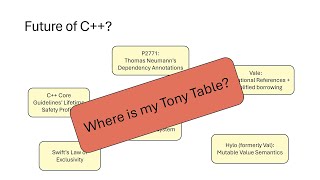
Lifetime Safety in C++ - Past, Present and Future
Explore C++ memory safety advancements, current mitigations, and future directions. Learn to enhance code safety without sacrificing performance or flexibility.
Observing Tokio - Tools for Illuminating Asynchronous Rust Programs
Explore tools for illuminating Tokio's inner workings: Tracing crate, Tokio Metrics, Task Dumps, and Tokio Console. Gain insights into async Rust programs and troubleshoot effectively.
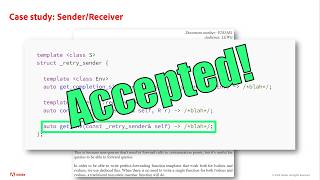
C++ Should Be C++ - Improving Lives Through Language Evolution
Pragmatic evaluation of C++'s challenges and future, emphasizing focus on improving lives through better libraries, talks, features, and understanding C++'s role in technology and society.
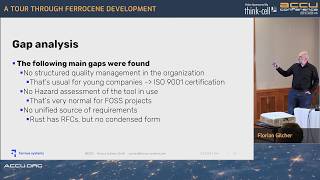
A Tour Through Ferrocene Development
Explore Ferrocene, an open-source Rust compiler variant designed for safety-critical systems in automotive and aviation, focusing on its documentation, correctness principles, and implementation approach.
Hydroflow: A Compiler Target for Fast, Correct Distributed Programs
Explore Hydroflow, a Rust-based dataflow runtime enabling correct program transformations for distributed systems. Learn about refactoring, replication, and partitioning techniques for optimizing distributed programs.