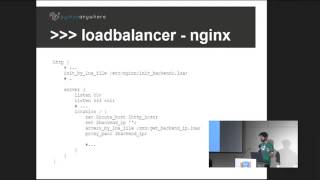
An HTTP Request's Journey Through a Platform-as-a-Service
Explore the journey of an HTTP request through a platform-as-a-service, focusing on PythonAnywhere's infrastructure. Learn about scaling, performance optimization, and insights for managing Python-based websites.
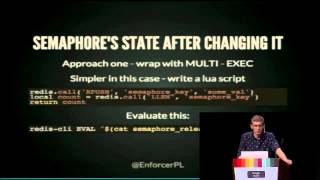
Distributed Locks with Python and Redis
Learn to implement distributed locks using Python and Redis for concurrent programming in distributed systems, with insights from building a modern contact center.
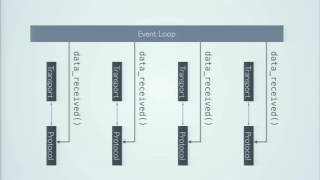
Writing Redis in Python with Asyncio
Explore asyncio by building a Redis-like data structure server in Python. Learn to handle commands, implement pub/sub, and tackle persistence in asynchronous programming.
High Availability Scaling with Share Nothing Architecture
Explore high availability scaling using Share Nothing Architecture, covering automated systems, data distribution, and tools like Celery and Redis for worldwide performance and availability.

How to Run a Corridor Track in a Remote Conference with Python
Explore creating a virtual 'corridor track' for remote conferences using Python. Learn to build a programmable MUD with asyncio, structlog, sly, and redis for interactive online networking experiences.
The Pattern - Machine Learning Natural Language Processing Meets VR/AR
Explore open-source NLP tools and techniques through three ML pipelines using Redis modules. Learn to build knowledge graphs, deploy BERT Q&A models, and implement text summarization with Google's T5.
A Crowdsourced Map for Checking Supermarket Wait Times Worldwide
Explore the development of a crowdsourced map for tracking supermarket wait times during the pandemic, utilizing Redis, uWSGI, and Flask to scale from a Raspberry Pi to multiple VPS servers.
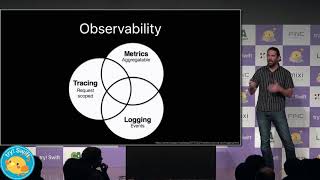
Swift Server Update
Swift Server Work Group's progress, incubation process, and active projects for server-side Swift development. Highlights ecosystem growth and opportunities for community involvement.
Application Autoscaling Made Easy With Kubernetes Event-Driven Autoscaling
Learn how Kubernetes Event-Driven Autoscaling (KEDA) simplifies application scaling based on external providers like Kafka, Azure, AWS, and GCP. Discover its ease of use and versatility for various scenarios.
A Real-World GraphQL Application in Production
Insights on building a real-world GraphQL app with Relay, Redux, and Node.js. Covers architecture, reactivity, testing, and lessons learned from Balsamiq's production deployment.

We Live in Memory - Making λ and GraphQL Respond in 70ms
Explore optimizing λ and GraphQL for lightning-fast 70ms responses, covering functions, APIs, databases, and deployment tools in this technical deep dive.

How to Build .NET Microservices
Learn to build scalable .NET microservices using open-source tools like EventStore, RabbitMQ, and Redis. Explore design patterns, communication strategies, and practical implementation techniques.
Setting Fire to My Desk - Adventures in Redis and Microcontrollers
Connecting microcontrollers to Redis: Implementing RESP protocol, building sensor circuits, and creating admin dashboards. Covers IoT security, battery management, and learning new technologies.

Living in Eventually Consistent Reality
Explore eventual consistency, CRDTs, and their role in geo-distributed databases. Learn how these structures work and their benefits for highly available systems.

Vector Databases and Large Language Models for Context Retrieval - LLMs in Production
Explore vector databases and LLMs for real-time context retrieval in AI applications. Learn to enhance generative models with up-to-date external knowledge, preventing hallucinations and improving accuracy.
High-Performance User-Space Protocol Stack: Balancing Performance and Generality
Discover how to build high-performance user-space protocol stacks using DPDK, achieving better performance while maintaining compatibility with applications like Redis and MySQL.
You Never Know When You Need a Fork - The Creation of Valkey
Explore the creation of Valkey, an open-source alternative to Redis, and learn about the challenges and future plans for this community-driven project.
Data Pipelines with Celery: Modular, Signal-Driven and Manageable
Explore efficient data pipeline design using Celery, Redis, and signal-based triggering. Learn to segment workflows, manage API limits, and optimize data processing for improved throughput and maintainability.

Scaling Memorystore to New Heights with Sub-Millisecond Latency
Scale Memorystore for demanding workloads, improve app performance, and reduce cloud costs. Explore top use cases and learn from Palo Alto Networks' implementation.

Every Mapping Counts in Large Amounts - Folio Accounting
Innovative folio accounting technique for Linux enhances memory management, improving performance in fork and unmap operations. Demonstrates significant speedup in fork-intensive workloads like Redis.

Build a Private Docker Registry with Quay - Cloud-Native Secure Docker Image Storage
Learn to install and run Quay for secure container image storage. Step-by-step guide covers Linode setup, Docker configuration, database deployment, and Quay installation, enabling you to build a private Docker registry.