
Matrix Long Short-Term Memory (mLSTM) - A New Alternative to Transformer LLMs
Explore the innovative xLSTM architecture and its matrix-based approach to neural networks, comparing its potential advantages over traditional transformer models in language processing.
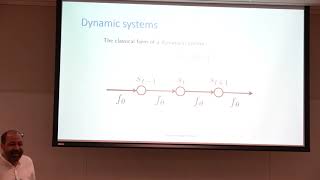
Recurrent Neural Networks and Backpropagation Through Time - Lecture 8
Dive into recurrent neural networks, exploring LSTM, GRU architectures, and advanced concepts like backpropagation through time and gradient challenges in deep learning implementations.
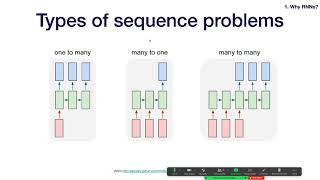
Recurrent Neural Networks - Full Stack Deep Learning - Spring 2021
Explore Recurrent Neural Networks: architecture, challenges, solutions, and applications. Dive into LSTMs, bidirectionality, attention mechanisms, CTC loss, and non-recurrent sequence models like WaveNet.
AudioGen- Textually Guided Audio Generation - Paper Explained
Explore text-guided audio synthesis with AudioGen, delving into its architecture, audio representation, language modeling, and innovative approaches for generating diverse sounds from textual descriptions.

Sign Language Detection Using Action Recognition with Python - LSTM Deep Learning Model
Learn to build a sign language detection system using action recognition, LSTM, and Python. Extract keypoints, create datasets, train deep learning models, and make real-time predictions for sign language interpretation.

LSTM Time Series Prediction Tutorial Using PyTorch in Python - Coronavirus Daily Cases Forecasting
Learn to forecast Coronavirus cases using LSTM and PyTorch. Covers data preprocessing, model building, training, evaluation, and future predictions with real-world time series data.

Long Short-Term Memory with PyTorch + Lightning
Learn to implement and train LSTM networks using PyTorch and Lightning, covering custom LSTM coding, PyTorch's built-in LSTM, and advanced training techniques for deep learning projects.

LSTM Recurrent Neural Network In Depth Intuition
Gain in-depth intuition on LSTM Recurrent Neural Networks, exploring memory cells, operations, and layers for advanced understanding of this powerful deep learning architecture.
Neural Nets for NLP - Recurrent Networks for Sentence or Language Modeling
Explore recurrent networks, LSTMs, and their applications in sentence modeling and NLP. Learn about vanishing gradients, pre-training, and the strengths and weaknesses of recurrent models.
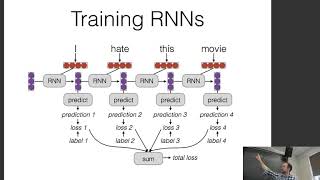
Neural Nets for NLP 2017 - Recurrent Neural Networks
Comprehensive lecture on recurrent neural networks, covering their architecture, challenges, and applications in NLP, with emphasis on LSTMs and practical implementation techniques.
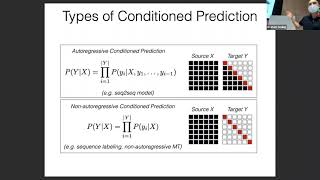
CMU Advanced NLP: Recurrent Neural Networks
Explore recurrent neural networks, LSTMs, and their applications in NLP, covering long-distance dependencies, prediction types, and optimization techniques for advanced language processing tasks.

Recurrent Neural Networks, Transformers, and Attention
Explore recurrent neural networks, transformers, and attention mechanisms in deep learning. Learn design principles, applications, and advanced concepts like LSTM and backpropagation through time.

Pytorch Text Generator With Character Level LSTM
Learn to build a character-level LSTM text generator in PyTorch, focusing on generating new baby names. Explore practical implementation of RNNs for creative text generation tasks.

RWKV- Reinventing RNNs for the Transformer Era
Explore RWKV, a novel architecture combining Transformer and RNN strengths. Learn about its linear attention mechanism, scalability, and performance in NLP tasks.

Parameter Sharing - Recurrent and Convolutional Nets
Explore parameter sharing in recurrent and convolutional neural networks, covering hypernetworks, RNNs, LSTMs, attention mechanisms, and ConvNets, with insights on architecture, training, and biological inspiration.
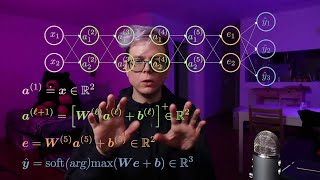
Recurrent Neural Networks, Vanilla and Gated - LSTM
Explore recurrent neural networks, including LSTM, covering architectures, training methods, and practical implementations using PyTorch for sequence-based tasks in deep learning.

Deep Learning for Natural Language Processing
Explore NLP architectures, transformers, language models, and advanced techniques for text generation and embedding learning in this comprehensive deep learning lecture.

CNN Applications, RNN, and Attention
Explore CNN applications in digit recognition, object detection, and semantic segmentation. Dive into RNNs, addressing their challenges with attention mechanisms, GRUs, LSTMs, and Seq2Seq models.
Long Short Term Memory Networks Explained Easily
Comprehensive explanation of LSTM networks, comparing them to simple RNNs and exploring their architecture and mathematical foundations for improved sequence learning.
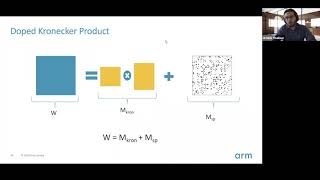
A Technique for Extreme Compression of LSTM Models
Explore extreme LSTM compression using sparse structured additive matrices. Learn doping techniques, co-matrix adaptation, and regularization for state-of-the-art accuracy at high compression factors in NLP applications.

AI-Based Environmentally Sustainable Cardiovascular Disease Diagnostic
Explore an LSTM-based diagnostic tool for CVDs, reducing misdiagnoses and medical waste while achieving high accuracy in disease detection.