Standardizing Early Hardware Access for Automotive Linux Systems
Exploring Linux adoption in automotive, addressing early hardware access challenges, and proposing standardization for improved performance in critical automotive applications.
Dynamic vCPU Priority Boosting in KVM for Latency-Sensitive Workloads
Exploring a framework for host-guest communication in KVM to minimize VM latencies by dynamically boosting vCPU thread priorities based on guest scheduling needs and host insights.
Zephyr Project - Results from Applying Open Source and Security Best Practices
Explore Zephyr's journey as a leading RTOS, its adoption of security best practices, and its pursuit of safety certification. Learn about the project's unique approaches and lessons learned in open-source development.
Building Hard Real-Time Linux Systems with Xenomai
Explore Xenomai's co-kernel architecture for mission-critical deterministic systems, its applications, kernel and hardware support, maintenance, and system creation process.
Realtime, Safety, and Mainline Linux - Future Directions Panel Discussion
Explore real-time safety in Linux through expert panel discussion, covering strategies, standards, certification, and hardware considerations for critical systems.
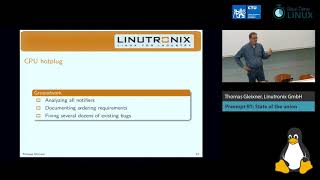
Preempt RT - State of the Union
Explore the current state and future developments of the Preempt RT real-time Linux kernel patch set with insights from a leading developer.
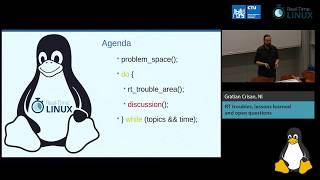
RT Troubles, Lessons Learned, and Open Questions in Real-Time Systems
Explore real-time system challenges, solutions, and open questions in Linux, covering CPU latency, write buffers, interrupts, and priority inversions.
State of the Union: Realtime Preemption Patch Development
Overview of ongoing development and mainlining efforts for the realtime preemption patch, including industry interest, chip design, scheduling, and realtime requirements.

Futexes Are Cursed - Challenges and Improvements in the FUTEX API
Explore the challenges and improvements in FUTEX API design, focusing on -RT kernel impacts and benefits for all users. Learn about corner cases and solutions in Linux kernel development.
Pattern-Based Failure Analysis of Real-Time Systems
Explore pattern analysis for RT latency issues in Linux systems. Learn about scheduling pattern databases and trace matching techniques for efficient problem-solving and potential failure prediction.
Apache Mynewt Overview - Open Source RTOS for IoT Devices
Explore Apache Mynewt, an open-source initiative for constrained IoT devices. Learn about its RTOS, networking stacks, image management, and modularity features for efficient embedded development.
Linux and Zephyr: IoT Made Easy
Explore how Linux and Zephyr complement each other to simplify IoT system development, focusing on cost-effective solutions and novel sensor bus remote access for efficient device communication.
The Zephyr Project - An Updated Overview of the Real-Time Operating System
Explore Zephyr, a scalable real-time OS for IoT devices. Learn about its features, architecture, and recent updates, including unified kernel benefits and improved performance for resource-constrained systems.
IRQs: The Hard, the Soft, the Threaded and the Preemptible
Explore interrupt handlers, soft IRQs, tasklets, and preemptible threads in Linux kernels. Learn to detect and manage IRQ scheduling issues across x86, ARM, and ARM64 architectures.
Bootstrapping the Partitioning Hypervisor Jailhouse - Tutorial
Learn to bootstrap Jailhouse hypervisor on x86 and ARM/ARM64 boards, hosting multiple Linux systems and bare-metal instances. Explore configuration, error reporting, and troubleshooting techniques.
Introduction to Realtime Linux - Concepts, Approaches, and Performance
Explore Linux's realtime capabilities, PREEMPT_RT patch benefits, and performance comparisons with other approaches. Gain insights into embedded systems and hard realtime implementation.
The Internet of Things and Life Beyond Linux
Explores IoT's future beyond Linux, discussing alternative approaches and criteria for choosing operating systems in embedded devices. Highlights ecosystem benefits and real-world examples.
Debugging Methodologies for Real-Time Issues in Linux Systems
Explore methodologies for debugging real-time performance issues in Linux systems, including latency tracing, instrumentation techniques, and dynamic probing for embedded systems.

Effectively Measure and Reduce Kernel Latencies for Real-time Constraints
Learn techniques to measure and minimize kernel latencies for real-time systems, exploring scheduler latency, execution methods, and task priorities on Intel and ARM architectures.
Not Really, but Kind of Real Time Linux
Exploring Linux system constraints for deterministic task control within real-time-ish limits. Discusses kernel configurations, code comparisons, and alternative approaches for achieving near real-time performance on standard Linux systems.
CPU Power Saving Methods for Real-time Workloads
Explore CPU power-saving techniques for real-time workloads, balancing energy efficiency and latency requirements. Learn tools and methods to optimize performance without compromising deterministic behavior.