Full-stack Reactive Java with Project Reactor & Spring Boot 2
Explore reactive Java programming with Project Reactor and Spring Boot 2. Learn to build message-driven, elastic, and responsive services using Reactive Streams and functional programming concepts.

Modeling Uncertainty - DDD Today
Exploring modern Domain-Driven Design principles, focusing on modeling uncertainty in distributed systems. Covers reactive systems, microservices, and practical heuristics for effective domain modeling.
Real-World Reactive Programming in Java - The Definitive Guide
Comprehensive guide to reactive programming in Java, exploring frameworks, enterprise-grade applications, and maintainable code for building responsive systems in real-world scenarios.
Reactive Spring
Explore reactive programming in Spring 5, covering WebFlux, Spring Data, Security, Boot 2.0, and Cloud Finchley. Learn to build scalable, resilient microservices with improved I/O handling and fault tolerance.

Reaching Beyond Traditional Boundaries with Clojure
Explore Clojure's powerful state control and reactive paradigm for enhanced development, including hot-swapping code and networked REPL capabilities in production environments.

Higher Kinded Types in a Lower Kinded Language - Functional Programming in Kotlin
Explore functional programming in Kotlin using Arrow library, focusing on higher-kinded types and powerful abstractions to enhance code quality and leverage native language capabilities.
Spring Boot - Up and Running
Explore Spring Boot's capabilities with experts Mark Heckler and Thomas Vitale, covering data integration, deployment, security, and reactive programming. Gain insights into this versatile development environment.
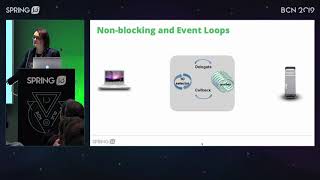
Benefits of Reactive Programming with Reactor and Spring Boot 2
Explore reactive programming benefits with Reactor and Spring Boot 2, focusing on scalability, resilience, and performance improvements for cloud-native applications through benchmarks and use cases.
Reactive Systems
Explore modern software architectures for 21st-century challenges. Learn about reactive systems, their properties, and how to build responsive, resilient, and scalable applications using message-driven approaches.
Strategic Monoliths & Microservices
Explore purposeful architecture, event-driven systems, and strategic approaches to monoliths and microservices. Learn how to drive innovation and resilience in software development.

Balancing Choreography and Orchestration
Explore the balance between choreography and orchestration in service architecture, debunking myths and showcasing scenarios where each approach excels in reducing coupling and improving system design.

Automating Processes in Modern Architectures
Explore modern process automation in microservices and event-driven architectures. Learn strategies for integrating components, implementing end-to-end processes, and addressing challenges in contemporary software design.
Reactive Patterns for Angular
Discover reactive patterns to streamline Angular components, reduce code complexity, and enhance application performance. Learn to refactor existing components and build new ones with a reactive mindset.

Spring Boot - Up & Running
Explore Spring Boot's capabilities with experts Mark Heckler and Thomas Vitale. Discover data integrations, production deployment, security, and programming paradigms while gaining insights into the vibrant Spring Boot community.
Go Reactive with Angular Signals
Explore Angular signals, a new feature for building reactive applications. Learn how to create, read, and change signals, and understand their relationship with RxJS Observables.
RxJS - A Better Async
Explore RxJS as a superior async solution, covering observables, operators, and testing techniques for improved handling of asynchronous operations in JavaScript.
Reactive Programming Demystified
Explore RxJS for composable app architecture, learn its use in Angular, React, and Vue, and discover future reactive primitives in TC39 and WHATWG for more declarative and portable code.
Stateful and Reactive Stream Processing Applications Without a Database
Explore stateful & reactive stream processing without databases. Learn to architect continuous, reactive applications using modern tech stacks like Kafka Streams, Spring Boot, and more.
Reactive Applications with Event Sourcing and Server Sent Events
Learn to build reactive applications using Event Sourcing and Server Sent Events, enabling real-time updates and scalable data management for modern web development.
Bringing New Life to the View Layer of Spring Web Apps with Thymeleaf
Explore Thymeleaf's modern approach to server-side templating in Spring web apps, enhancing developer experience and integrating seamlessly with client-side frameworks for efficient UI development.
From Spring Framework 4.3 to 5.0
Explore Spring Framework's evolution from 4.3 to 5.0, focusing on developer experience improvements, JDK 9 integration, HTTP/2 support, and reactive architecture advancements.