
Learning Shallow Quantum Circuits and Quantum States in Polynomial Time
Efficient algorithms for learning shallow quantum circuits and states, extending to polylog depth. Key techniques involve reconstructing low-complexity quantum systems from local observables.
Introduction to Quantum Information Theory - Lecture 3
Explore quantum information theory foundations, including entropy, reversible computation, and universal quantum computation in this advanced physics lecture.
New Ideas on Tensor Networks for Entanglement in Quantum Many-Body Systems
Explore new applications of tensor networks in quantum systems, including random networks, material properties, and learning tasks. Gain insights into capturing entanglement and analyzing complex quantum phenomena.
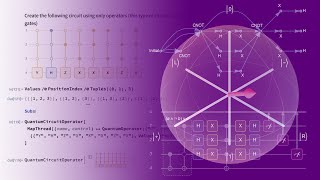
Quantum Circuits: Introduction to Wolfram Quantum Computation Framework
Explore quantum computing with Wolfram's framework, covering states, transformations, algorithms, and circuits using symbolic expressions and Wolfram Language.
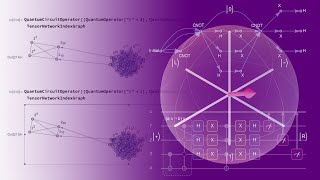
Review of Quantum Framework Functionalities - Wolfram Quantum Computation Framework
Explore Wolfram's Quantum Computation Framework, covering quantum states, transformations, algorithms, and hardware implementation using Wolfram Language.
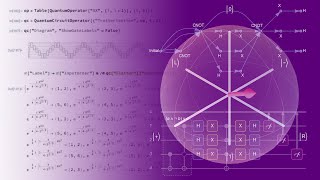
Quantum Operators, Time Evolution and Quantum Measurement
Explore quantum operators, time evolution, and measurement using Wolfram's Quantum Computation Framework. Learn to model and simulate quantum processes symbolically.
An Automata-Based Framework for Verification and Bug Hunting in Quantum Circuits
Explore a novel automata-based approach for analyzing quantum circuits, enabling efficient verification and bug detection in large-scale quantum systems using tree automata and algebraic representations.
Learning Quantum with Generative Models
Explore generative models for quantum state learning, covering neural networks, RBMs, and applications to GHZ states and local Hamiltonians.
Fragilience - The Quantum State of Survivable Resilience in a World of Fragile Indifference
Explore the concept of "fragilience" and its impact on survivable resilience in a world characterized by fragile indifference, offering insights into navigating complex security challenges.
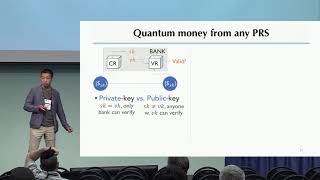
Pseudorandom Quantum States
Explore pseudorandom quantum states, their definitions, applications in quantum money, and related concepts like pseudorandom unitary operators in this cryptography research presentation.
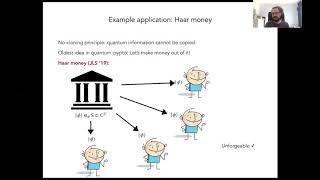
Efficient Simulation of Random States and Random Unitaries
Explore efficient simulation techniques for random quantum states and unitaries, covering applications, limitations, and technical contributions in quantum theory.
Refuting Spectral Compatibility of Quantum Marginals
Delve into quantum marginal problem's spectral compatibility through a mathematical framework using symmetry-reduced semidefinite programming hierarchy for detecting incompatible spectra in quantum states.
Parameterized Complexity of Weighted Local Hamiltonian Problems and the Quantum Exponential Time Hypothesis
Delve into parameterized complexity of weighted local Hamiltonian problems, exploring quantum states, Hamming weight constraints, and their implications for quantum computational theory.
Efficient Learning of Ground and Thermal States Within Phases of Matter
Delve into advanced quantum computing concepts, focusing on efficient methods for learning ground and thermal states in matter phases, with emphasis on sample complexity and algorithmic improvements.
Fundamental Limitation on the Detectability of Entanglement in Quantum Systems
Delve into quantum entanglement detection limitations, exploring theoretical trade-offs between efficiency and effectiveness in quantum systems, with focus on single-copy and multi-copy measurements.
Concentration Bounds for Quantum States and QAOA Limitations
Delve into quantum state concentration bounds, exploring limitations of QAOA through polynomial approximations and their implications for shallow circuits and dense Hamiltonian evolution.
Quantum Theory in Finite Dimension Cannot Explain Every General Process
Explore groundbreaking research demonstrating how certain finite-dimensional processes in quantum theory require explanations beyond classical probability and quantum mechanics frameworks.
New Additivity Properties of the Relative Entropy of Entanglement and Its Generalizations
Delve into quantum entanglement theory through an exploration of relative entropy additivity properties, focusing on bipartite pure states, Bell diagonal states, and generalized Dicke states.
Cost of Quantum Secret Key and Privacy Formation Theory
Delve into quantum secret key theory, exploring key cost calculations, privacy dilution protocols, and entanglement measures in quantum states through advanced theoretical frameworks.
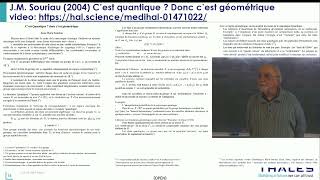
Souriau's Geometric Principles for Quantum Mechanics
Explore geometric principles bridging classical and quantum mechanics, examining symmetries, Planck's constant, and prequantization to determine quantum states through inequalities.
Measuring and Deleting One Qubit of Several - Quantum Computer Programming - Lesson 68
Explore the mathematical principles behind measuring or deleting a single qubit in multi-qubit quantum states, enhancing your understanding of quantum systems.