Embedding Theories for Quantum Simulations on Hybrid Classical-Quantum Architectures
Explore quantum embedding theory for spin-defects in solids, comparing frameworks and discussing applications on classical and quantum computers for electronic structure calculations of qubits.
Physical Review Journal Club - Quantum Research with the Authors
Explore efficient quantum simulation for molecular spectroscopy using superconducting bosonic processors, with insights on implementation, photon detection, and algorithmic approaches.
Approaches to Quantum Information Processing With Cold Atoms
Explore quantum simulation and computation approaches using cold atoms for understanding nature and advancing computational capabilities.

Classical and Quantum Simulations of Nuclear Dynamics - Sofia Quaglioni
Explore nuclear dynamics through classical and quantum simulations, combining chiral effective field theory with ab initio methods for accurate S-factor evaluations and quantum computing applications in scattering theory.
Language Models for Rydberg Atom Quantum Simulation - Roger Melko
Explore language models for Rydberg atom quantum simulation in this talk by Roger Melko, bridging quantum physics and machine learning for novel insights into long-range quantum matter.
Aspects of Quantum Simulation of the Fermi-Hubbard Model - IPAM at UCLA
Explore quantum simulation of the Fermi-Hubbard model, focusing on Trotter error bounds and optimization techniques for improved accuracy in quantum circuits and time evolution algorithms.
Language Models for Quantum Simulation - IPAM at UCLA
Explore how language models like GPT are revolutionizing quantum simulation, with focus on their application in learning quantum states in Rydberg atom arrays and potential impact on quantum computing.
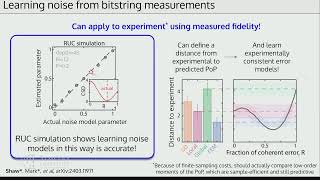
Using Chaos to Characterize a Programmable Analog Quantum Simulator
Explore chaos in analog quantum simulators, uncovering random behavior, estimating fidelity, and learning noise models for large-scale entangled states using Rydberg atom arrays.
Hardware-Efficient Quantum Computing Using Qudits
Explore hardware-efficient quantum simulations using qudits, enabling complex gauge field computations and opening doors for near-term quantum devices.
Probing the Limits of Classical Computing with Arbitrarily Connected Quantum Circuits
Explore the computational gap between classical and quantum computers through random circuit sampling in highly connected geometries, focusing on limitations and potential improvements.
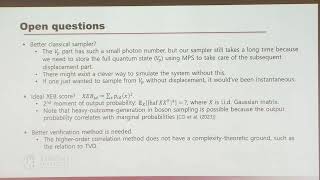
Classical Algorithm for Simulating Experimental Gaussian Boson Sampling
Explore a classical algorithm for simulating Gaussian boson sampling, challenging claims of quantum advantage in current experiments with high photon loss rates.
News on Tensor Networks for Machine Learning and Quantum Computing Simulation
Explore recent advancements in tensor networks for enhancing machine learning and simulating quantum processors, covering deep neural networks, convolutional networks, and large language models.
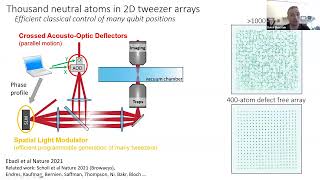
Logical Quantum Processor Based on Reconfigurable Atom Arrays
Advances in quantum computing using neutral atom arrays for error-corrected logical qubits. Demonstrates improved performance over physical qubits in various quantum processing tasks.
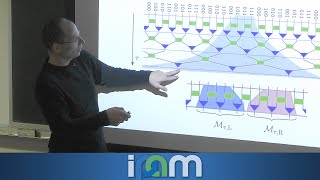
Quantum Simulation of Condensed Matter Using Trotterized Entanglement Renormalization
Explore quantum simulation of strongly-correlated matter using MERA-based variational quantum eigensolver. Learn about implementation on NISQ devices, gradient-based optimization, and experimental tests on ion-trap devices.
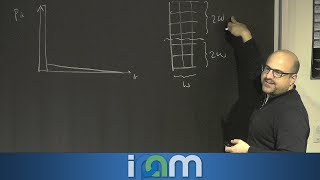
Tensor Networks and the Negative Sign Problem
Explore tensor networks and the negative sign problem in quantum systems, examining simulation challenges and correlation implications for systems with negative Hamiltonian entries.

Logical Quantum Processor Based on Reconfigurable Atom Arrays
Explores advancements in quantum computing using neutral atom arrays, demonstrating improved error correction and logical qubit processing for enhanced algorithmic performance.
Adaptive Quantum Simulation Algorithms - IPAM at UCLA
Explore adaptive quantum simulation algorithms, focusing on variational quantum eigensolvers and their optimization for noisy intermediate-scale quantum processors.
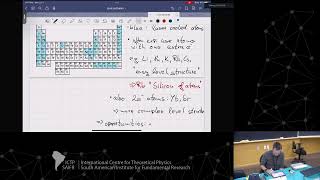
Quantum Information Processing and Simulation with Rydberg Atom Arrays - Class 1
Explore quantum information processing and simulation using Rydberg atom arrays in this advanced physics lecture, part of a series on non-equilibrium quantum systems.
Photonic Quantum Computing: A Bright Future for Many Applications
Explore photonic quantum computing architectures, applications, and future challenges. Discover quantum machine learning, reinforcement learning, and secure computing in quantum networks.
Exploring Random Quantum Circuits: A New Implementation Method
Discover a novel method for constructing random quantum circuits, comparing its properties to traditional approaches and exploring its potential for quantum hardware implementation.
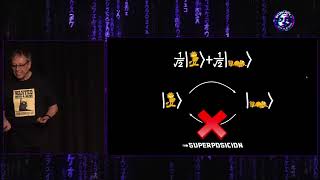
Playing with Qubits III - Quantum Cybersecurity
Explore quantum technologies' impact on cybersecurity, including quantum communications, post-quantum cryptography, and applications beyond Shor's algorithm in this cutting-edge presentation.